Douriean Fletcher's Afrofuturist Jewelry Gets Major Museum Exhibition in 2026
Fletcher's Queen Ramonda necklace, made of 18-karat gold-plated copper, pyrite, and amethyst, is now headed to Baltimore's Walters Art Museum through August 9.
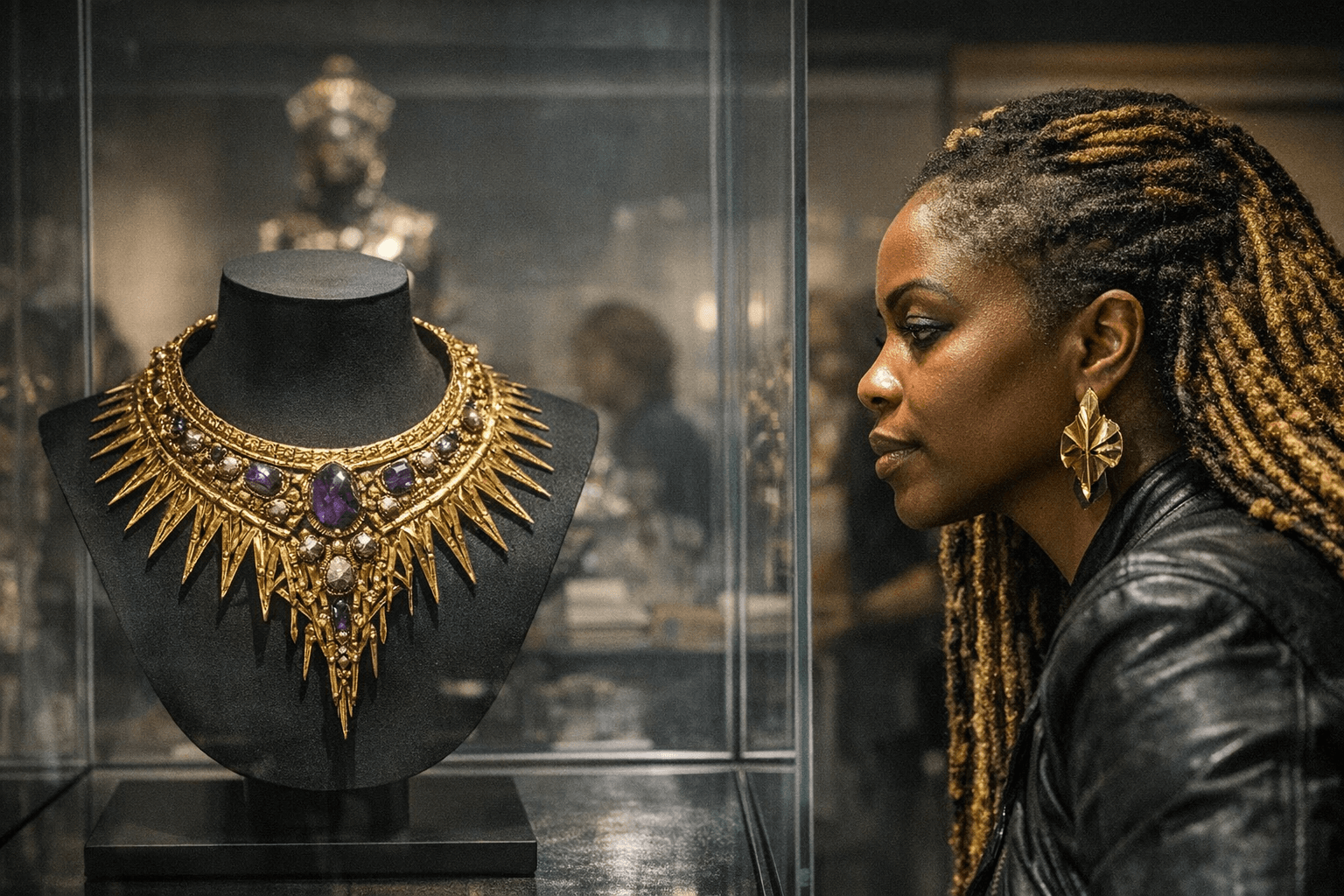
The necklace Douriean Fletcher built for Queen Ramonda's tribal council scene in Black Panther is not a prop you can walk past quickly. Constructed from 18-karat gold-plated copper, aluminum, pyrite, and amethyst, it sits in the exhibition "Douriean Fletcher: Jewelry of the Afrofuture" alongside Okoye's warrior armor, a collar of 18-karat gold-plated copper strung with brass Ghanaian beads and finished in leather. These are not costume replicas. They are the originals, and after closing at New York's Museum of Arts and Design on March 15, 2026, they travel to the Walters Art Museum in Baltimore, where the exhibition opens April 18 and runs through August 9.
MAD organized this show, which it describes as the first major museum exhibition dedicated to Fletcher, a self-taught jewelry artist whose practice spans independent studio work, television, and Hollywood film. The exhibition unfolds across three thematic sections: Fletcher's formative years and studio practice, her breakout film and television work, and her current artistic explorations. The Walters presentation comprises more than 100 works spanning Fletcher's full career, including a dozen pieces selected by the artist herself from the Walters' permanent collection.
The cinematic objects are the most immediately recognizable. Fletcher designed jewelry for the Dora Milaje and for Angela Bassett's Queen Ramonda across both Black Panther (2018) and Black Panther: Wakanda Forever (2022). At the Walters, those pieces are displayed alongside a selection of costumes by Academy Award-winning designer Ruth E. Carter, whose work on the franchise won her the first Oscar for costume design awarded to a Black woman. Fletcher's credits extend further back: her jewelry also appears in the 2016 television miniseries Roots and in Coming 2 America (2021).
What makes the exhibition more than a film retrospective are the reference works Fletcher placed alongside her own. A Maasai neckpiece, sculptures by Alexander Calder and Art Smith, and two ancient Egyptian rings, all of which the artist says directly shaped her designs, are on view at the Walters. The juxtaposition turns the gallery into a working argument about lineage: that contemporary Black adornment draws from a technical and spiritual continuum that predates Hollywood by millennia.
Fletcher's material vocabulary reflects that argument precisely. Her early pieces use natural materials, brass, and gold rooted in ancestral traditions. Her Messenger Collection, documented in MAD press materials as gold and semi-precious stones, circa 2021, exemplifies the studio practice that runs beneath the film work. "My work channels Afrofuturism by honoring ancestral technologies while imagining new futures through adornment," Fletcher said. "Each piece is an energetic portal, rooted in a desire to remain connected to African cosmologies and designed to activate personal power, spiritual memory, and liberation across time."
The MAD presentation, which ran October 4, 2025 through March 15, 2026, included a public program series: Fletcher led a beading workshop on October 5, design historian and co-curator Sebastian Grant delivered a lecture on jewelry and Afrofuturism on November 20, and a soft-metals jewelry-making workshop followed on December 16. On February 26, Fletcher joined a virtual conversation with Anthony Francisco, former Senior Visual Development Artist for Marvel Studios, on the process of designing iconic superhero characters.
For those who missed New York, the Walters run offers four months with a show that treats adornment as both evidence and argument: that craft is a form of cultural memory, and that the hands shaping brass and stone are always in conversation with the past they inherit.
Know something we missed? Have a correction or additional information?
Submit a Tip