Hancocks marks Queen Elizabeth II centenary with jewellery in royal context
Queen Elizabeth II’s centenary becomes a lesson in royal jewelry language, from pearl restraint and brooch placement to inherited stones and coronation crowns.
The royal jewel box as an archive
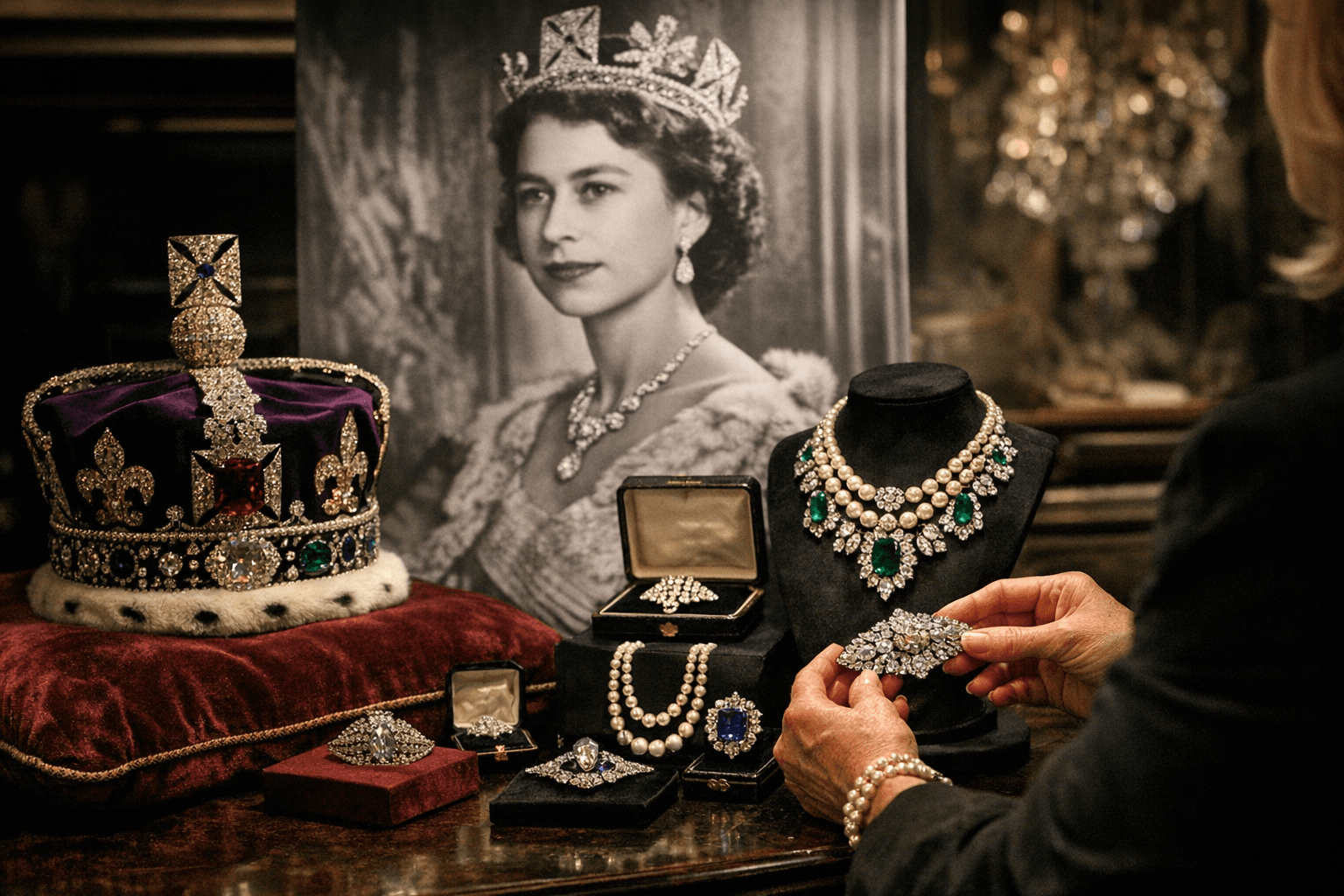
Queen Elizabeth II’s centenary is not being marked as a simple anniversary. Hancocks Jewellers has used the moment to treat her jewelry collection as a visual archive, mapping the pieces to the occasions that made them part of public memory. That approach matters because royal jewels are never only ornaments. They are repeated signals, worn into a language that collectors now know how to read.
Hancocks, Manchester’s oldest jeweller, says its story began in 1860 and that its King Street address has remained central to the business for generations. That long continuity gives the centenary feature a fitting frame: a jeweller with more than 150 years of history turning to the queen whose own style became one of the most recognized in modern Britain. Queen Elizabeth II was born on 21 April 1926, and the 100th anniversary on 21 April 2026 gave the brand a natural reason to revisit the jewels that defined her public image.
Why repetition made the style recognizable
The most revealing thing about royal jewelry is not always the stone size or the setting. It is repetition. A strand of pearls worn often enough becomes a signature. A brooch pinned in the same place, high at the shoulder or centered on a bodice, becomes a visual cue. A tiara reserved for state occasions turns into a symbol of continuity rather than just decoration.
That is the lesson Hancocks draws from Queen Elizabeth II’s most famous pieces. The value lies in how often they were worn, where they appeared, and what those appearances meant. In a royal wardrobe, the same jewel can move from private significance to public shorthand, and the collector’s eye follows that shift closely. Mid-century and ceremonial jewels now attract attention not just for design, but for the photographs, events, and decades of repetition attached to them.
Pearls, brooches, tiaras: the royal grammar collectors chase
Pearls have always suggested restraint, and in royal dress they often read as a kind of disciplined luminosity. Brooches, meanwhile, do more than decorate lapels and bodices. Their placement can be read almost like punctuation, especially in official portraiture where every detail is deliberate. Tiaras carry a different weight altogether, since they belong to a narrow ceremonial register and often appear only in the most formal settings.
For collectors, these habits create categories that are now instantly legible. A jewel with royal-style provenance, visible public wear, and repeated appearance in state imagery becomes more than an antique. It becomes a reference point. That is why so many serious buyers look for mid-century forms that echo the queen’s own habits: classic pearl necklaces, finely made brooches, and tiara silhouettes that feel connected to the pageantry of the reign.
Inherited pieces and the power of provenance
Few things sharpen a collector’s interest like an object that has crossed from one reign into the next. In 2023, the Cullinan III, IV and V diamonds from Queen Elizabeth II’s personal jewellery collection were used in Queen Mary’s Crown for the coronation of King Charles III. Those diamonds had long been worn by Elizabeth II as brooches, which makes their transformation especially revealing. The stones did not simply survive history. They were rewritten by it.
That movement from personal jewel to constitutional object is exactly why provenance matters so much in royal jewelry. A stone that can be traced through decades of wear, then reset for a national ceremony, carries a layered identity collectors find irresistible. It also explains why inherited pieces, especially those with documentary links to public appearances, command such attention in the market for ceremonial jewels. The object is no longer only judged by craftsmanship. It is judged by the story it has already lived.
From private adornment to public image
Hancocks’ centenary feature works because it treats jewelry as part of the queen’s broader public narrative rather than a parade of sparkling highlights. That is the right frame. Queen Elizabeth II’s style was built on consistency, and consistency is what makes an image endure. When a jewel reappears across decades, it begins to define the wearer as much as the wearer defines it.
The Royal Family’s current centenary programme reinforces that point on a larger scale. At The King’s Gallery, Buckingham Palace, the exhibition Queen Elizabeth II: Her Life in Style brings together more than 300 items and is described as the largest and most comprehensive exhibition of the late queen’s fashion ever staged. Clothing, jewellery, hats, shoes, accessories, design sketches, fabric samples and correspondence all sit side by side, making clear that the late queen’s style was never isolated from the life around it. Jewelry was part of that system of meaning, not an afterthought.
What this teaches the vintage collector
The queen’s jewelry legacy has sharpened the way collectors approach vintage pieces. The most compelling objects are often the ones that can answer a few precise questions:
- Was the jewel worn repeatedly, and can it be seen in photographs or official imagery?
- Does the piece have a documented connection to a named wearer or a major ceremony?
- Has a stone, setting, or crown element been reset, inherited, or repurposed across generations?
- Does the design belong to the disciplined, ceremonial vocabulary that defined mid-century royal dress?
That is why royal repetition still matters. It turns a brooch into a recognized signature, a tiara into a historical marker, and a diamond into a living emblem of continuity. In Queen Elizabeth II’s case, the jewels did what the best vintage pieces always do: they held memory in metal and stone, and they kept returning to view until the public learned to recognize them at a glance.
This article was produced by Prism’s automated news system from verified source data, official records, and press releases, then run through automated quality and moderation checks before publishing. The system is built and supervised by the people who set the standards it runs under. Read our full AI policy.
Did this article answer your question?