The Devil Wears Prada 2 spotlights vintage jewelry and statement pieces
The sequel turns jewelry into a collector’s clue sheet, from Etruscan Revival motifs to 1980s statement pieces and vintage-inspired necklaces worth decoding.

The jewelry in The Devil Wears Prada 2 is already telling a second story
The most interesting thing about the jewelry in *The Devil Wears Prada 2* is not simply that it is expensive. It is that the pieces read like evidence: an Etruscan Revival earring here, a Boivin cuff there, a rose-cut diamond ring with just enough age and wear to suggest a life before the camera found it. WWD says the sequel is scheduled to debut in 2026, and even before release, the accessories are being discussed as a styling language in their own right.
That matters because the film’s jewelry is not functioning as decoration alone. It is a field guide to collecting, one that moves from historical revival motifs to recognizable 1980s vintage signatures and then into contemporary pieces chosen to echo those older references. For anyone who loves vintage jewelry, the film offers a useful reminder: provenance may be glamorous, but the real pleasure lies in learning how to read a setting, a silhouette, and a surface.
Etruscan clues, revival taste and the allure of antiquity
The most intellectually satisfying pieces in the film are the Etruscan references. Getty notes that revival jewelry was popularized by the Castellani family in the 19th century, when they tapped into a European and American fascination with antiquity. Britannica describes Etruscan jewelry as developing original forms, techniques and styles from Etruscan taste, shaped in part by imported Phoenician jewelry. That history still matters on the market because “Etruscan-looking” is not a single style, but a spectrum of references that collectors learn to separate by texture, construction and motif.
The Metropolitan Museum of Art points to the richness of Etruscan tomb groups, which could include a pendant necklace, disk earrings, fibulae, a dress pin and finger rings all together. That breadth helps explain why Etruscan Revival jewelry often feels so layered and theatrical onscreen. Look for granulation-like texture, roped wire, archaic silhouettes and a handmade irregularity that signals fascination with the ancient world rather than literal antiquity itself. In the film, those cues make Miranda Priestly’s jewelry feel less like costume and more like a private archive.
Miranda Priestly’s vintage statement pieces
Meryl Streep’s Miranda wears some of the sharpest vintage references in the sequel, and they come from Fred Leighton. WWD identifies 1980s diamond-and-black-enamel interlocking-circle earrings, a 1980s diamond-and-gold cuff by Boivin and an antique 2.5-carat rose-cut diamond ring. That mix is telling: one part late-20th-century boldness, one part old-world softness, one part high-jewelry polish.
The interlocking-circle earrings are the easiest clue to place if you are hunting the look in the vintage market. Black enamel paired with diamond gives the piece graphic contrast and a distinctly 1980s edge, while the interlocking motif pushes it toward a confident, almost architectural glamour. The Boivin cuff carries a different authority. Boivin is a name collectors associate with sculptural form and strong gold work, and a diamond-and-gold cuff from the 1980s should feel substantial rather than delicate. The rose-cut diamond ring, by contrast, offers an antique glow rather than a modern flash. Its lower-domed faceting catches light in a soft, candlelit way that remains one of the easiest signatures to recognize.
Andy Sachs and the new language of recognizable luxury
Anne Hathaway’s Andy Sachs is styled with pieces that work on two levels: they read instantly onscreen and they point shoppers toward a market already fluent in named designers. WWD identifies her recurring necklace as a Marlo Laz squash blossom bead choker priced at about $26,800, and another necklace as a Jemma Wynne Forme emerald-cut diamond toggle pendant necklace. InStore also notes Andy’s signature pearl-and-gold-nugget necklace, a piece that feels like shorthand for a character whose jewelry is becoming part of her visual identity.
The Marlo Laz choker is the kind of piece that explains why celebrity styling can distort perception. At roughly $26,800, it sits firmly in the designer-luxury category, yet its bead-and-choker structure is also readable enough to inspire lookalikes across the vintage and contemporary market. If you want the spirit without the same price, search for graduated bead chokers, squash blossom arrangements and gold spacers with visible handwork rather than sterile perfection. The Jemma Wynne toggle necklace, with its emerald-cut diamond, leans modern but still echoes a collector’s taste for clean geometry and a single strong stone.
The designer names behind the film’s jewelry
The film’s jewelry vocabulary reaches beyond the most visible necklaces. WWD reports designs from Jemma Wynne, Marlo Laz, Briony Raymond and others, which makes the styling feel less like a single aesthetic and more like a conversation among jewelers. That is one reason the jewelry already functions as a marketing moment: people are noticing the pieces before the film arrives, and that tends to create demand for exact matches, near matches and cleverly interpreted vintage alternatives.
Faraone Mennella appears in that mix as well. The brand launched in 2001, and National Jeweler notes that Roberto Faraone Mennella and Amedeo Scognamiglio founded it with a boost in visibility from Patricia Field. That history helps explain the label’s place in a film like this. It straddles the line between contemporary luxury and the kind of jewelry that carries a strong, recognizable point of view, making it a natural fit for a character-driven wardrobe. In the sequel, InStore identifies a rubellite “Miranda Ring,” another example of how color stones can anchor a costume without disappearing into it.
Renato Cipullo and the charm of old-world family craft
Renato Cipullo’s presence in the conversation adds another valuable layer for collectors. His site says he was born in Naples into a family of jewelers and spent the 1960s in his boutique in Ischia. The Couture Show also notes that he is the brother of Aldo Cipullo, the designer behind Cartier’s Love Bracelet. That family lineage matters because it places his work inside a broader Italian jewelry story, one that values invention, recognizable profile and a certain confident elegance.
For shoppers, Cipullo is a useful name to know when looking for vintage pieces with character rather than mere sparkle. His amethyst earrings in the film are part of that appeal: colored stones, especially in older settings, often offer a more distinctive entry point into collecting than round brilliant diamonds. The shape, mount and scale matter as much as the gem itself, and Cipullo’s background suggests exactly that kind of design intelligence.
How to read the vintage market now
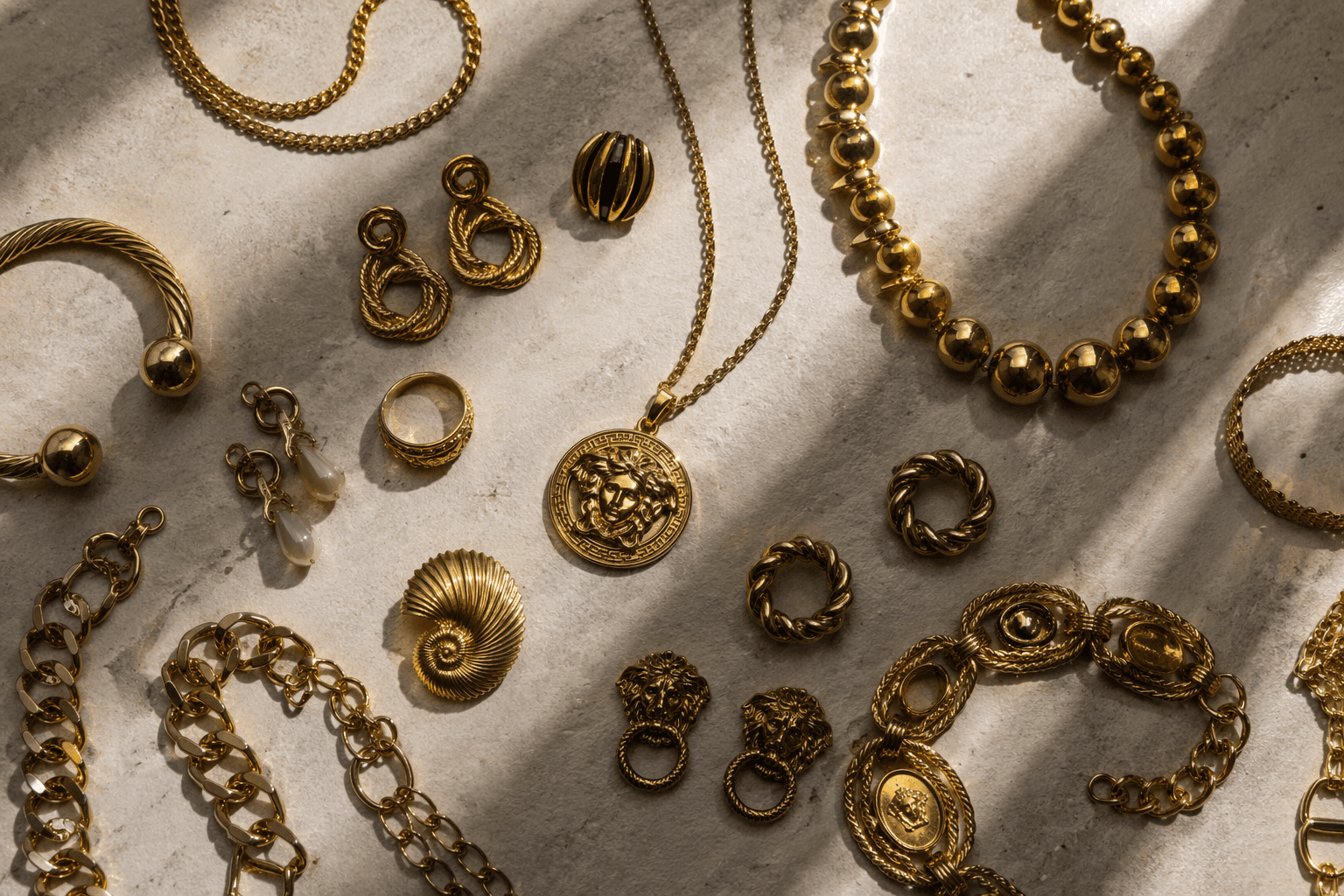
The smartest way to approach the jewelry this film is spotlighting is to look for the signatures, not the celebrity association. A true vintage piece should show coherent construction: prongs that suit the era, hinges that behave as they should, enamel that has aged with integrity, and clasps or mounts that feel original to the design. Etruscan Revival jewelry may show archaic textures and ancient-inspired motifs, while 1980s pieces often announce themselves with bold scale, mixed materials and a more graphic silhouette.
- For ancient-inspired looks, search for granulation, roped detail and disk motifs.
- For 1980s glamour, look for enamel, cuffs with presence and rings with recognizable old-cut stones.
- For designer-led vintage, study signatures, maker’s marks and the weight of the construction before the label alone sways you.
The value of *The Devil Wears Prada 2* jewelry is that it gives collectors a way in. It shows how a necklace can define a character, how a cuff can carry historical memory and how a ring can turn a close-up into a lesson in taste. Long after the film’s release, the most enduring takeaway may be this: the best vintage jewelry does not imitate history. It preserves the thrill of recognizing it.
Know something we missed? Have a correction or additional information?
Submit a Tip