Van Cleef & Arpels, from ballerina clips to Dance Reflections
A Van Cleef & Arpels ballerina clip can place a jewel in the early 1940s, while later dance projects show how the maison kept that stage language alive.
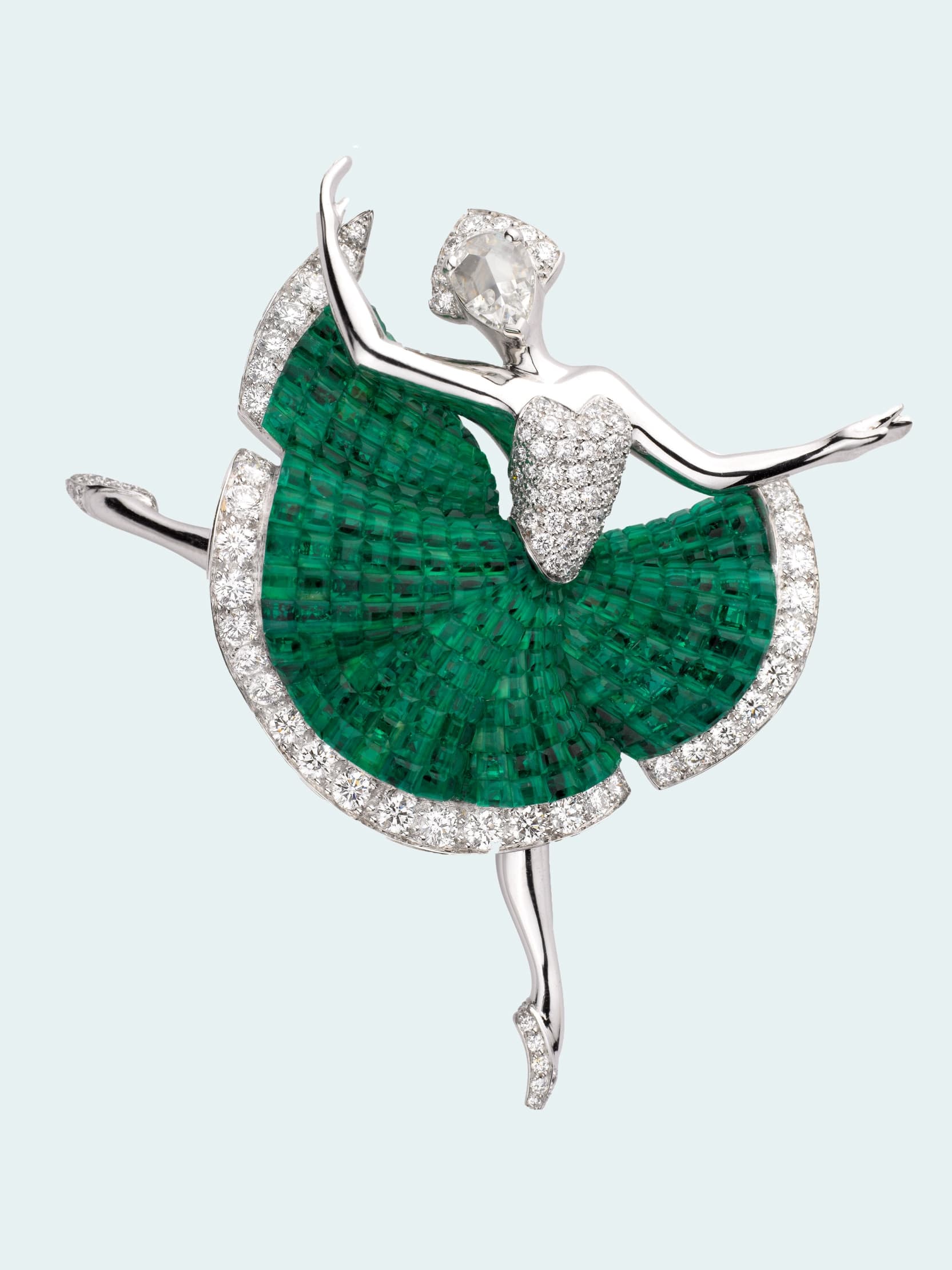
Hold a Van Cleef & Arpels ballerina clip in your hand and you are holding a small archive of performance culture. For collectors, the dance motif is not decorative trivia but a dating tool, a provenance clue, and a window into how the house translated ballet from the stage to the jewel box.
Dance as a house language
Van Cleef & Arpels says its relationship with dance reaches back to the 1920s, when Louis Arpels took his nephew Claude to the Paris Opera. That origin story matters because it frames the ballerina motif as something learned in the theater, not invented as a marketing flourish. The house’s dance story runs through Paris, then New York, and eventually into contemporary choreography, which is why the motif still feels specific rather than generic.
That continuity gives collectors a useful lens. When a motif returns across decades, the key question is not simply whether it is a ballerina, but which chapter of the maison’s dance history it belongs to. Early figural clips belong to the wartime and immediate postwar era; later references belong to a very different conversation about patronage, repertory, and cultural memory.
Why the ballerina clip reads as a mid-century signal
The first ballerina clips were created in New York in the early 1940s, after Van Cleef & Arpels opened its first New York boutique in 1939. The maison dates its first ballerina-and-fairy clips to 1941, placing them in the same moment as the Spirit of Beauty clip, which it describes as a symbol of hope. That chronology gives the motif a precise collecting frame: early 1940s, New York, and a house that was translating theatrical elegance into wearable sculpture.
The dancer motif is unusual even within jewelry history. Classical ballet dancers are described as extremely rare as a motif in the jewelry arts, which is part of why these pieces have held such fascination for collectors. A true period ballerina clip should feel like a compact stage tableau, with the figural subject doing the work of identification. If the motif is there but the spirit feels looser, more generalized, or later in tone, it may be a reinterpretation rather than one of the foundational designs.
The names that matter in provenance
Collectors should pay close attention to the maker story behind the motif. Van Cleef & Arpels says the ballerina design was developed with designer Maurice Duvalet and the Rubel Brothers of Rubel Frères. That collaboration is especially important because Rubel Frères had worked with the maison since 1915, which ties the ballerina clips to an established production network rather than a one-off novelty.
That detail helps separate authentic lineage from later homage. A dance-theme jewel linked to the early 1940s should sit comfortably within the maison’s New York expansion and the original clip format. Later pieces inspired by ballet may borrow the silhouette, but they often lack the layered provenance that makes the early ballerina clips so collectible. For buyers, the strongest examples are the ones with a clear line back to 1941, Maurice Duvalet, and the maison’s New York workshop context.
Balanchine and the leap from ornament to choreography
The dance story becomes even more visible in 1961, when Claude Arpels met George Balanchine, the co-founder of New York City Ballet. Their shared interest in gemstones led to Jewels, the 1967 ballet that remains one of the most important reference points in Van Cleef & Arpels’ dance history. Here the house moved beyond depicting dancers and into direct dialogue with choreography itself.
That shift matters for collectors because it marks a second design era. The ballerina clips belong to the jewelry object as miniature performance. Jewels belongs to the broader idea of dance as structure, rhythm, and movement translated through stones. If the early clips are about figuration, Balanchine is about abstraction with a theatrical pulse. Both are authentic to the house, but they belong to different collecting conversations.
How to read later revivals
Van Cleef & Arpels’ later collaboration with choreographer Benjamin Millepied began in 2012, extending the dance connection into contemporary performance. The house also launched Dance Reflections by Van Cleef & Arpels, an initiative guided by creation, transmission and education. It supports artists and institutions presenting modern and contemporary choreography and encourages new productions, which makes clear that the maison sees dance not as a frozen heritage but as a living practice.
The first Dance Reflections festival in London ran from March 9 to March 23, 2022, in partnership with the Royal Opera House, Sadler’s Wells and Tate Modern. For collectors, this contemporary chapter is not a substitute for the ballerina clips; it is a different kind of provenance story altogether. A jewel tied to Dance Reflections speaks to cultural patronage and present-day performance, while an early ballerina clip speaks to the early 1940s and the maison’s formative design language.
Collector’s cues for authentic dance-theme VCA pieces
When you are evaluating a dance-theme Van Cleef & Arpels jewel, start with period, then move to form, then to paper trail. The strongest clues are often the simplest:
- Early ballerina or fairy subject matter, especially in clip form
- A date or family attribution tied to 1941 or the early 1940s
- Association with New York after the 1939 boutique opened
- Links to Maurice Duvalet or Rubel Frères
- A provenance story that fits the maison’s established dance timeline, not a vague ballet inspiration
Later reinterpretations may reference the same vocabulary, but they should not be mistaken for the originals. The authentic appeal of these pieces lies in their specificity: they come from a moment when the house translated ballet into gold, stones, and movement with a clarity that collectors can still read today. That is why Van Cleef & Arpels’ dance pieces endure, not as costume jewelry nostalgia, but as one of the clearest records of how performance shaped luxury design.
This article was produced by Prism’s automated news system from verified source data, official records, and press releases, then run through automated quality and moderation checks before publishing. The system is built and supervised by the people who set the standards it runs under. Read our full AI policy.
Know something we missed? Have a correction or additional information?
Submit a Tip