Adams County Amish Country grows into a working backroads economy
Amish Country’s backroads stores now function as a real retail corridor, where locals buy food, furniture, boots, and bulk staples without leaving Adams County.

Amish Country in Adams County is no longer just a scenic detour off the main roads. Along Wheat Ridge Road, Burnt Cabin Road, Duffy Road, and nearby lanes near West Union, Seaman, and Peebles, it works as a retail corridor where families can buy groceries, furniture, baked goods, boots, saddles, and everyday staples in one run.
That matters in a county of 27,477 people in the 2020 Census, with an estimated 27,865 residents in July 2025 and 583.9 square miles of land area. In a place that still posted $321.9 million in retail sales in 2022 and a median household income of $50,264 in 2020 to 2024 Census data, the Amish Country market is part shopping district, part local supply chain, and part day-trip destination.
A working backroads market, not just a scenic stop
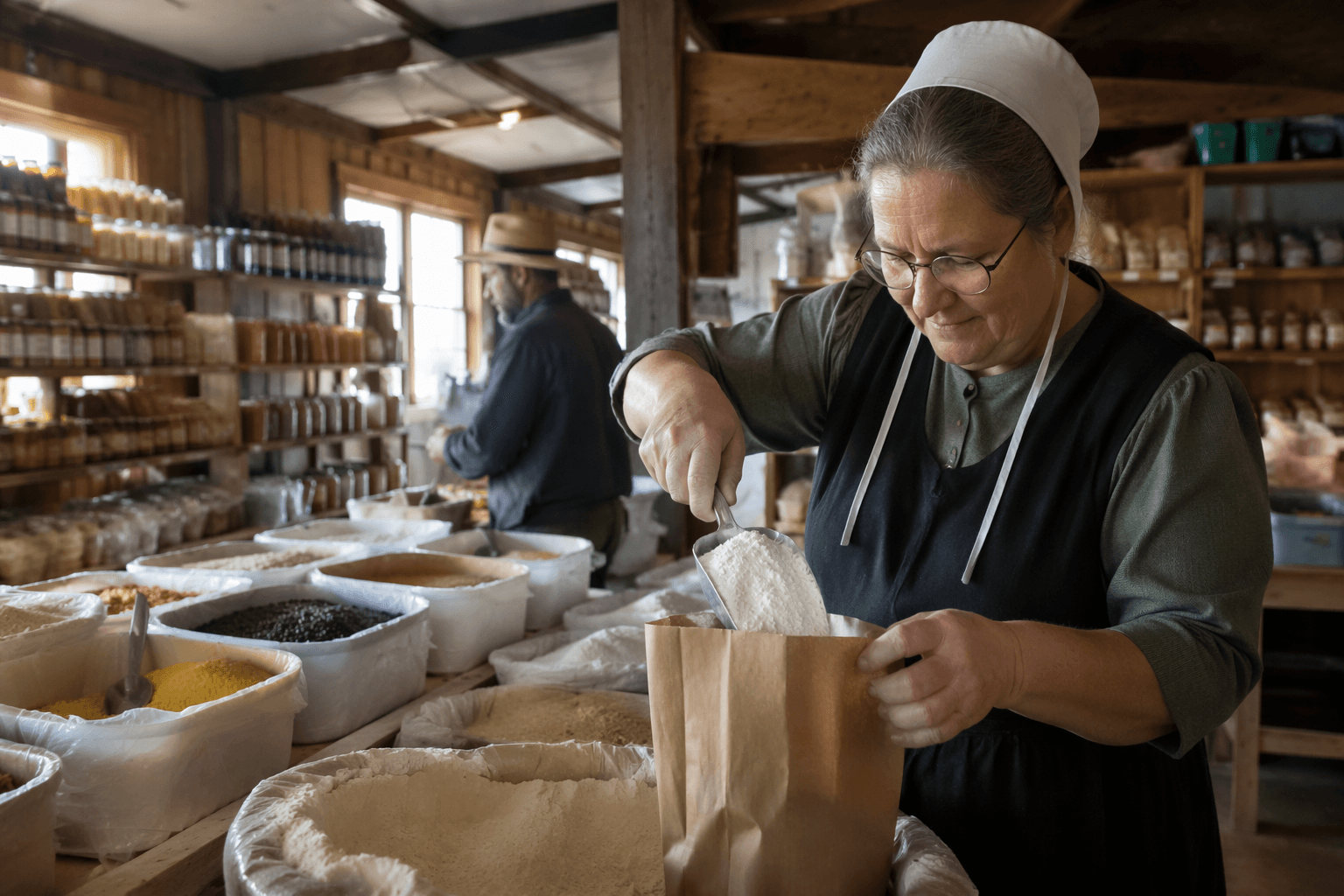
The Amish community here traces its modern growth to 1976 and now includes more than 96 households, according to the Adams County Travel & Visitors Bureau. What visitors notice first is still the traditional scene: buggies, horses, children on scooters, babies in wagons, and clothes drying in the fresh air. Those details draw attention, but the real story is the set of stores that turn the corridor into a place where locals actually shop.
Miller’s Bakery & Gifts sells Amish bread, donuts, pies, cakes, and gifts. Miller’s Bulk Foods carries groceries, deli sandwiches, country cheese, hams, eggs, milk, summer sausage, butter, jams and jellies, baking supplies, Amish books and cookbooks, Minnetonka Moccasins, hats, and local produce. Raber’s Shoe and Saddlery focuses on work boots, hiking boots, leather goods, saddles, and harness supplies, while Yoder’s Furniture, Bakery & Bulk Foods grew from a horse-and-buggy roadside pie stand into a destination market in the Wheat Ridge Amish community.
That mix is what makes the corridor useful. It is built around goods people can use the same day, not souvenirs alone, and it gives nearby towns a way to keep dollars circulating closer to home.
Where the stops are and what you can buy
The two biggest named anchors in the current county tourism listing sit on the roads that shape the Amish Country experience. Miller’s Furniture is at 960 Wheat Ridge Road, open Monday through Saturday from 9 a.m. to 5 p.m., and says it offers more than 5,000 handmade items under 40,000 square feet of indoor shopping. Yoder’s is at 2621 Burnt Cabin Road, open Monday through Saturday from 8 a.m. to 9 p.m., and is described as an authentic, one-of-a-kind Amish variety store now owned by Wayne Yoder.
Those hours matter because they make the corridor usable as a practical day trip. A shopper can combine furniture browsing, bulk food buying, and bakery stops without trying to fit the trip into a narrow weekend window, and the longer hours at Yoder’s give the road network a late-day retail anchor.
A quick stop along the corridor can cover a full grocery list:
- Fresh bread, donuts, pies, and cakes
- Bulk groceries and pantry items
- Country cheese, hams, eggs, milk, butter, and summer sausage
- Jams, jellies, and baking supplies
- Amish books, cookbooks, and practical clothing items
- Handmade furniture and other household goods
- Work boots, hiking boots, saddles, harness supplies, and leather goods
That is why the roads around Wheat Ridge and Burnt Cabin feel less like a novelty route and more like a functioning local market. The stores serve visitors, but they also serve the people who live nearby and know exactly which driveway leads to which shop.
Why the county’s numbers make this corridor matter
Adams County’s scale helps explain why this pocket of commerce has an outsized profile. With fewer than 28,000 residents and a land base of 583.9 square miles, the county has a lot of ground to cover, and not many concentrated shopping districts. A retail corridor that can draw both residents and visitors therefore matters more than its map size might suggest.
The spending figures back that up. Countywide retail sales reached $321.9 million in 2022, and the Adams County tourism office says visitor spending increased 15% in its 2023 report compared with the previous one. The same tourism materials said six new lodging establishments were added to the map, a sign that Amish Country sits inside a broader visitor economy rather than standing alone.
The county’s new Welcome Center, supported by State Capitol Budget funding in 2021 and 2024, adds another layer. It suggests local leaders are treating Adams County not as a pass-through rural area, but as a place where visitors can be directed to stops, overnight stays, and backroad businesses that depend on steady traffic.
Birding, heritage, and the way a small event grew
Amish Country’s draw is not limited to stores. The Adams County Amish Bird Symposium began with an idea in the fall of 2003, was developed in February 2004, and grew out of the work of Roman Mast, Edge of Appalachia Preserve director Chris Bedel, and local resident Randy Lakes. What was expected to attract only a few dozen people ended up filling a basement with more than 100 English and Amish attendees from around the region.
That first gathering later moved to Yoder Log Homes and developed into a recurring attraction built around hawk and owl identification, migration, barn owls, and saw-whet owl movements in Adams County. The 2025 annual listing ran from March 1 through March 20, 2025, showing that the symposium has become part of the county’s yearly calendar rather than a one-time curiosity.
The bird symposium fits the same pattern as the stores on Wheat Ridge and Burnt Cabin: a local idea, a rural setting, and a draw that keeps bringing people back because it offers something specific and hard to find elsewhere.
Part of a larger Ohio Amish map
Adams County is not one of Ohio’s largest Amish settlements, and that is part of what makes it interesting. The Young Center for Anabaptist and Pietist Studies estimated Ohio’s Amish population at 84,065 in 2023, with Holmes County the largest settlement in the state and Geauga County the second largest. Adams County’s more compact, younger settlement shows how a smaller community can still build a recognizable identity and a practical retail economy.
The result is a backroads district that does several jobs at once. It supplies households, serves day-trippers, supports local lodging, and gives Adams County a retail identity rooted in food, craftsmanship, and everyday use. In a county this small, the Amish Country corridor is not a side attraction, it is one of the places where the local economy is easiest to see.
This article was produced by Prism’s automated news system from verified source data, official records, and press releases, then run through automated quality and moderation checks before publishing. The system is built and supervised by the people who set the standards it runs under. Read our full AI policy.
Did this article answer your question?