Adams County Fair Brings Together Livestock, Entertainment, and Community Traditions
West Union's Adams County Fair unites 4-H livestock exhibitors, grandstand concerts, and generations of farming families at Boyd Avenue each summer.
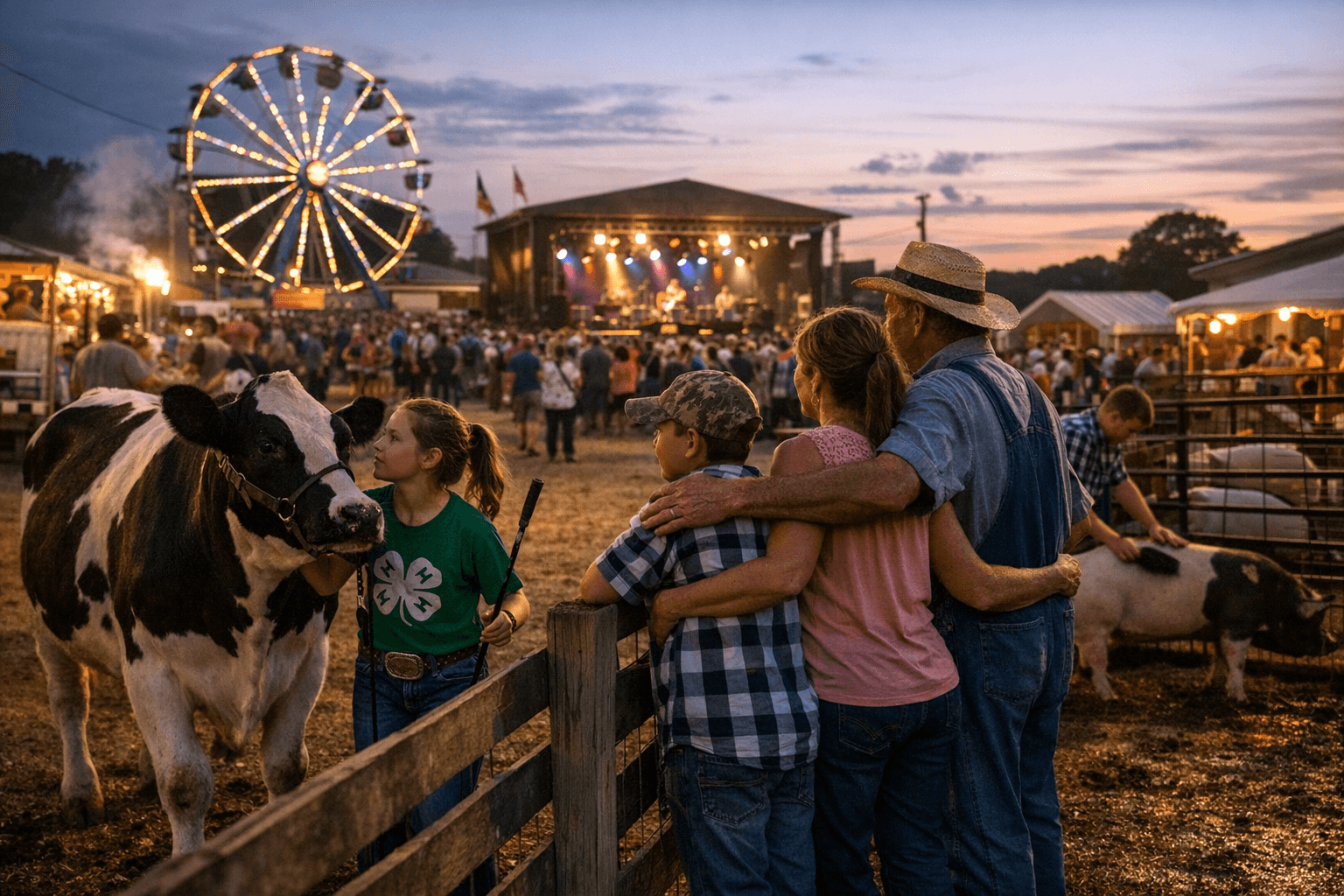
Few institutions in Adams County carry the unbroken thread of community identity that runs through the Adams County Fair. Staged each year at the Adams County Fairgrounds on Boyd Avenue in West Union, the fair serves as the county's principal annual agricultural exposition and community festival, drawing livestock exhibitors, midway visitors, local vendors, and families whose connection to the event spans generations. It is, by almost any measure, the most consistent public gathering the county produces.
A Tradition Built on Two Pillars
County fairs have always served a dual purpose: part agricultural showcase, part communal reunion. At their core, they exist so that local producers can demonstrate the quality of their livestock and crops, and so that young people can compete, learn, and earn recognition for their work. The Adams County Fair fulfills both functions without apology. Its programming preserves agricultural knowledge at a time when fewer families farm professionally, and it sustains the kind of face-to-face community networks that are difficult to replicate through any other civic vehicle.
Over recent decades, the fair's programming has expanded to include family entertainment, grandstand shows, and a broader range of attractions designed to draw regional visitors who may not have a direct connection to farming. That expansion has broadened attendance without erasing the fair's agricultural roots. Livestock shows and junior fair competitions remain central, not peripheral, to the event's identity.
The Adams County Agricultural Society
Behind the fair is the Adams County Agricultural Society, a volunteer board composed of community members, local farmers, and organizers who coordinate every aspect of the event. The society sets the annual schedule, manages exhibit hall logistics, books entertainment, and handles the financial reporting and legal notices required by Ohio state law. It is a working board, not a ceremonial one, and its membership reflects the county's agricultural and civic fabric.
The society also manages partnerships with local civic groups and businesses that supply concessions and stage entertainment during fair week. Those relationships are not incidental; they determine much of what visitors experience on the midway and in the grandstand. The Agricultural Society functions, in effect, as the organizational backbone of one of the county's largest annual economic events.
What Happens at the Fair
The range of activity during fair week covers considerable ground. Livestock shows anchor the agricultural programming, with 4-H and FFA exhibitors bringing cattle, swine, sheep, poultry, and other animals to compete before judges. Agricultural competitions extend to produce, crafts, and other exhibitor categories that reflect the breadth of rural life in Adams County. The midway provides carnival rides and games that draw younger visitors and families looking for something beyond the show barns.
Grandstand concerts and entertainment bookings give the fair an evening identity that extends well past the livestock barn hours. Local vendors set up throughout the fairgrounds, creating a seasonal marketplace that benefits food concessionaires and merchandise sellers who depend on fair week for a meaningful portion of their annual revenue. The combination of competitions, entertainment, and commerce gives the fair a full-week rhythm that no single event type could sustain on its own.
Youth Development as a Core Mission
For many young people in Adams County, the fair is the primary setting in which agricultural education becomes tangible. The Adams County Agricultural Society works directly with 4-H and FFA chapters to manage livestock shows and junior fair competitions, giving youth exhibitors a structured pathway from project animal to public competition. That process teaches animal husbandry, record-keeping, public presentation, and the kind of responsibility that comes from caring for a living animal over months of preparation.
The junior fair is not a sideshow to the main event; it is one of the fair's foundational purposes. For students considering agricultural careers, participation in 4-H and FFA programming at the county level is often the first professional experience they receive. The fair provides both the stage and the stakes.
The Fairgrounds Beyond Fair Week
The Adams County Fairgrounds on Boyd Avenue does not go quiet after the midway trucks leave. The Adams County Agricultural Society operates the site year-round, making it available for rentals, community gatherings, and agricultural programming throughout the calendar year. Events like tractor pulls and flea markets have established their own followings at the fairgrounds, drawing different crowds than the summer fair but reinforcing the site's role as a central community venue.
That year-round activity serves a practical financial function as well. Rental income and off-season events help sustain the fairgrounds infrastructure, which in turn supports the capacity to host the annual fair at full scale. The fairgrounds is not simply a fair venue; it is a community asset that generates activity and economic return across all four seasons.
Economic Impact on West Union and Beyond
Fair week delivers a concentrated economic boost to West Union and the surrounding area. Downtown merchants, food vendors, and concessionaires see seasonal revenue spikes that are difficult to replicate outside of the fair's gravitational pull. For small operators who anchor their year-end finances around the fair's attendance, the Agricultural Society's ability to maintain and grow the event has direct implications for business viability.
That economic dimension matters particularly in a county that has navigated significant debates around workforce development and the industrial reuse of former power-plant sites. The fair does not resolve those structural questions, but it provides a reliable, annually recurring economic event that supports local commerce at a scale no other local institution consistently matches.
Planning a Visit
The Adams County Agricultural Society posts current schedules, ticketing information, volunteer opportunities, and vendor application deadlines on the fair's official site. Because fair programming is managed locally and can shift from year to year, the Agricultural Society's website and fairgrounds office are the authoritative sources for dates and specifics. Visitors looking to exhibit, volunteer, or rent the fairgrounds for other events will find contact and booking information there as well.
The fairgrounds sit on Boyd Avenue in West Union, accessible for those traveling into Adams County from surrounding communities. Whether the draw is the livestock barn, the grandstand, or the midway, the fair's geography keeps everything within reach of a single venue.
What the Adams County Fair ultimately offers is something harder to schedule than a concert or quantify like a tax return: a reliable annual gathering where agricultural heritage, youth achievement, and community life share the same grounds for a week. That combination, sustained year after year by a volunteer board and its network of partners, is the fair's most durable attraction.
This article was produced by Prism’s automated news system from verified source data, official records, and press releases, then run through automated quality and moderation checks before publishing. The system is built and supervised by the people who set the standards it runs under. Read our full AI policy.
Did this article answer your question?