Adams County Petitioners Seek Constitutional Ban on Large Data Centers
Adams County for Responsible Development submitted 1,822 signatures to Ohio's attorney general, launching a push to constitutionally ban data centers larger than 25 megawatts statewide.
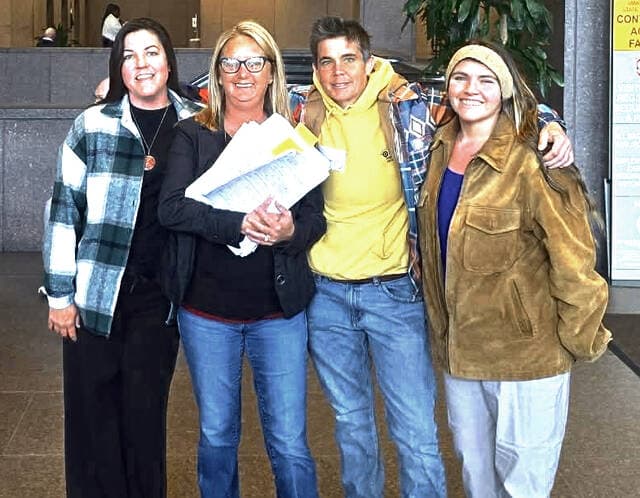
Danielle Kinhalt, a member of Adams County for Responsible Development, helped deliver a petition to the Ohio Attorney General's Office seeking to ban data centers exceeding 25 megawatts. "Really, the data centers we just don't want the mega AI data centers," she said.
On Monday, March 16, residents from Adams and Clermont counties traveled to Columbus to deliver those petitions to the Ohio Attorney General's Office. Organizers submitted 1,822 signatures for review, with nearly two-thirds from Adams and Brown counties and the remainder collected across 16 additional counties. The filing represents the first formal step in the statewide initiative process for a proposed constitutional amendment.
Jessica Adams Baker, who helped coordinate the signature-gathering effort, framed the moment in stark terms. "Our way of life is under attack without community input and no lasting economic benefit to the community," Baker said. The group acted after feeling that community concerns were not being taken seriously by local decision makers.
Nikki Gerber, another organizer who made the trip to Columbus alongside Baker, Emily Harper, and Kinhalt, pointed to what she sees as a pattern of exploitation targeting unzoned rural land. "What it feels like they are doing is just taking advantage of the unzoned rural areas of Ohio, where they can go ahead and put in whatever they want," Gerber said.
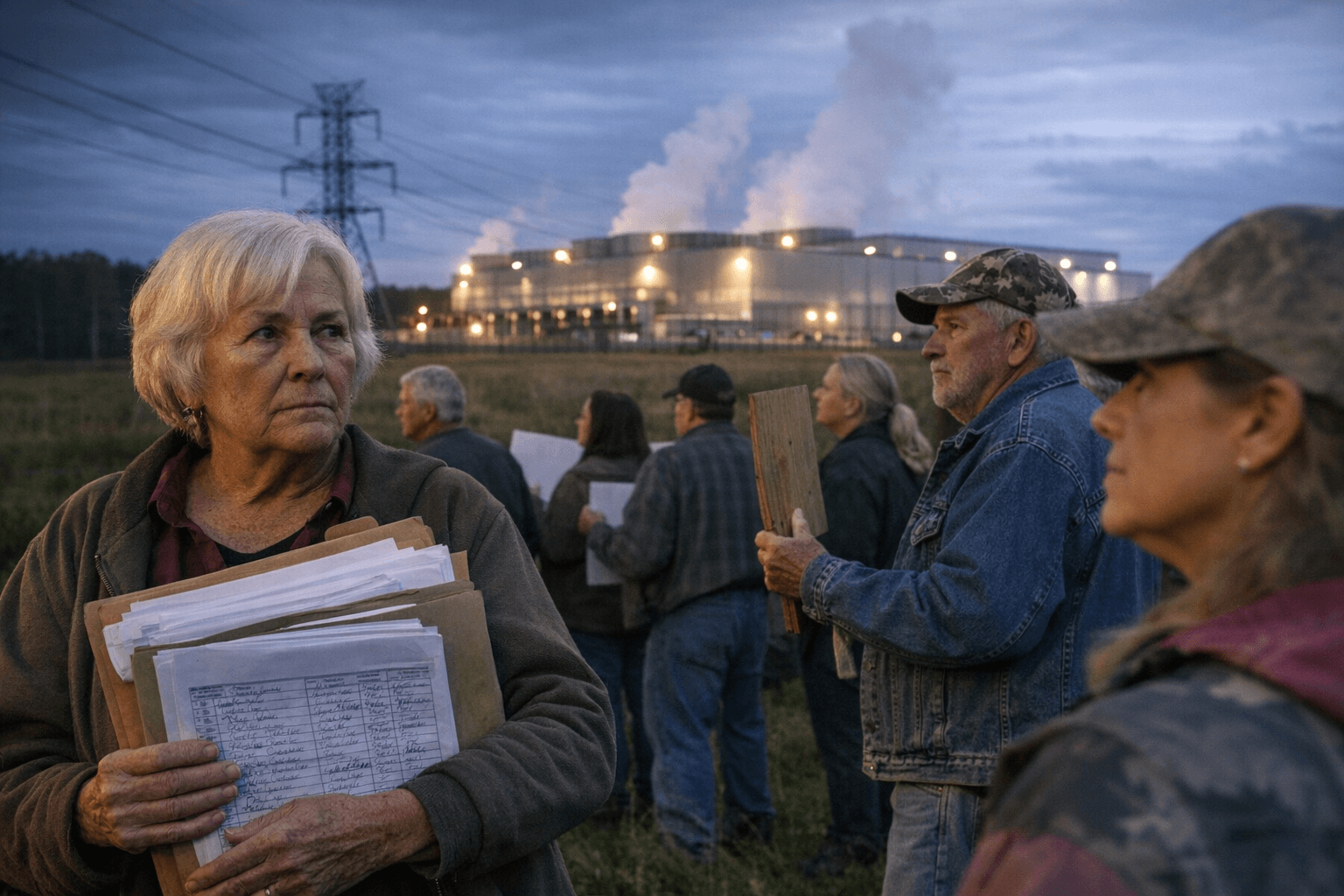
The push comes as the U.S. Army Corps of Engineers issued a permit to enable a data center project near the former Stuart power plant in Adams County. AES Ohio disclosed in a Feb. 3 regulatory filing that a data center "in the vicinity" of the Stuart plant would require 1,300 megawatts of electricity by 2032, which would make it one of Ohio's largest data centers, consuming 31 times the annual power consumption of Adams County.
Kinhalt described the wall of silence that pushed organizers to act. "We felt like our local government just wasn't listening to us and giving us any answers at all. With the NDAs, they just kept saying they don't know anything and then we see people on the property doing their due diligence. Our commissioners, our economic developer, no one would give us any answers," she said.
That frustration with non-disclosure agreements extends well beyond Adams County. State Reps. Brian Stewart and Adam Bird filed House Bill 695 in response to a data center development in Mount Orab, in Brown County, where many residents were upset about a non-disclosure agreement signed by local government officials. House Bill 695 would prohibit specific local elected officials from entering into NDAs in response to some officials withholding information from residents about plans for data centers. The bill was referred to the House Local Government Committee on February 18, 2026.
The 25-megawatt threshold at the center of the proposed amendment is not a symbolic number. Attorney General Dave Yost has until March 26 to determine if the group's petition is accurate. If he gives it the green light and the measure is approved by the Ohio Ballot Board, the group would have to gather 413,446 valid signatures by July 1 to make the ballot.
The scale of what organizers are trying to block has grown dramatically in recent years. According to an analysis from McKinsey and Company, a 30-megawatt data center was considered large a decade ago. Today, facilities using 200 megawatts or more are becoming common, driven by the rapid growth of artificial intelligence. The petitions also call on Adams County commissioners to establish "rural zoning" that could make data centers harder to build locally, adding a county-level demand alongside the statewide constitutional push.
Kinhalt said the group eventually connected with another organization and an attorney and decided they would have to go through the state to get answers. That decision, made by a handful of neighbors, produced 1,822 signatures across 18 counties in eight days and set in motion a process that could place a question before every Ohio voter by November.
This article was produced by Prism’s automated news system from verified source data, official records, and press releases, then run through automated quality and moderation checks before publishing. The system is built and supervised by the people who set the standards it runs under. Read our full AI policy.
Did this article answer your question?