Adams County's 1797 founding shapes its historic identity today
Adams County’s 1797 start still shows up in West Union’s courthouse records, local history groups, and the county’s role as one of Ohio’s oldest communities.
Adams County’s age is not just a line in a charter. It still shapes where local records live, why West Union matters as the county seat, and how residents connect to places like Manchester, Ripley, Peebles, Seaman, and Winchester. The county was created in 1797, before Ohio statehood, and that early start remains visible in the institutions and historic places people use today.
Why 1797 still matters
Adams County was created on July 10, 1797, by proclamation of Arthur St. Clair, then governor of the Northwest Territory. It was named for John Adams, the second president of the United States, and the county government identifies it as Ohio’s third oldest county. That makes the county part of the first wave of civil organization in the territory that later became Ohio.
The timing matters because Ohio did not enter the Union until 1803. Adams County was already organized before statehood, which helps explain why its history reads less like a later county story and more like an early frontier foundation. Historical sources also describe Adams County as one of the four counties into which the Northwest Territory was divided at the time, which places it near the center of the territory’s earliest governing map.
Manchester, West Union, and the county’s first centers
The county’s civil organization was completed on Tuesday, September 12, 1797, at Manchester, according to the Adams County GenWeb Project. That history describes Manchester as the site of the first white settlement in the Virginia Reservation and the third in Ohio. For anyone trying to understand Adams County’s origins, Manchester is the starting point for the county’s public life.
West Union came later, but it is the town that carries the county’s daily government identity now. A local history article says West Union was platted in 1807, and that timeline helps explain how the county seat became the practical center for records, courts, and public business. The courthouse town is where the county’s early origin story meets modern administration, and that connection still gives West Union a different weight than an ordinary small town.
What the county’s age changes in daily life
Being one of Ohio’s oldest counties affects Adams County most clearly through its institutions. The Adams County Travel and Visitors Bureau history brochure brings together the Adams County Heritage Center, the Adams County Historical Society, and the Adams County Genealogical Society, showing that local history is preserved through archives, family records, photographs, and community memory, not only through monuments or scenic sites. That makes the county’s founding a living part of local access, because residents and researchers can still trace names, deeds, and family lines through those institutions.
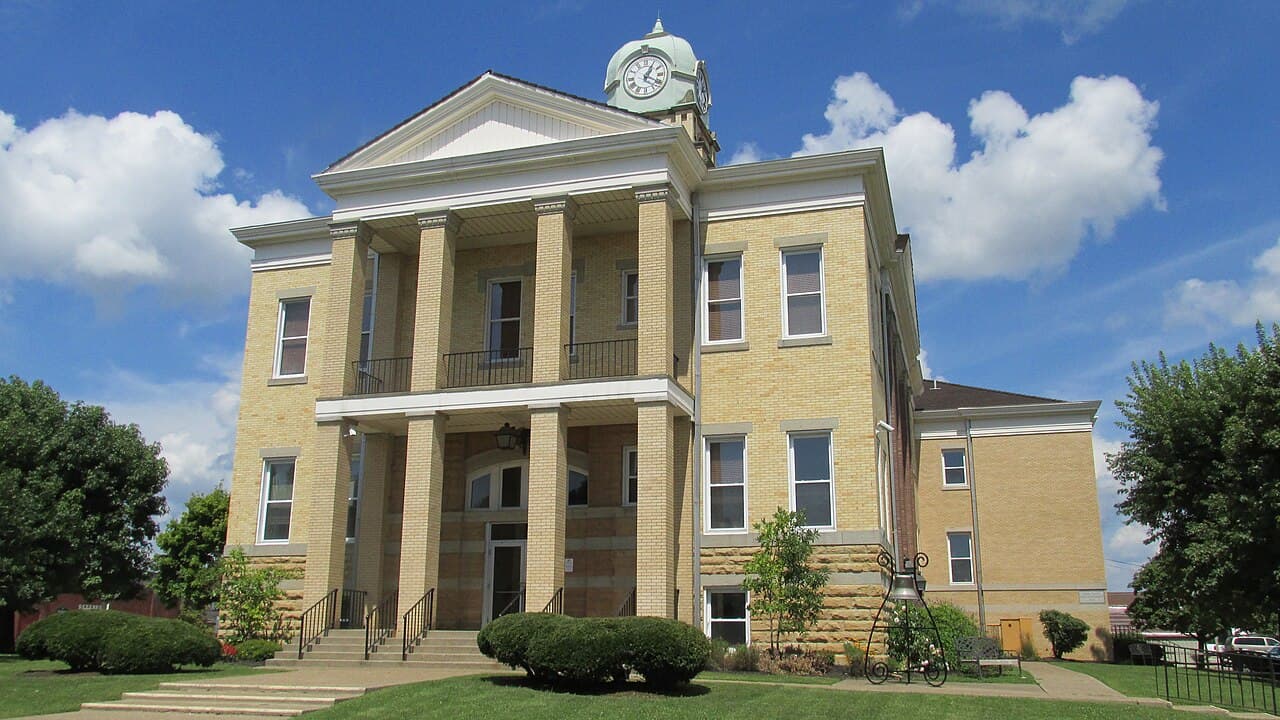
The Adams County Courthouse in West Union remains central to that system. Courts and public records are not just administrative tools in a county this old; they are part of how the county’s earliest organization still reaches into the present. When a place has been recording land, families, and civic life since the 1790s, the courthouse becomes more than a government building. It becomes the repository that ties present-day residents to the county’s first decades.
The places that keep history visible
Adams County’s historic identity is spread across familiar places rather than locked into one landmark. River towns like Manchester and Ripley sit beside inland communities such as Peebles, Seaman, and Winchester, and together they reflect a county that took shape early and then expanded through a network of settlements. That pattern helps explain why county roads, town names, and local organizations often carry older roots than visitors expect.
Public history is especially visible at Serpent Mound Park, where the Adams County Historical Society held its first summer meeting on July 4, 1931. That date shows that organized preservation in the county has its own deep history, extending back nearly a century. It also shows how local people have long treated history as something to be gathered, studied, and shared in public spaces rather than left in archives alone.
The Adams County Historical Society’s ties with the Adams County Travel and Visitors Bureau and the Ohio History Connection reinforce that network. The county’s history is not preserved by a single office or one plaque. It is sustained through a web of institutions that connect research, interpretation, and public access across the county.
How to use Adams County’s history today
If you are trying to understand Adams County as it exists now, start with West Union, then work outward to Manchester, Ripley, Peebles, Seaman, and Winchester. Those places show how an 1797 county developed from an early territorial settlement into a community with a courthouse seat, historical organizations, and a strong local memory. The county’s age also makes genealogy and family research especially relevant, because older counties tend to leave deeper paper trails.
- The Adams County Heritage Center for local interpretation and exhibits
- The Adams County Historical Society for preservation and public history
- The Adams County Genealogical Society for family research and records
- The Adams County Courthouse in West Union for the civic record of county life
A practical way to experience that history is to use the institutions that already hold it:
The Ohio History Connection’s county-boundary material and historical atlas references place Adams County within the broader evolution of Ohio’s map, which is another reason the county’s founding still matters. This is not just an old date on a county page. It is the reason Adams County remains one of the clearest windows into Ohio’s earliest territorial era, and why its courthouse town and historical institutions still define how the county understands itself.
This article was produced by Prism’s automated news system from verified source data, official records, and press releases, then run through automated quality and moderation checks before publishing. The system is built and supervised by the people who set the standards it runs under. Read our full AI policy.
Did this article answer your question?