Alamance Middle Schoolers Explore Haw River History, Water Quality at Glencoe Museum
Alamance-Burlington middle schoolers tested Haw River water quality at Historic Glencoe's Textile Heritage Museum, connecting Indigenous history to the river that shaped the county's industrial identity.
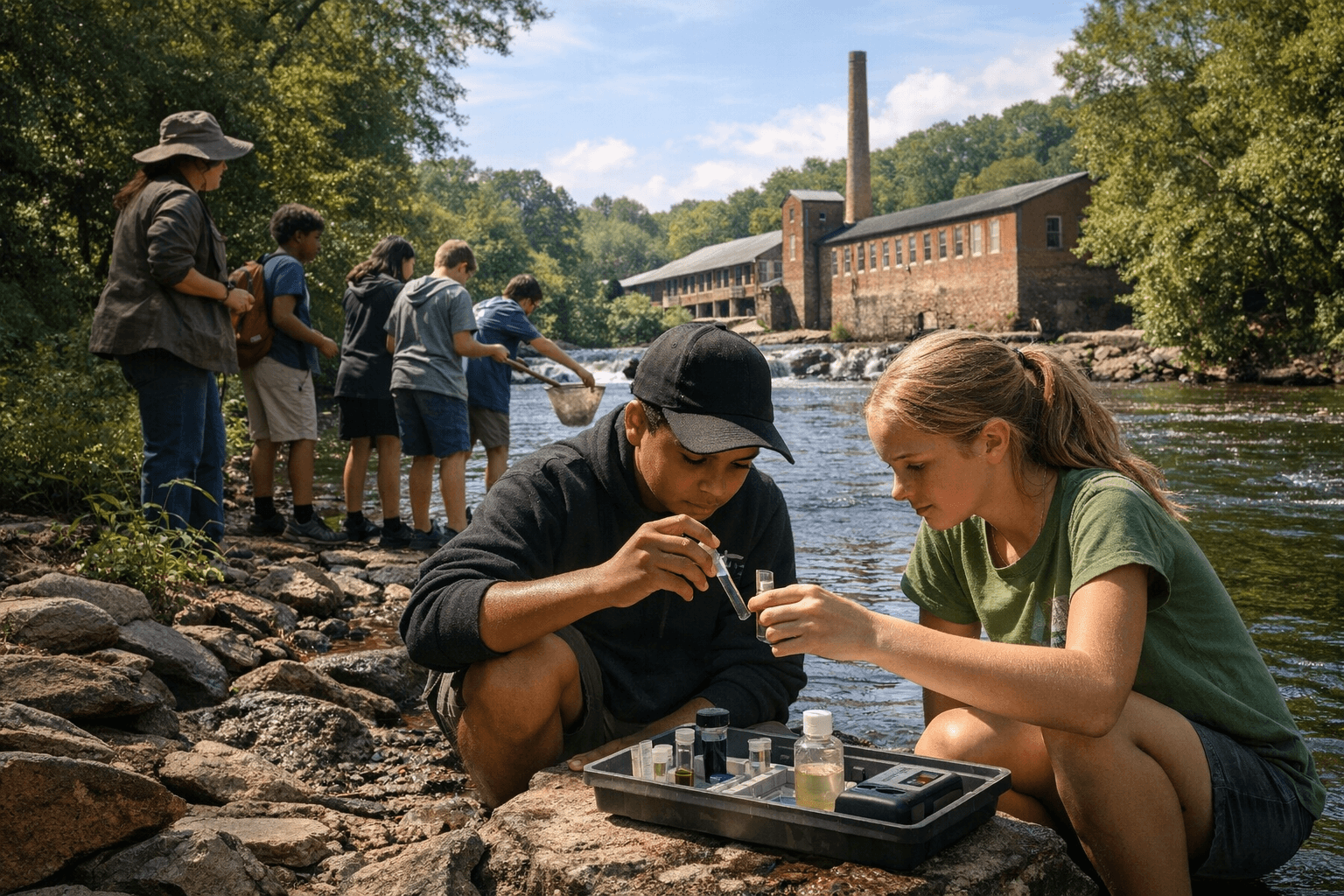
Middle school students from the Alamance-Burlington School System gathered Saturday at the banks of the Haw River on the grounds of Historic Glencoe's Textile Heritage Museum, collecting water samples and tracing a current that has shaped Alamance County life for more than a thousand years.
The field visit wove together three distinct threads: hands-on water quality testing, the Indigenous history of the Sissipahaw people who gave the Haw its name, and the rise and fall of the textile mills that turned the river's power into cotton fabric shipped across the world. The museum, housed in the restored Glencoe Company Store and Management offices three miles north of Burlington on Glencoe Street, sits at one of the most intact mill village complexes in the American South.
The Sissipahaw, part of the Eastern Siouan people, lived in small, interconnected villages on the ridges overlooking the Haw for over a thousand years before European settlers arrived. Their name endures in the river, in the nearby community of Saxapahaw, and in the county's geographic identity. Students heard those stories during their visit, connecting the waterway they tested to communities who fished and farmed its banks long before the first mill wheel ever turned there.
The industrial chapter of the Haw's story began in earnest at Glencoe in 1880, when the Holt family built a cotton mill and village on a 105-acre site along the river. Glencoe was among ten early mills constructed along the Haw in Alamance County, and it ran continuously until 1954, producing plaid and cotton fabrics that reached markets worldwide. The Glencoe Mill Village Historic District was added to the National Register of Historic Places in 1979, and the 6,000-square-foot museum that anchors it today preserves looms, fabric samples, mill worker artifacts, and evidence of the water-powered machinery that defined the county's economy for three-quarters of a century.
Water testing brought that history into the present tense. The Haw River, which once powered the spindles of Glencoe and nine other Alamance County mills, now runs through a landscape where industrial use has given way to trail networks, paddle accesses, and conservation efforts. Students taking samples on Saturday were measuring a river whose health reflects more than a century of industrial transformation, and whose future depends in part on the communities that live along its banks today.
The Textile Heritage Museum has expanded its educational school programs in recent years through a partnership with the Alamance Parks Department, formalized in September 2018, which has helped grow visits from students across the county. For ABSS students, the museum sits at the intersection of science, history, and civic identity, a place where a water sample and a centuries-old story share the same riverbank.
This article was produced by Prism’s automated news system from verified source data, official records, and press releases, then run through automated quality and moderation checks before publishing. The system is built and supervised by the people who set the standards it runs under. Read our full AI policy.
Did this article answer your question?


