Elon sophomore finds belonging through campus and Alamance support group
Maria Lagunes Flores found belonging at Elon in the Gender & Sexuality Living-Learning Community and through a scholarship network that also connects to Alamance County support.

Maria Lagunes Flores arrived at Elon expecting the usual first-year scramble for friends and a place to fit in. Instead, her first year became a clearer lesson in how campus housing, scholarship support and local LGBTQIA+ resources can shape a student’s sense of identity and home.
During Pride Month, her experience stands out because it is not only about personal growth. It also shows how Elon University’s structures, and Alamance County’s support network beyond campus, can help students move from uncertainty toward belonging.
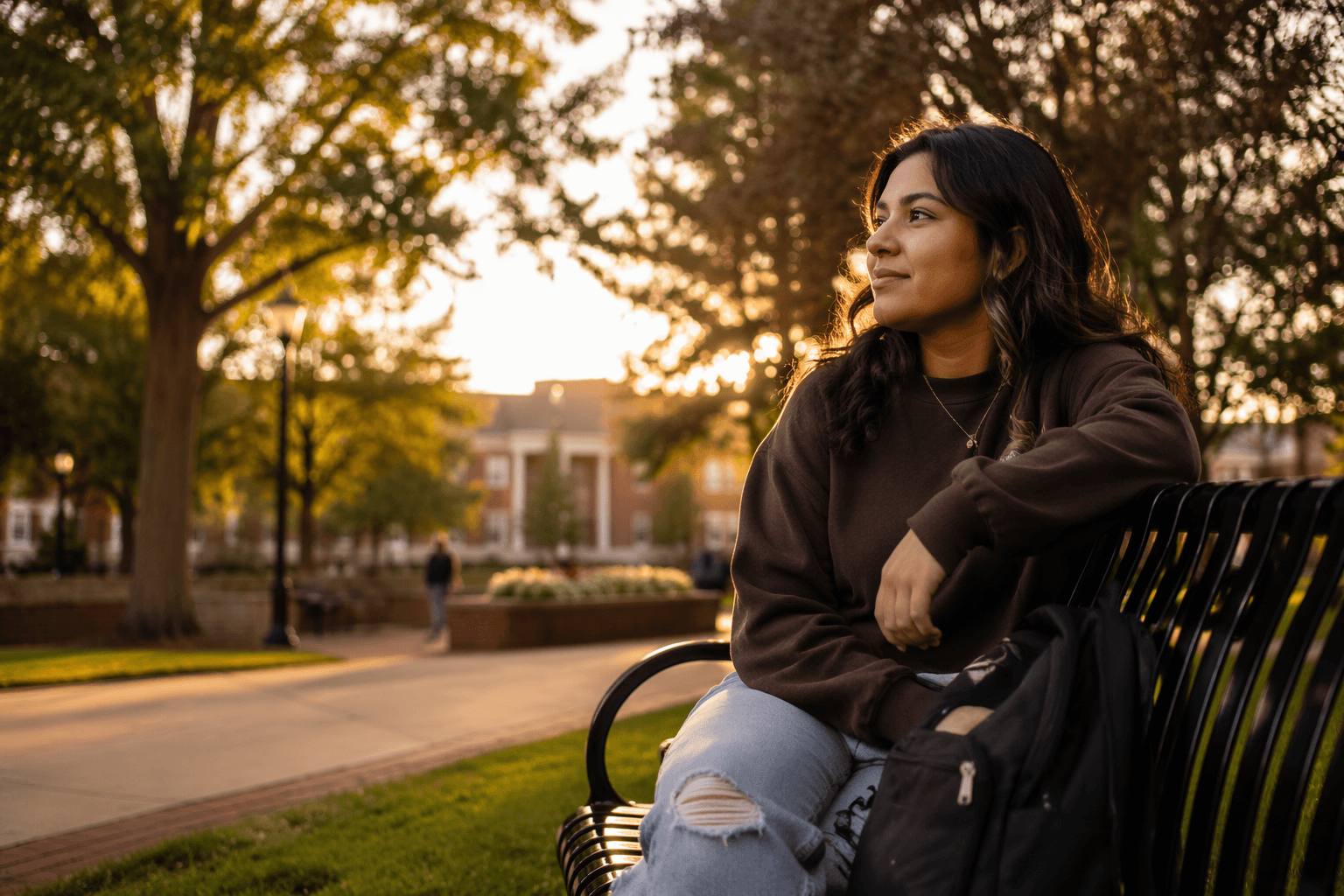
A campus home in the Colonnades
For Lagunes Flores, the strongest anchor was the Gender & Sexuality Living-Learning Community in the Colonnades Neighborhood. Elon says the community includes single rooms with private baths, along with shared lounge, study and kitchen space, giving students both privacy and the chance to build everyday connection. The university’s Gender & LGBTQIA Center says the G&S LLC has grown substantially in recent years and is often cited as a highlight of students’ on-campus experiences.
That matters for queer and trans students because housing is often where the smallest daily routines become the foundation for community. At Elon, the G&S LLC and Gender Inclusive Housing are presented as options of interest to queer and trans students, making the residence hall more than a place to sleep. It becomes a setting where identity is visible, understood and supported.
One memorable moment in Lagunes Flores’ first year came on move-in day, when she and her roommates carried pride flags through the residence hall. It was a small act, but one that turned a campus ritual into a public declaration that they were not just arriving as students, they were building a shared home. For a first-year student, that kind of gesture can matter as much as any formal orientation program because it signals who belongs in the space and who is expected to be seen.
How scholarship support and identity-building overlap
Lagunes Flores is also part of Elon’s Odyssey Program, which the university describes as a four-year, highly selective, merit-based scholarship program for students who are academically strong, civically engaged, action-oriented and demonstrate high financial need. The program is designed to move students through college as a group, which means support is not limited to tuition help. It also includes pre-orientation, identity development, service learning, global study, professional development, leadership development, mentoring and community building.
Elon lists Lagunes Flores as a member of the Class of 2029 and a recipient of the Leon and Lorraine Watson Scholarship. That detail is important because it shows how financial access and belonging can work together. A scholarship can open the door, but the cohort model, mentoring and identity-focused programming help determine whether a student feels at home once inside.
Her background adds another layer to that picture. Lagunes Flores grew up in a Native American community in Lumberton, North Carolina, and her first year at Elon gave her room to think about identity across different settings and histories. The story of her first year is therefore not just about finding friends on campus. It is also about navigating what it means to bring more than one community experience into a new environment and to find people and spaces that recognize that complexity.
Where Elon’s Pride Month support shows up
Elon marked Pride Month 2026 with programming through the Gender & LGBTQIA Center, including an annual community coffee. That kind of event may seem small from the outside, but it helps explain how the university’s support system works in practice. Pride Month programming, living-learning communities and scholarship cohorts create repeated contact points, so students do not have to rely on a single club meeting or one-off event to find connection.
The broader message from Lagunes Flores’ first year is that support is most effective when it is layered. A housing community gives daily contact. A scholarship program gives structure, mentoring and access. Pride Month programming gives a visible campus signal that LGBTQIA+ students are not expected to disappear into the margins during the academic year.
For local readers, this is also where the campus story starts to matter beyond Elon. Students who feel secure enough to lead, speak and build community on campus are more likely to carry that confidence into the county’s civic life. That is especially true when campus programs are connected to organizations nearby rather than sealed off from them.
The Alamance County link: Transcend Alamance
Lagunes Flores’ experience also points toward Transcend Alamance, a community-led initiative that says it creates belonging for LGBTQIA+ and gender-expansive people of any age, race and ability in Alamance County. The group says it provides links to local resources, support groups and affirming spaces, which makes it a practical bridge between university life and county life.
Its trans and nonbinary support group meets in person on the fourth Wednesday of each month from 6:30 to 8:00 p.m. for adults 18 and older. The group description says it serves people in Alamance County and surrounding rural areas, a reminder that affirming spaces are not only needed in the county seat or on campus but also for people who travel in from smaller communities nearby.
That local network matters because not every student experiences identity support first through a campus office. Some find it through peers, roommates or a nonprofit that is already doing the quieter work of resource-sharing and mutual aid. In that sense, Elon’s campus environment and Transcend Alamance’s community work complement one another. One helps shape the student experience inside the university. The other extends support into the county, where students, families and adults are often looking for the same thing: a place to belong without having to explain why that matters.
What this first year says about life at Elon
Lagunes Flores’ first year suggests that belonging does not happen by accident. It is built through housing arrangements, scholarship structures, identity-centered programming and community organizations that give students and residents a place to show up as themselves. At Elon, the Gender & Sexuality Living-Learning Community and Odyssey Program help make that possible. In Alamance County, Transcend Alamance extends that same work outward, offering a support structure that reaches adults, students and rural residents alike.
For Elon, the lesson is that Pride Month is not only a celebration calendar item. It is a test of whether support systems are visible, usable and connected to life beyond campus. Lagunes Flores’ story shows that when those pieces line up, a first-year student can find more than a dorm and a scholarship. She can find a community that helps define what home looks like.
This article was produced by Prism’s automated news system from verified source data, official records, and press releases, then run through automated quality and moderation checks before publishing. The system is built and supervised by the people who set the standards it runs under. Read our full AI policy.
Did this article answer your question?


