Mebane Residents Guide to Tracking City Planning and Development Decisions
Mebane approved 82 new homes on Gibson Road 4-1 last month while adding nearly 2,000 residents every three years. Here is how to track what gets built next.
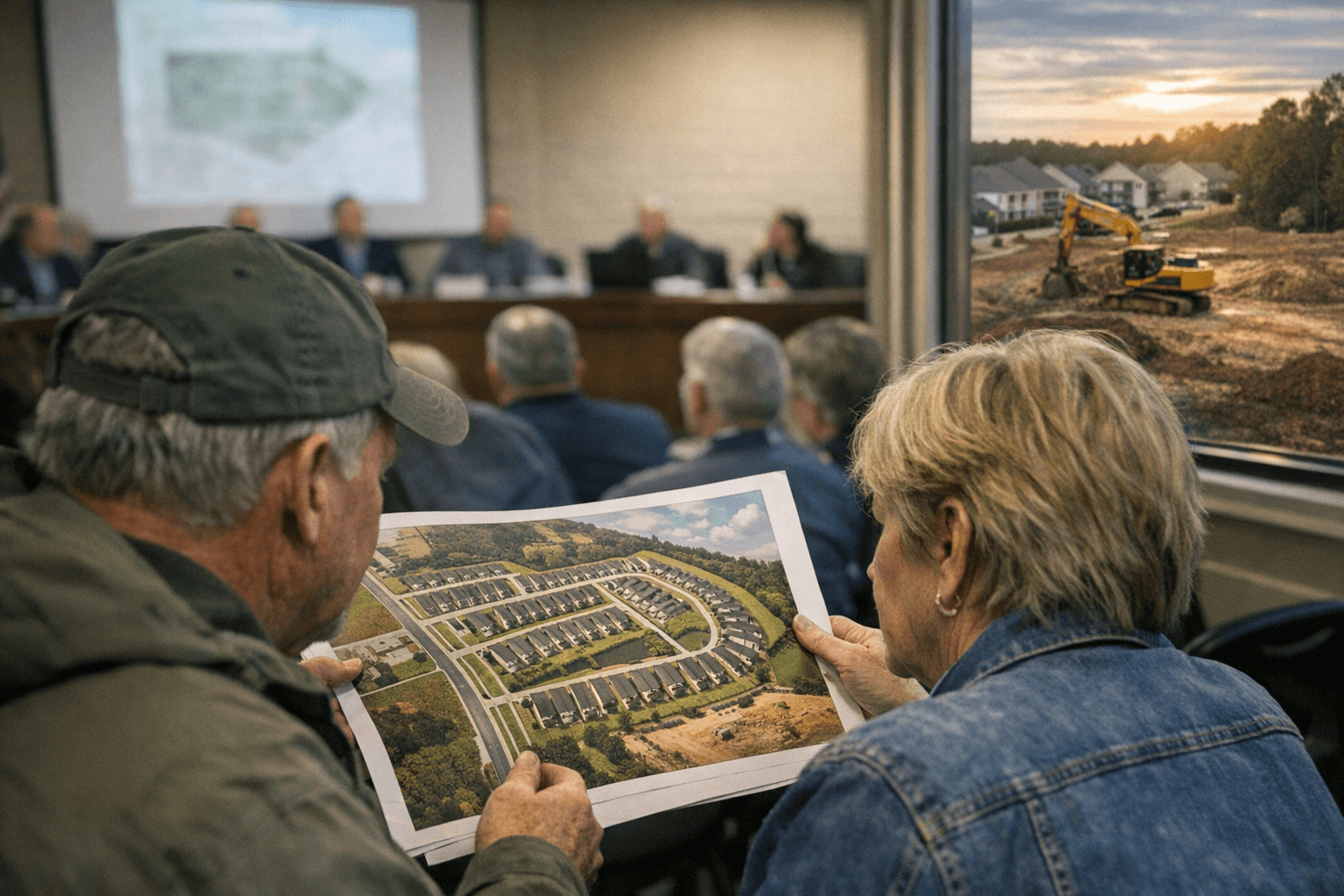
Four City Council members voted last month to put 82 homes on Gibson Road, and one did not. Councilmember Jonathan White cast the lone dissenting vote on the Oakview Cove subdivision, developed by Smith Douglas Homes, citing the absence of any public recreation space in the project. That single no vote is worth studying. In a city that has grown 164.5% since 2000 and added 1,981 new residents between 2020 and 2023 alone, every rezoning carries consequences residents can see coming months in advance — if they know where to look.
Why Mebane's Growth Makes This Urgent
U.S. Census Bureau data confirms Mebane grew 10.9% between 2020 and 2023, reaching 20,212 residents and making it the fastest-growing city in North Carolina's Piedmont Triad region. By 2026 the estimated population is 21,862, expanding at roughly 2.84% annually. The city has tripled in size since 1990, a trajectory few North Carolina municipalities match. Mebane's recorded population was just 218 in 1900; it crossed 2,000 by 1940 and now surpasses 21,000. Its position along the I-40/I-85 corridor, straddling both the Research Triangle and Piedmont Triad regions, draws residential and commercial developers continuously.
Recent proposals illustrate the pace: a proposed 565-home Preserve at Mill Creek development drew organized neighborhood engagement through late 2024 and early 2025; a large commercial corridor project near GKN Driveline along Trollingwood-Hawfields Road appeared before Council at its December 2, 2024 meeting; and in February 2025 the Planning Board unanimously recommended a conditional rezoning of 58.87 acres at 968 North First Street. That frequency means the window for effective public input is shorter than most people expect, and understanding the machinery ahead of time is the only reliable advantage.
The Planning Backbone: Mebane 2045 and the UDO
Two documents govern nearly every land-use decision in Mebane. The first is Mebane 2045, the city's current comprehensive land development plan, a yearlong update that established community goals and a long-range vision for growth. Staff reports on every rezoning petition routinely evaluate whether the request is consistent with this document. Citing Mebane 2045 by name during public testimony, and explaining whether a proposal aligns with or contradicts its stated goals, is one of the most effective tools available to a speaker at a public hearing. The city has also adopted separate long-range plans governing bicycle, pedestrian, and transportation infrastructure, all of which staff may reference in project evaluations.
The second document is the Mebane Unified Development Ordinance (UDO), maintained and enforced by the Planning and Zoning Department at 102 South 5th Street. The UDO governs all land use within the city's planning jurisdiction. Its Table of Permitted Uses is the first reference point for any parcel: uses labeled "Z" are permitted by right, uses labeled "CC" require a Special Use Permit, and anything outside those categories requires a full rezoning. Variances allow relief from specific UDO regulations when a property owner can demonstrate documented hardship.
How a Rezoning Moves from Concept to Vote
This is the core process, and each stage has a distinct deadline and a specific opportunity for public input.
1. Application and intake. A developer submits a complete rezoning application with associated fees to the Planning and Zoning Department at least three weeks before the Planning Board's monthly meeting date.
Missing this cutoff means a one-month delay, which gives tracking residents valuable advance notice once an application appears on the calendar.
2. Planning Board review. The Mebane Planning Board, a nine-member advisory body, meets on the second Monday of each month at 6:30 p.m. at City Hall, 106 E.
Washington Street. Board members review staff reports, hear public comment, and issue a recommendation: favorable, conditional, or negative. This stage is your first and often most consequential window. Proposals are frequently modified here before they reach the Council, making early engagement more productive than waiting for the final vote. Note that Orange County appoints one ETJ-area resident to serve on this board, giving cross-county projects representation from both sides of the Alamance-Orange County line.
3. Staff report and agenda packet publication. Before any public hearing, the city publishes an agenda packet containing the staff report, site maps, proposed ordinance language, and supporting exhibits.
These packets are posted on the city's website ahead of each meeting and represent the single most important document to read before attending. Look specifically for the staff's recommended motion, the consistency finding relative to Mebane 2045, and any proposed conditions.
4. City Council public hearing. The Council, led by Mayor Ed Hooks and managed by City Manager Richard J.
White, III, holds the final vote. This is a formal public hearing: residents may speak, submit written comment, and have their remarks entered into the official record. The Council may approve, deny, modify conditions, or return the item for additional review.
5. Recording and follow-through. Approved rezonings and development agreements are recorded at the Alamance County Register of Deeds.
Conditional-use permits and development agreements may also appear in county records. For projects affecting state right-of-way or requiring sewer and water approvals, additional filings appear with NCDOT and municipal utility boards. When infrastructure crosses jurisdictional lines, as it can for Mebane given its dual-county footprint, those additional sign-offs can extend project timelines significantly.
Where to Find Documents and Track Projects
The city maintains an interactive Development Map on its website that displays every active project from proposed rezoning through construction, with each entry linked to a public hearing case number. Use this map to identify projects in your neighborhood before they reach a hearing. For each project, the corresponding agenda packet and staff report will be posted to the city's website ahead of the relevant Planning Board or Council meeting.
For legal notice of upcoming public hearings, the Alamance News (alamancenews.com) publishes required notices and provides detailed coverage of Planning Board and Council decisions. Register with CodeRed by Crisis 24, Mebane's public notification system, and sign up for the city's municipal email list to receive meeting agendas and hearing notices automatically. City Clerk Stephanie W. Shaw, reachable at 106 E. Washington Street, is the correct point of contact for procedural questions about submissions and deadlines.
How to Give Effective Public Comment
The most impactful comments at public hearings share three qualities: they are specific, they are grounded in adopted city plans, and they arrive early in the process rather than at the final vote.
- State your name, address, and a single clear ask (approve, deny, or attach a named condition) within your first sentence.
- Reference Mebane 2045 or a specific UDO provision when your concern relates to land use compatibility or city vision goals.
- Cite sections of the staff report directly if you have traffic, environmental, or infrastructure concerns; it shows you have read the file.
- Keep remarks to two or three minutes; planning boards respond better to focused testimony than to general objections.
- Submit written comments and signed petitions to City Clerk Stephanie W. Shaw before the posted deadline so they enter the official meeting record.
- Bring evidence: photographs, traffic counts, and letters from engineers or other experts strengthen the record and can lead to required mitigation measures, noise barriers, landscaping buffers, or restricted delivery hours written directly into permit conditions.
Mini-Case: Preserve at Mill Creek
The proposed 565-home Preserve at Mill Creek development is a practical example for understanding red flags and the real influence of organized community engagement. Before the Planning Board hearing, the developer invited 65 neighboring property owners to community meetings on August 12 and December 9, 2024, and held a virtual session with the Mill Creek Homeowners' Association on January 7, 2025. When the Planning Board meeting arrived, a dozen residents testified. Neighbors including Rebecca Caison, Robert Reid, and Gary Linz acknowledged the developer's responsiveness to concerns raised in those earlier sessions, a public acknowledgment that documented results from pre-hearing organizing.
When reviewing a project of this scale, the staff report's red flags to check include: the traffic impact analysis (does it account for cumulative volume from other concurrent developments in the same corridor?), any school capacity letter from the relevant district, stormwater management and floodplain mapping, and the specific conditions staff recommends attaching to the approval. If a condition you consider essential is absent from the staff's recommended motion, public comment at the Planning Board stage, not the Council vote, is the correct moment to request it.
The ETJ Wrinkle
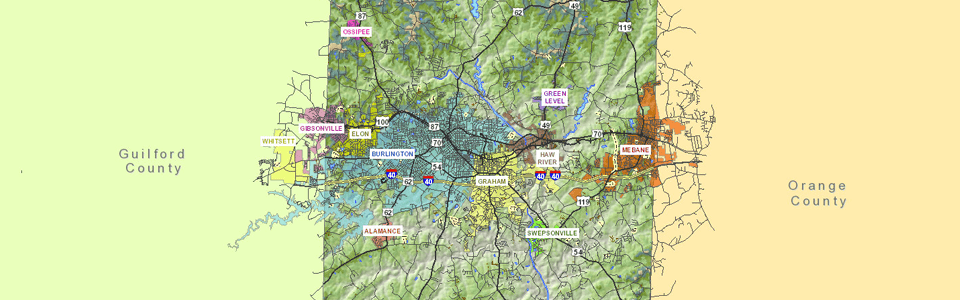
Mebane's planning jurisdiction extends beyond its formal city limits through an Extraterritorial Jurisdiction (ETJ) that spans parts of both Alamance and Orange County. ETJ residents are subject to Mebane's zoning rules and may participate in Planning Board proceedings, but should confirm their specific eligibility and representation structure with both the City of Mebane and Orange County directly. The cross-county geography also creates infrastructure complexity: when sewer lines, water extensions, or road improvements must cross jurisdictional boundaries, additional approvals from neighboring bodies are required and can delay project timelines in ways that are not always visible in a single council agenda packet.
The Formal City, the Active Opportunity
Mebane has been a formally incorporated city only since 1987, though its industrial history traces back to the White Furniture Company's founding in 1881 and a census count of just 218 residents in 1900. The planning apparatus that now processes subdivisions, commercial corridors, and infrastructure agreements is relatively young by comparison, and it remains genuinely responsive to organized, documented public input. The 4-1 Oakview Cove vote reflects a process that residents can engage at every stage: from the intake desk at 102 South 5th Street to the Council chambers at 106 E. Washington Street, the full record is public, the deadlines are posted, and the meetings are open.
This article was produced by Prism’s automated news system from verified source data, official records, and press releases, then run through automated quality and moderation checks before publishing. The system is built and supervised by the people who set the standards it runs under. Read our full AI policy.
Did this article answer your question?