Saxapahaw’s name links today’s village to its Indigenous past
Saxapahaw’s name preserves a Sissipahaw past beneath the village’s music-and-mill image. The Haw River community’s revival still sits on older Indigenous, textile, and environmental history.

Saxapahaw’s best-known identity, as a weekend river village with music, food, and canoe access, sits on top of a much older story. The name itself reaches back to a Sissipahaw town on the Haw River visited by John Lawson in 1701, long before the restored mill and ballroom turned the place into a destination. That makes Saxapahaw more than a brand: it is a living reminder of what came first, what followed, and what has been easier to see.
The name points to the river before the village

NCpedia’s account of the Sissipahaw places them in present-day Alamance County and says they were also known as the Saxapahaw in historical documents. It adds that some scholars think the Sissipahaw and Shakori may have been the same people, and that survivors of the early 1700s conflicts likely joined the Catawba Nation. Those details matter because the village’s name is not a decorative echo, it is one of the few widely visible links to the earliest recorded history of the Haw River corridor.
That history is easy to miss when the present-day village is framed mainly through concerts, kayaking, and the restored mill complex. But the name Saxapahaw carries the memory of a landscape that existed before textile power, before riverfront redevelopment, and before the village became a small but widely visited stop in western Alamance County. The community today is a census-designated place and unincorporated area, with a 2020 population of 1,671, so the scale of the place is small even if its public image travels far beyond its borders.
The mill era reshaped the river
The built village grew from the river economy that followed. John Newlin bought the old gristmill and adjoining land in 1829, then formed John Newlin and Sons with his sons James and Jonathan in 1844. That same year they began construction of a cotton mill, a one-story brick building measuring 50 by 200 feet, and by 1848 they were producing yarn. In 1859, the building grew by two more stories and weaving and dyeing were added, turning the site into a more complex textile operation tied directly to Haw River waterpower.
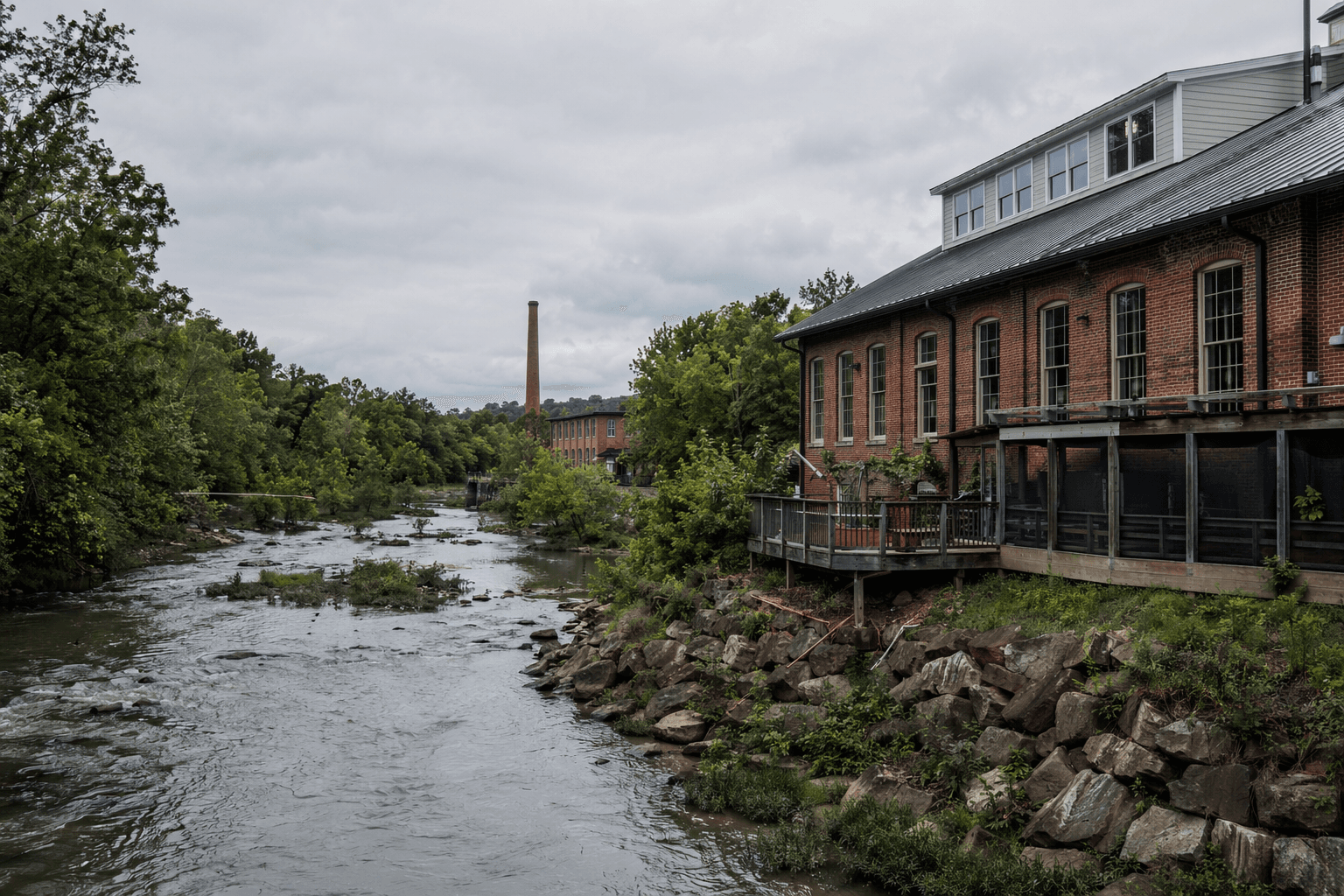
Newlin was more than a mill owner. NCpedia describes him as a merchant, industrialist, land speculator, abolitionist, and Quaker leader, and says he opposed slavery and worked with the Manumission Society of North Carolina. Later owners included textile pioneer Edwin M. Holt and Senator B. Everett Jordan, which shows how the site passed through different eras of North Carolina industry and influence. The Saxapahaw mill site shifted to hydroelectric power in 1938, then suffered tornado damage in 1994 and never resumed operations.
The rebuild that followed changed the physical meaning of the place again. Remodeling was completed in 2006, and the restored mill buildings now known as Rivermill house apartments, along with businesses, a school, and an event center. The old factory stopped being just a machine for making yarn and became a mixed-use village center, but the brick shell still carries the outline of its textile past.
What visitors see now
Today’s Saxapahaw is built around reuse. The Haw River Ballroom opened in 2011 after years of deconstruction and renovations in the former Dye House of the historic cotton mill. Its own history emphasizes three floors, a riverside deck and courtyard, and solar and geothermal power, all of which fit the village’s current image as a place where old industrial space has been recast for cultural life.
Heather LaGarde founded the ballroom, and the venue has hosted nationally renowned music artists and global events. The rhythm of that scene is part of what made Saxapahaw recognizable well beyond Alamance County. The Alamance County Visitors Bureau says Saturdays in Saxapahaw drew 1,000 to 1,500 people on each summer weekend for 16 years as of 2020, with about 400 bands applying each year for 17 booking slots. In a community of 1,671 residents, that kind of draw shows how thoroughly the village’s identity has become tied to a regional arts economy.

The Saxapahaw Museum adds another layer. The visitors bureau highlights a one-room schoolhouse that was used from 1929 to 1949 and a replica of Troop 65’s hut, which gives the village a more intimate archive than the ballroom or mill complex alone. Visitors also encounter the General Store, canoe access, and the restored mill buildings, all of which help explain why Saxapahaw is read as both a place to spend an afternoon and a place with a long memory.
How the village tells its own story
What Saxapahaw remembers most visibly is the sequence that led from mill to reuse. What is easier to overlook is how much older the place is, and how the Indigenous name remains attached to a landscape that later became a textile village, then an entertainment stop, then a symbol of adaptive reuse. The contrast is not subtle: one story is celebrated in concert schedules and restored brick, while the other lives mostly in historical records and the name itself.
That tension is part of why Saxapahaw matters within Alamance County. The county’s population was estimated at 186,177 on July 1, 2025, and Saxapahaw now occupies a small but visible place inside that larger growth pattern. The Haw River Assembly, founded in 1982 to restore and protect the Haw River and Jordan Lake, keeps attention on the river corridor as more than scenery. In May 2026, the organization reported that two proposed subdivisions could bring 956 homes near Morrow Mill and Austin Quarter roads, a reminder that the land around Saxapahaw is still being reshaped.
For a visitor, the most useful way to read Saxapahaw is to look at the layers in order. The name points to the Sissipahaw. The mill buildings point to John Newlin’s river-powered industry. The ballroom, museum, and riverfront businesses point to the village’s present-day reinvention. Taken together, they show a community that has become famous for what it built, even as the oldest part of its story remains embedded in the name on the map.
This article was produced by Prism’s automated news system from verified source data, official records, and press releases, then run through automated quality and moderation checks before publishing. The system is built and supervised by the people who set the standards it runs under. Read our full AI policy.
Did this article answer your question?