Albany County courthouse tells story of frontier funding and identity
Albany County’s first courthouse was built with private money, territorial politics and civic ambition, and its downtown site still anchors Laramie’s public life.
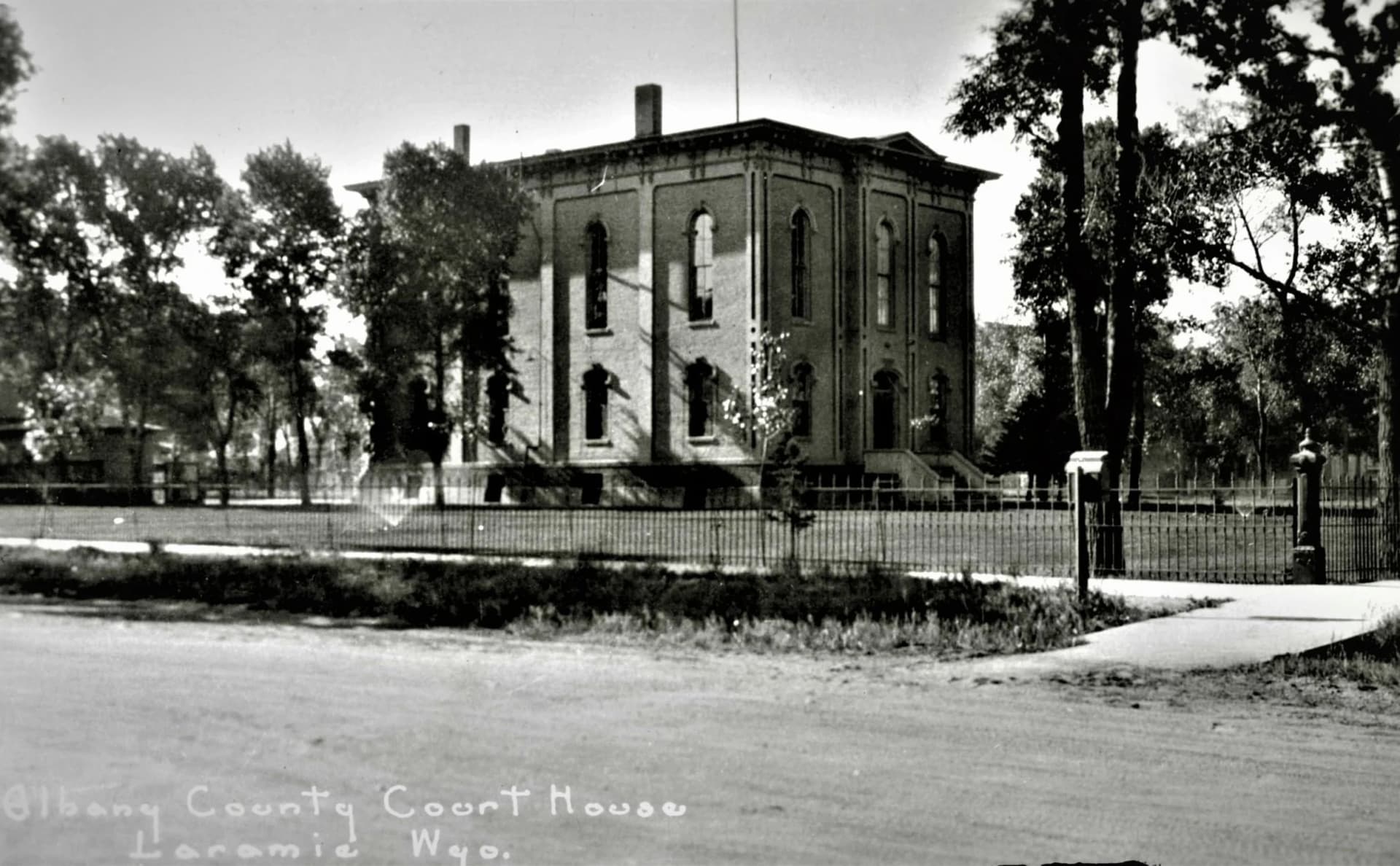
Albany County’s first courthouse was financed like a frontier project, not a modern public building. Before the county had mature bonding authority, banker and philanthropist Edward Ivinson fronted the money for the building that became the first courthouse in Wyoming Territory constructed specifically for that purpose.
How Albany County paid for government before modern finance
Albany County formed in 1868, just as Laramie was emerging as a regional center in the new territory. The county’s need for a courthouse came early, but the financial tools to build one did not. Ivinson stepped in as contractor and lender, effectively carrying the cost until the Wyoming Territorial Legislative Assembly passed a bonding act that allowed Albany County to repay him.
That arrangement makes the courthouse more than an old building. It shows how frontier government worked in practice: local power depended on personal credit, territorial law, and political relationships strong enough to turn a county’s need into a funded public project. Stephen Wheeler Downey and Melville C. Brown helped secure the bonding bill, tying the courthouse’s existence directly to territorial politics rather than to any settled system of county finance.
A courthouse built for the job, not adapted for it
The original building began with a cornerstone laid in 1871. It was functional by 1872, then formally dedicated after the county obtained bonding authority and could finish paying Ivinson back. Secondary courthouse histories describe the original structure as a two-story red brick building designed by Dupene and Gumry and constructed by Ivinson and Peter Gumry.
That detail matters because it separates Albany County’s courthouse from the improvisation common in early western settlements. A courthouse adapted from a store or hotel says one thing about a town’s priorities. A courthouse built from the start to house county government says another: Laramie was already organizing itself around law, records, taxation, and the daily machinery of public authority.
Stephen Wheeler Downey, who helped dedicate the building, gives the story another durable local link. He was an early territorial representative to Congress and one of the founders of the University of Wyoming, which ties the courthouse to the broader civic architecture of the state’s early years. Ivinson, meanwhile, later became one of Laramie’s major philanthropists, funding a hospital, a cathedral, a home for aging women, and an orphanage.
Why the same site still shapes downtown Laramie
The original courthouse stood on the same block that still holds the current Albany County Courthouse at 525 E. Grand Avenue. The original building was demolished in 1931, and the replacement rose immediately afterward on the same site, with sources placing construction in 1931-1932 and completion in 1933. That continuity is part of the story: the county did not move its civic center away from the downtown block that first concentrated its authority.

The location itself helps explain why the building remains so visible in daily Laramie life. Grand Avenue is not a remote governmental campus. It is part of the city’s working core, where county business, public memory and neighborhood traffic still meet in one place. The courthouse site links the earliest days of territorial administration to the place residents still use when they go downtown.
The courthouse block as a stage for justice and protest
The same block that once symbolized frontier institution-building later became a public stage for some of Albany County’s hardest moments. In August 1904, Joe Martin, an African-American man, was lynched from a light pole just across Grand Avenue from the courthouse. That killing stands as a grim reminder that the courthouse did not exist outside the racial violence and failures of justice that marked the era around it.
The site returned to the center of public attention during the Matthew Shepard case. Shepard was beaten on the night of October 6-7, 1998, and died at age 21. Russell Henderson and Aaron McKinney appeared in Albany County court in Laramie on October 9, 1998, and protests on the courthouse lawn were frequent during the court proceedings and sentencing in 1998 and 1999.
That history turns the courthouse lawn into more than a patch of grass. It became a place where the county’s justice system was watched, challenged and interpreted in public. For residents, the block is not only a landmark from the 1870s but a civic space where questions of violence, punishment and accountability were argued in view of the community.
What the courthouse says about Albany County identity
Albany County’s courthouse story belongs to the county’s wider record of early political firsts. The Albany County Historical Society timeline says Laramie saw the first women in world history serve on a jury in March 1870 and the first women in world history vote in a general election in September 1870. Those milestones place the courthouse in a county that was not just building government, but also testing the boundaries of who could participate in it.
That broader record helps explain why the courthouse remains such a useful lens on Albany County identity. It captures the county’s earliest fiscal improvisation, the role of private capital in public construction, the rise of territorial law, and the way one downtown block became a shared site for government, memory and protest. The building on 525 E. Grand Avenue is still doing what the first courthouse did in the 1870s: marking where county power lives, and showing how that power was financed, contested and made visible in Laramie.
This article was produced by Prism’s automated news system from verified source data, official records, and press releases, then run through automated quality and moderation checks before publishing. The system is built and supervised by the people who set the standards it runs under. Read our full AI policy.
Did this article answer your question?
