University of Wyoming’s WIRO powers nightly research on Jelm Mountain
Jelm Mountain’s familiar ridge hides a telescope UW uses every clear night, keeping Albany County connected to live astronomy, student training, and public tours.
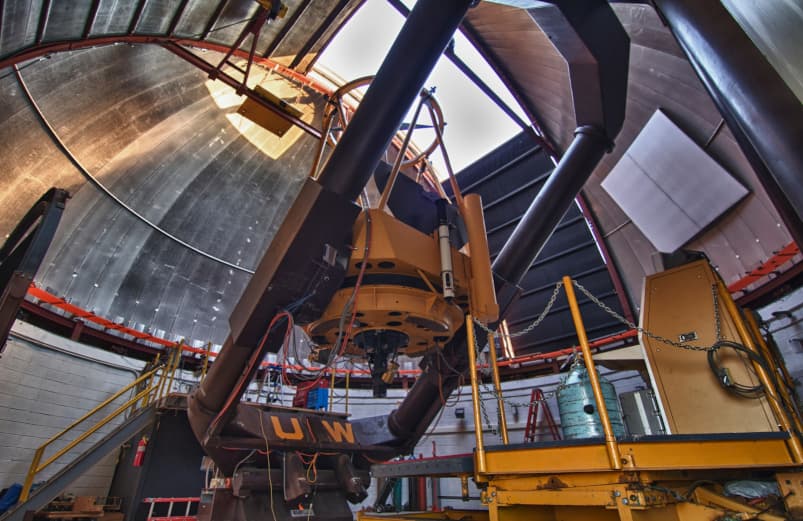
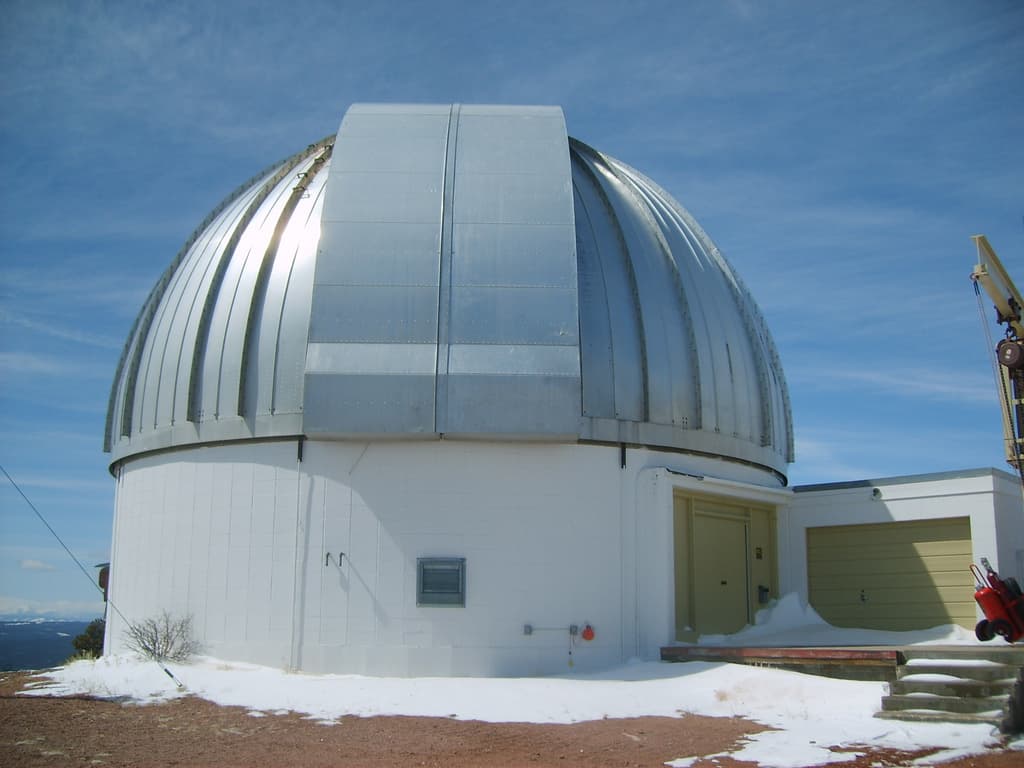
The lights on Jelm Mountain do not mark a scenic relic. They mark the University of Wyoming’s Wyoming Infrared Observatory, a 2.3-meter telescope sitting 9,656 feet above sea level about 25 miles southwest of Laramie, where UW says astronomers and students use it every clear night of the year. In Albany County, that makes WIRO less a mountain view than a piece of working scientific infrastructure, still feeding research, teaching, and UW’s public identity.
A mountain chosen for science, not scenery
WIRO was completed in 1977 and dedicated the following year, with University of Wyoming Board of Trustees minutes placing the dedication ceremony for July 28, 1978 at the Washakie Center. The location was chosen for the practical advantages astronomers still seek: dry air, low turbulence, dark skies, and proximity to campus. Built as a partnership between the University of Wyoming and the National Science Foundation, the observatory was designed from the start as a serious research tool, not a symbolic outpost.
Those choices still explain why the facility matters from Albany County’s perspective. Jelm Mountain gives UW a high-country research site close enough to remain tied to university life in Laramie, yet far enough above town to provide the observing conditions infrared astronomy needs. That combination has helped make WIRO one of the county’s least visible but most durable assets.
What makes WIRO unusual in the astronomy world
The University of Wyoming describes WIRO as the world’s first fully computer-controlled telescope, a distinction that still gives the observatory an outsized place in the history of modern astronomy. The university also says WIRO was briefly the world’s largest infrared telescope, and that it remains one of the largest observatories in the world by several measures. It is the second-highest professional observatory in the continental United States and the largest telescope owned and operated by a single institution.
The engineering behind it is part of the story too. UW says the telescope has about 60,000 pounds of moving mass and was built to be accurate to a few seconds of arc by a one-tenth-horsepower motor. That kind of precision is what allows a mountain-top facility in Albany County to collect data that still matters to researchers working on planets, stars, galaxies, quasars, and cosmology.
How the telescope serves University of Wyoming science
WIRO is not an isolated observatory doing one narrow kind of work. The University of Wyoming Department of Physics & Astronomy says its observatories support investigations ranging from planets and star formation to galaxies, quasars, and cosmology, and WIRO sits inside that broader pipeline of undergraduate, graduate, and faculty research. The telescope is used nightly by faculty and students, which means the site doubles as a laboratory and a training ground.
That educational role is easy to overlook from the highway, but it is central to what the observatory does. A faculty profile for Jordan M. Stone ties WIRO to instrument development, exoplanet detection, and planet formation, showing that the telescope still supports contemporary projects rather than only historical curiosity. For a university city like Laramie, that matters because the observatory helps keep astronomy research visible, active, and locally grounded.
Why Albany County should care if the lights ever went out
If WIRO stopped operating, Albany County would lose more than a mountaintop facility. It would lose a place where students observe, faculty test instruments, and the university demonstrates that world-class science can still happen just outside town. It would also lose a visible sign that the county’s geography continues to matter to higher education, federal research partnerships, and the reputation of the University of Wyoming.
WIRO is one of four observatories the university highlights for student research and public engagement, alongside Red Buttes Observatory, Apache Point Observatory, and the Star Observatory. That network helps show how the observatory fits into a larger institutional identity: not just a single telescope on Jelm Mountain, but part of a university-wide effort to connect research and public learning. In practical terms, that keeps Albany County on the map for visitors, students, and science-minded residents who understand that some of the university’s most important work happens outside the classroom.

A public-facing piece of local culture
WIRO also reaches beyond researchers. Public daytime tours are available by calling the University of Wyoming Department of Physics & Astronomy, and university event notices have tied WIRO open house programming to October campus events in 2021, 2023, and 2024. That pattern matters because it shows the observatory is not sealed off from the community; it is folded into campus life and, by extension, into Albany County’s public calendar.
That access helps explain why the observatory has become part of the county’s identity even for people who never use a telescope. Residents know Jelm Mountain as part of the landscape, but the University of Wyoming has made it part of something more consequential: a functioning observatory where the night sky still produces data, trains students, and sustains a research tradition that began in the 1970s and is still moving today.
This article was produced by Prism’s automated news system from verified source data, official records, and press releases, then run through automated quality and moderation checks before publishing. The system is built and supervised by the people who set the standards it runs under. Read our full AI policy.
Did this article answer your question?