Allendale County property taxes explained: how local bills are built
Allendale County bills begin with value, not a flat fee. The Assessor, Auditor and Treasurer each play a separate role, and the 4% rate can cut the bill sharply.
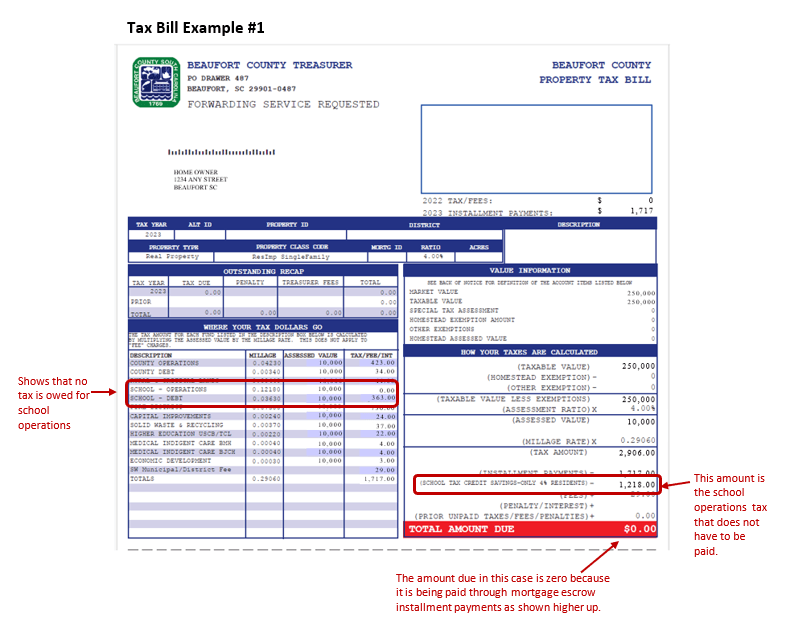
One mill equals $100 in tax for every $100,000 of assessed value on an Allendale County property-tax bill. The county’s Assessor, Auditor and Treasurer each handle a different part of the process, and the numbers on the bill depend on whether the property is a primary residence, how it is classified, and what millage is set by local taxing bodies.
How the bill is built
South Carolina property tax is built from three pieces: value, assessment ratio and millage. In plain terms, the county first determines what a property is worth, then applies the correct tax rate category, then multiplies that taxable value by the millage rate that funds local services.
The bill is tied to fair-market value rather than a flat household fee. Property tax helps pay for the local services people use every day, including schools, police and fire protection, and public libraries. In South Carolina, local governments administer and collect property tax with assistance from the state Department of Revenue.
A mill is the smallest unit in the formula. One mill equals 1/1000 of assessed value.
Who does what in Allendale County
The Assessor appraises real property, the Auditor maintains the property tax rolls and calculates individual property taxes, and the Treasurer collects the taxes. Allendale County’s office listings reflect that division, with the Assessor, Auditor and Treasurer listed separately.
In current county listings, Crystal Isham is the auditor and Valaree Chess Smith is the treasurer. The Assessor’s office is at the Allendale County Courthouse, 292 Barnwell Hwy., Allendale, SC 29810, and the office lists 803-584-2572 as its main phone number. If a tax bill seems off, value questions start with the Assessor, bill calculation questions with the Auditor, and payment questions with the Treasurer.
What the 4% rate means for a homeowner
For owner-occupied legal residences, South Carolina offers a 4% assessment ratio. That lower ratio can make a major difference because it reduces the taxable portion of the home’s value before millage is applied. The key catch is that the owner must apply with the county assessor to receive the lower residential rate.
Owner-occupied-dwelling documentation is required for the 4% special assessment ratio, and a misstatement can be grounds for denial. For a homeowner, that means the classification is not automatic just because the property is lived in full time.
The lower rate applies to a legal, full-time residence. If a home changes hands, changes use or is misclassified, the owner should not assume the 4% rate is already in place. The safest step is to confirm the filing with the Assessor before the next bill is issued.
The U.S. Census Bureau lists the county’s median owner-occupied home value at $76,200 for 2020-2024. At the 4% ratio, that home’s assessed value would be $3,048. From there, the millage rate determines the rest of the bill.
Why reassessment can change a bill
South Carolina reappraises real property on a countywide basis every five years, with a one-year extension allowed by county ordinance. In reassessment years, increases in fair-market value are limited unless an assessable transfer of interest occurs. A home does not simply get reset to a new sale price every time it changes hands.
Assessors cannot simply revalue property at the sales price after a sale in a non-reassessment year. A sale may trigger certain tax consequences, but it does not give the county free rein to ignore the reassessment rules.
If the bill changed because of a new assessment, ask whether the property was part of a reassessment cycle or whether an assessable transfer of interest occurred.
Where millage comes in
Millage is the rate applied after the property is assessed, and it is where local budgeting becomes visible on a household bill. County bills can include county base millage, school district millage and special district millage. The final number reflects multiple local levies, not a single countywide decision.
School funding is a major part of the picture. The Department of Revenue says approximately two-thirds of county-levied property taxes support public education. Qualifying owner-occupied residential property taxed at the 4% ratio is exempt from school property taxes.
Local tax credits can also affect the bottom line. Local option sales tax credit factors may reduce property tax bills in jurisdictions that impose a 1% local option sales tax.
Millage is not completely free-floating. Local governing bodies may raise operating millage only within a cap tied to inflation and population growth.
What to do if something looks wrong
If the value looks too high, start with the Assessor and ask how the property was appraised. If the 4% owner-occupied rate is missing, the problem is usually the application or documentation, not the millage. If the property is already classified correctly but the bill still looks off, the Auditor is the office that maintains the tax rolls and calculates the bill.
If the issue is payment or posting, the Treasurer is the right office to contact. Keep copies of the owner-occupancy application, any reassessment notices and prior tax bills. Claims for certain property-tax exemptions generally must be received within two years of when taxes were paid, so waiting too long can limit options.
The county was created in 1919 from parts of Barnwell and Hampton counties, and the U.S. Census Bureau shows a small county with 8,039 residents in 2020 and an estimated 7,355 on July 1, 2025. The U.S. Census Bureau lists a median owner-occupied home value of $76,200.
This article was produced by Prism’s automated news system from verified source data, official records, and press releases, then run through automated quality and moderation checks before publishing. The system is built and supervised by the people who set the standards it runs under. Read our full AI policy.
Did this article answer your question?