Allendale County Schools Struggle to Retain International Teachers Amid Visa Costs
"Some of my very best teachers are having to return to their countries," says Allendale County's superintendent as a new $100,000 H-1B visa fee threatens a quarter of her staff.

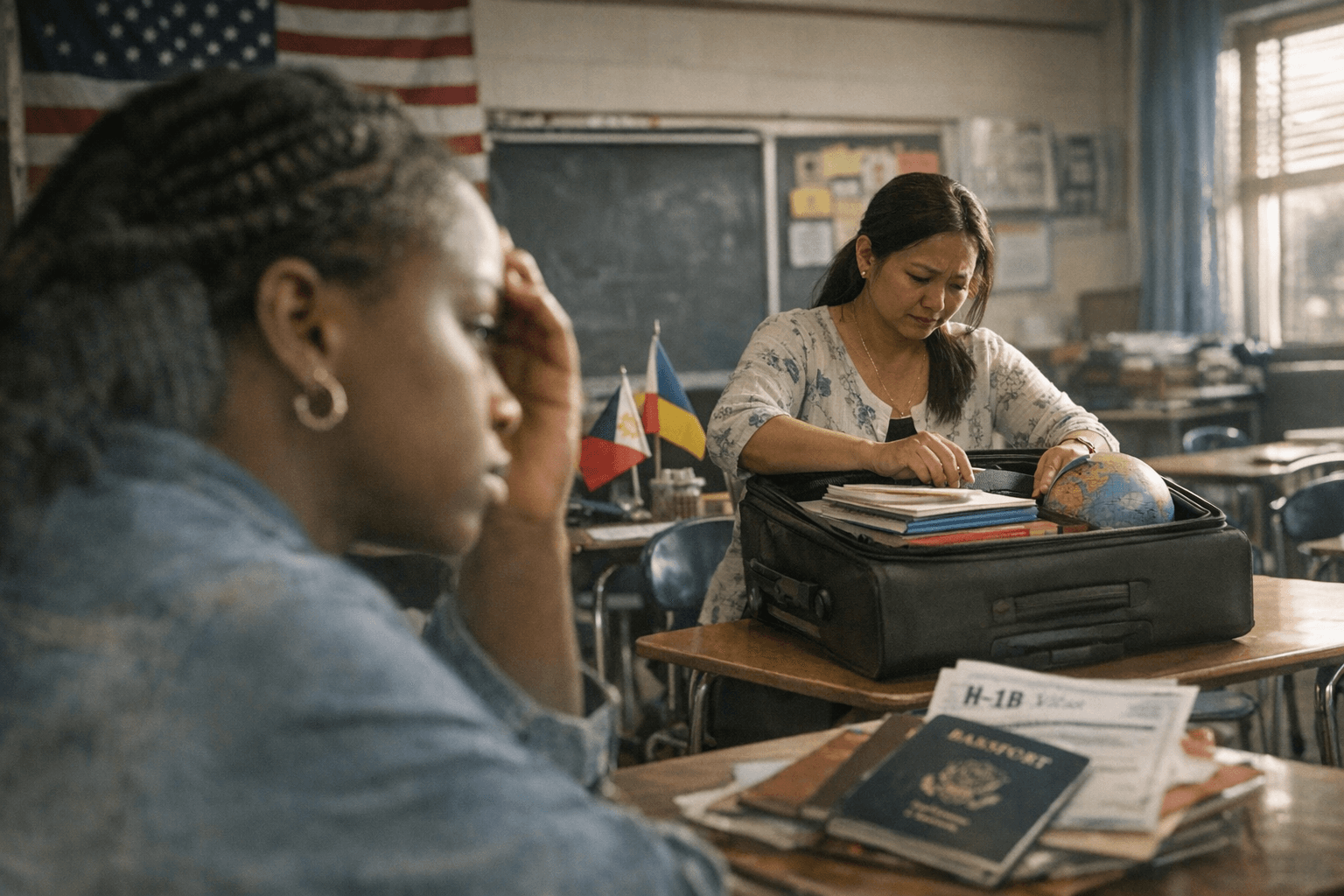
A quarter of the teachers in Allendale County School District come from other countries, and the Trump administration's visa policy changes are now putting that workforce in jeopardy. Superintendent Vallerie Cave says the newly announced $100,000 fee on H-1B visas, combined with deepening immigration uncertainty, has made it too costly and too risky to extend contracts for some of the district's international staff or recruit new international candidates.
"Some of my very best teachers are having to return to their countries," Cave said.
The stakes are concrete. International educators, drawn largely from Jamaica and the Philippines, fill classrooms in math, science, language arts, and special education across the rural, high-poverty district. Even before the new fee took effect, sponsoring a single international teacher cost between $15,000 and $20,000 annually, according to Cave. The $100,000 H-1B fee represents a cost increase that district leaders say they simply cannot absorb at scale.
The Trump administration has justified the fee by arguing that foreign workers displace American employees, citing particularly high-wage technology sectors. Critics counter that the policy ignores the reality facing districts like Allendale County, where international recruiting has long filled vacancies that domestic candidates do not apply for. A National Education Association analysis found that more than 2,300 educators currently work under H-1B visas across roughly 500 school districts nationally.
Carolyn Mitchell, the district's executive director of human resources, said one immediate strategy is to recruit international teachers already working in other school systems who hold J-1 visas and want to convert to H-1B status, a path the district believes could allow it to avoid the $100,000 fee. Whether that approach survives legal scrutiny remains an open question; the sources do not detail the precise mechanism by which such a conversion would sidestep the fee.
"You have to try to figure out every alternative way when you know that you may need people," Mitchell said.
For positions where the district could not pursue international replacements due to cost and uncertainty, a district official identified only as Sipe said administrators advertised openings early and succeeded in hiring local candidates. Sipe cautioned, however, that other school leaders are not optimistic they will replicate that outcome.
The district's international teachers work under a mix of H-1B and J-1 visa classifications. The research notes do not specify how many of those educators hold each visa type, nor does available reporting enumerate exactly how many contracts are currently at risk of non-renewal. What Cave's account makes clear is that the subject areas most dependent on international hires, including special education, are the same ones where rural districts already face the deepest domestic shortages.
This article was produced by Prism’s automated news system from verified source data, official records, and press releases, then run through automated quality and moderation checks before publishing. The system is built and supervised by the people who set the standards it runs under. Read our full AI policy.
Did this article answer your question?