Allendale County's Historic Sites Connect Residents to Community Heritage
Allendale County holds 14 National Register sites spanning 50,000 years of human history, from prehistoric chert quarries to a suffragist's cottage now serving as the Fairfax Public Library.
Formed in 1919, Allendale is South Carolina's youngest county, yet it contains the oldest known human habitation in the state. That paradox sits at the heart of what makes Allendale County's historic landscape so remarkable: a compact geography holding layers of human activity that stretch from deep prehistory through the Civil Rights era, all accessible to residents willing to look past the county's present-day economic hardships. Allendale County has 13 places on the National Register of Historic Places, including 3 places of national significance and 3 places of statewide significance. Each of those designations represents a thread in a story that belongs to everyone who lives here.
Prehistoric Foundations: The Topper Site and the Chert Quarries
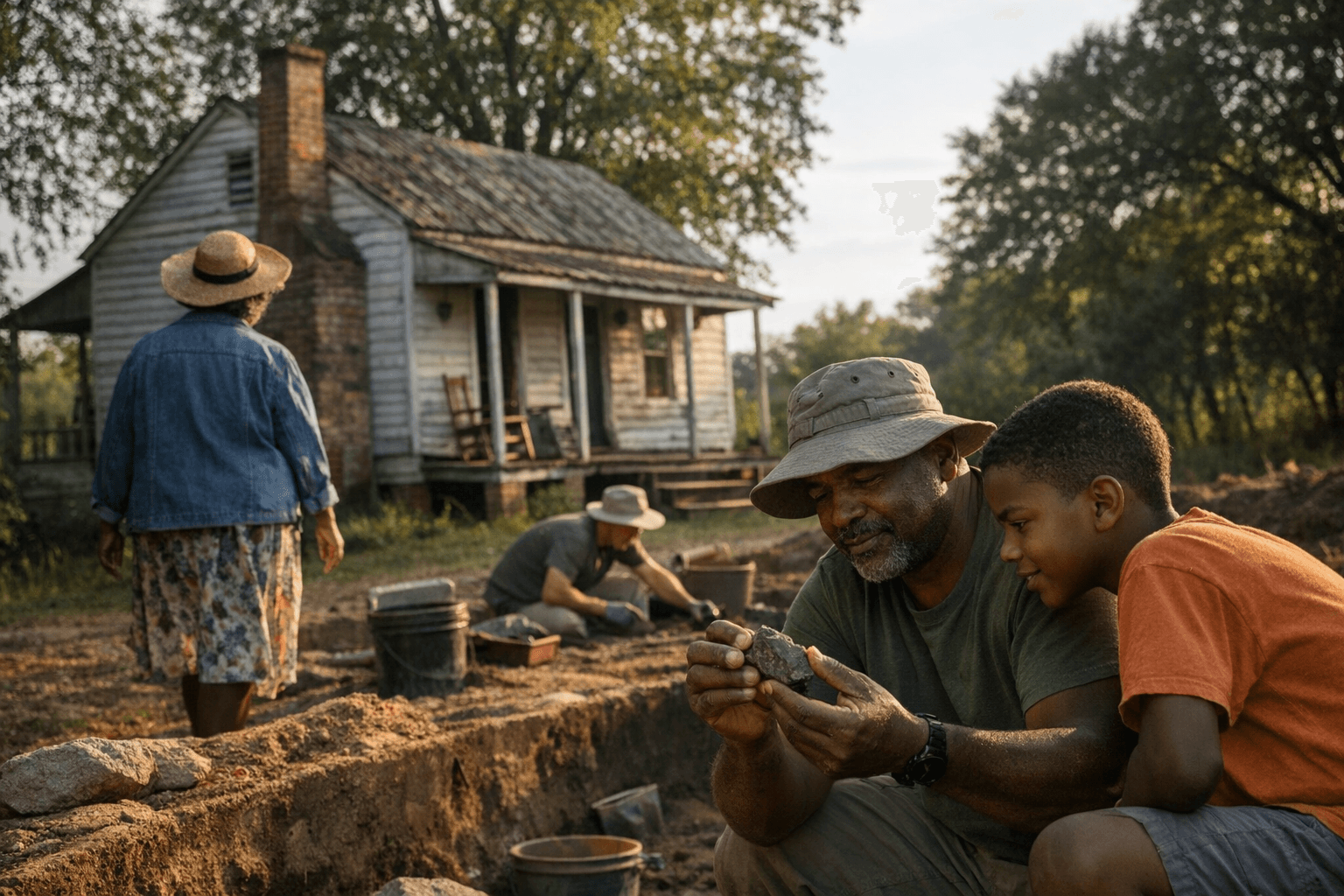
No place anchors Allendale County's identity to deep time more forcefully than the Topper Site, located near Martin. It is the location of an archeological excavation providing possible evidence of a pre-Clovis culture dating back 50,000 years. The site, named after John Topper, the tenant who discovered it, has been under excavation by archaeologists from the University of South Carolina for about one month a year since 1999, after an initial exploratory dig in the mid-1980s.
For most of its history, Topper's significance was confined to academic journals and field reports. That changed in December 2025, when USC Salkehatchie established a permanent Topper Site exhibit on the Allendale campus, offering the first public display of artifacts from the nationally significant Topper Site in Allendale County. The collection includes stone artifacts recovered from deeply buried deposits in sand and alluvial layers, material that has contributed to academic debate about early human activity in the Southeastern United States and questions about pre-Clovis occupation. Permanent public access to Topper materials supports curriculum development for USC Salkehatchie and local schools, creates opportunities for guided visits and classroom tie-ins, and increases the county's appeal to visitors seeking both heritage and research-oriented tourism.
Topper is not the only prehistoric site of significance here. Archaeological investigations in Allendale have found evidence of human settlement dating back more than sixteen thousand years, and these prehistoric people used "Allendale Chert" in making stone tools. The Allendale Chert Quarries Archaeological District, along with the Red Bluff Flint Quarries, both carry National Register recognition and represent a prehistoric industrial landscape that drew tool-makers from across the Southeast.
The Courthouse: Where County Government Was Born
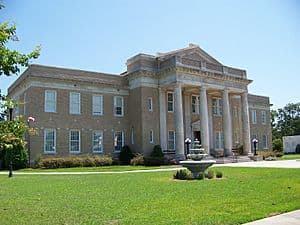
At the corner of Memorial Drive and Highway 278 in the town of Allendale stands a building that is, in a legal and civic sense, the county itself made physical. The Allendale County Courthouse, constructed in 1921-1922, is significant as the county's first and only courthouse. Allendale County, the last county established in South Carolina, emerged in 1919 from parts of Barnwell and Hampton counties, jurisdictions thought at the time to be too large to govern effectively.
It was built in 1921-1922 and is a two-story yellow brick and limestone-accented building with a central block with pedestaled pediment dominated by a monumental, unengaged, flat-roofed Neoclassical Revival portico. The courthouse was designed by the prominent architectural firm G. Lloyd Preacher and Company, which had offices in Augusta and Atlanta, making it a notable example of regional civic architecture by a firm with deep local roots.
The new building's construction was part of a larger project that included the overall reconstruction of the historic courthouse's interior and rehabilitation of its exterior, following a devastating arson fire that destroyed much of the building's interior on the morning of May 18, 1998. The interior's restoration, in plan and detail, is based upon the 1921 architectural drawings by G. Lloyd Preacher and Company. The result is a building that reads both as a faithful preservation of its founding era and a functioning seat of county government. Flanking one side of the courthouse is a large flag pole and a granite obelisk monument dedicated to the citizens of Allendale County who fought in World Wars I and II, the Korean War, and the Vietnam War.
Faith Communities and the Fabric of Rural Life
No landscape feature is more embedded in Allendale County's rural identity than its churches, many of which predate the county itself by a century or more. Europeans began arriving in the area in the 1750s, settling at Matthews Bluff on the Savannah River and Jackson's Branch, a tributary of the Salkehatchie; other families settled along the headwaters of the Coosawhatchie and its tributaries, and in 1759 they organized Coosawhatchie Church, which became Beech Branch Baptist Church.
After the Revolution, the area became more settled, with Baptists, Lutherans, and Methodists each establishing churches in the vicinity. Great Salkehatchie Baptist Church at Ulmer was organized in 1790. St. Nicholas Lutheran Church was founded around 1800. A log building housed Swallow Savannah Methodist Church around 1816. The buildings of Smyrna Baptist Church, organized in 1827, and Antioch Christian Church, organized in 1833, remained standing at the start of the twenty-first century.
Antioch Christian Church carries National Register status, as does Smyrna Baptist Church, located south of Allendale on South Carolina Highway 22. The Smyrna Baptist Church is a historic church building located south of Allendale on South Carolina Highway 22, and like Antioch Christian Church, it represents an important part of the community's heritage. Taken together, these congregations document the religious geography of a county shaped by frontier settlement, agricultural economy, and deeply rooted community bonds.
The Virginia Durant Young House: A Suffragist's Legacy in Fairfax
On U.S. Route 278 in Fairfax stands a modest but historically consequential structure: the Virginia Durant Young House, now home to the Fairfax Public Library. The Virginia Durant Young House, also known as Fairfax Public Library, is a historic home located at Fairfax, Allendale County, South Carolina. It was built in 1881 and is a 1.5-story frame, weatherboarded, vernacular Victorian cottage with a gable roof.
The woman behind the designation lived a life that punched far beyond the county's boundaries. During her lifetime, Virginia Durant Young was a journalist, novelist, humanitarian, political activist, and internationally recognized leader of the women's suffrage movement in South Carolina and the nation. She was an editor and owner of the Fairfax Enterprise newspaper and was the first woman elected to the State Press Association; she worked with Susan B. Anthony as a suffragist.
The Youngs left their home and vast collection of books to the Town of Fairfax as a library. They also contributed the seed money for the Allendale County Hospital, stipulating that it must be located in Fairfax. The house was listed on the National Register in 1983, and its continued function as a public library gives it a daily civic relevance that few historic structures can claim.
Plantation-Era Sites and Antebellum Architecture
Prominent architectural styles found in Allendale County are Late Victorian, Classical Revival and Greek Revival, a trio that maps almost directly onto the county's plantation-era building stock. Gravel Hill Plantation is a large historic property located at 3954 Augusta Stage Coach Road and carries National Register recognition, as does Roselawn, known locally as the Lawton House. The Colding-Walker House, also known as Robwood, is a historic home found near Appleton on South Carolina Highway 52 and was added to the National Register in 1998.
Several additional plantation properties, including Belfast Plantation, Butterfield Plantation, Creek Plantation, Erwinton Plantation, and Grimkie Plantation, round out a landscape that tells a complicated and deeply layered story about land, labor, and wealth in the antebellum Lowcountry. These sites demand engagement with the full history of the people who lived and worked on them, not only the families whose names appear in deeds.
Along the Savannah River: Matthews Bluff and Burton's Ferry
Allendale County's western boundary is the Savannah River, and several historic sites cluster along its banks where geography shaped settlement and conflict alike. The Pipe Creek Light Horse, a patriot cavalry force consisting of men from what came to be Allendale and Hampton Counties, established a camp at Matthews Bluff; in March 1779, patriots fleeing the disastrous Battle of Brier Creek in Georgia floated on logs or swam across the Savannah River, and their commander, General John Ashe, took refuge at Matthews Bluff. In April 1781, the Battle of Wiggins Hill near Burtons Ferry ignited bloody conflict among neighbors.
Today, Burton's Ferry Bridge and the Lower Savannah River Alliance walking trail give residents and visitors a way to access this stretch of river where Revolutionary-era history played out. The trail connects landscape to memory in one of the county's most historically charged corridors.
The Allendale County Library and Little Miss Arnold's Schoolhouse
The Allendale County Library houses a collection of photographs and Indigenous American artifacts, making it a practical starting point for anyone tracing local history. The original building was Allendale's high school, adding another institutional layer to a structure that has served the community across generations. Miss Arnold's Schoolhouse, a short distance from the courthouse, documents the county's early educational history and the individual teachers whose work shaped generations of students.
A County That Rewards Deeper Looking
Topper feeds a broader long-term trend: growing public appetite for deep-time stories that connect modern communities to ancient landscapes. For Allendale County, the site is a tangible thread linking local identity to prehistory and a lever for educational programming in schools and museums. The same is true of the county's broader historic inventory. The courthouse grounds, the suffragist's library in Fairfax, the Revolutionary-era river bluffs, the pre-Civil War churches still holding services today — each site operates as a specific, verifiable connection between the present and a layered past.
Allendale County was formed in 1919 from southwestern portions of Barnwell County, along the Savannah River, and part of Hampton County, just to its south. For a county barely a century old by legal definition, it carries an extraordinary depth of documented human presence. Protecting and interpreting that presence is both a civic responsibility and one of the county's most durable assets.
This article was produced by Prism’s automated news system from verified source data, official records, and press releases, then run through automated quality and moderation checks before publishing. The system is built and supervised by the people who set the standards it runs under. Read our full AI policy.
Did this article answer your question?