Fairfax Train Depot Reflects Allendale County’s Railroad-Era Origins
Fairfax’s old depot is still doing civic work, not just looking historic. It now doubles as a senior center, tying railroad-era memory to a present-day public asset.
A depot that still serves the town
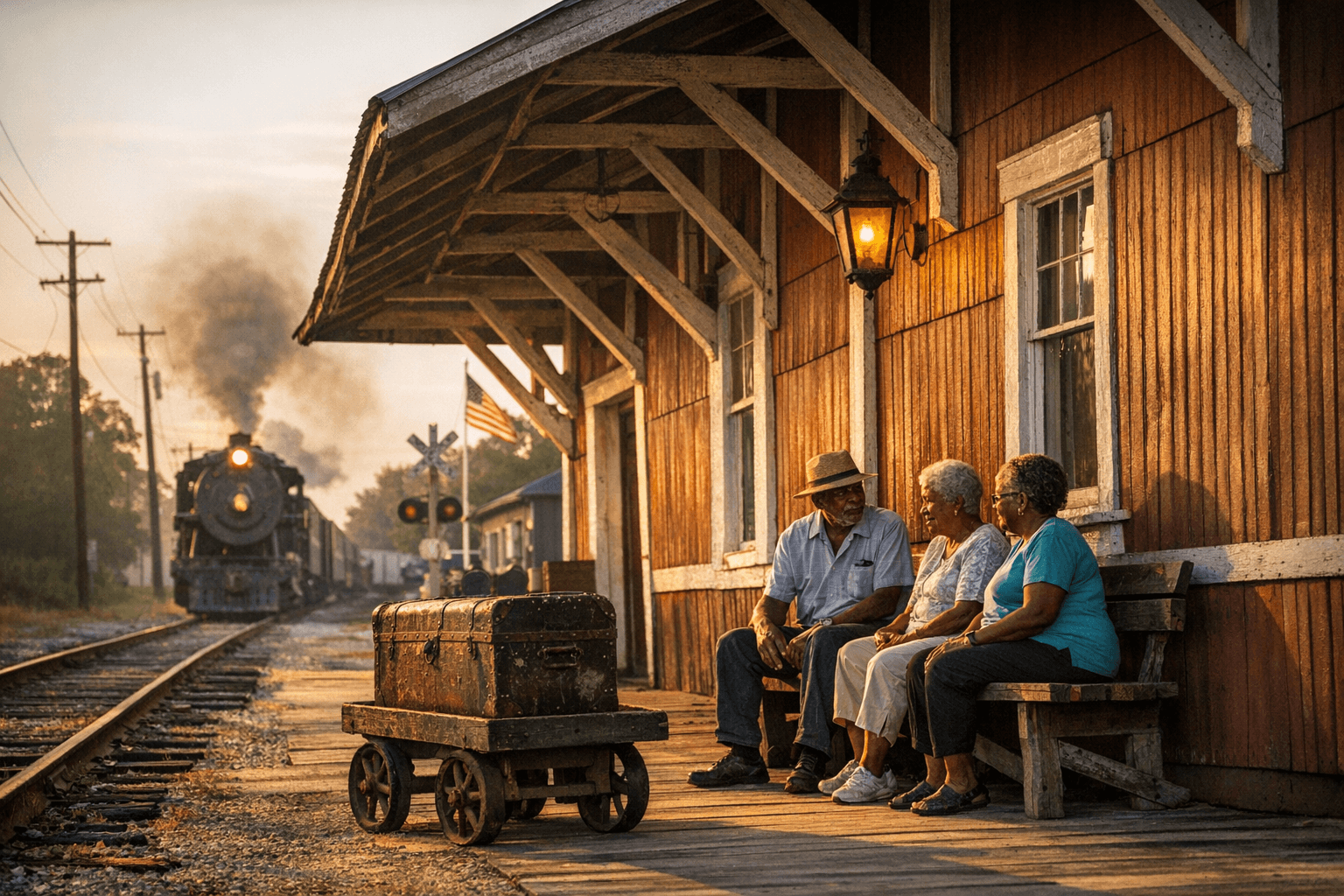
The Fairfax Train Depot is one of the clearest places where Allendale County’s railroad past still has a daily purpose. Standing along Pickens Avenue in Fairfax, the late-1800s building is not simply preserved as a relic: it is used as a senior citizen community center, giving the old station a second civic life.
That matters in a county where public buildings have to justify their upkeep by doing real work. Fairfax’s depot connects the town’s origin story to present-day use, turning a landmark into a gathering place for older residents, community meetings, and town events.
How the railroad shaped Fairfax
Fairfax did not begin as a railroad town, but rail lines gave it the form it still carries. Before 1880, the settlement centered around Owen’s Store and Bethlehem Baptist Church, with at least six families living there. Around 1870, the first postmaster was appointed and the post office was called Sanders.
The Port Royal Railroad changed the town’s direction when it began operating through Fairfax in 1873. The train stop became known as Campbellton Station, and later, when the South Bound Railroad crossed the earlier line in 1891, that crossing became the center of Fairfax. Local tradition says a child drew the name “Fairfax” from a hat belonging to a railroad official, an image that captures just how casually and yet decisively a town’s identity can be shaped.
Fairfax received its first charter on December 26, 1893. It was incorporated in 1896 and rechartered on May 16, 1898. By the 2020 census, the town’s population was about 1,622, small enough that each public building still matters in a very direct way.
What the depot does now
The strongest argument for preserving the depot is not nostalgia, but function. The county describes the building as a senior citizen community center, which means the structure is still part of the town’s active civic infrastructure. In a place like Fairfax, that kind of reuse matters because a landmark that stays open can keep serving the same community that once built its life around the rail lines.
A 2019 report on the town’s senior and community center project added more detail about how the building was expected to work in practice. Councilman Albert Sauls said the project had been underway for about three years, and that the building was being designed to preserve the feel of the original structure while keeping it in the middle of town so everyone could feel included. He said it would seat about 280 people, or a little over 350 standing, giving Fairfax a flexible venue for everyday use and larger gatherings.
The same report said the center would not be limited to one age group. Tiffine Forester said she was excited that both youth and seniors would have a place to gather, underscoring the building’s role as a shared civic space rather than a single-purpose preservation project.
Who pays for it, and why that matters
Public dollars are part of the story here. Funding for the senior and community center project came from the Penny Sales Tax and state funds, which means county and state taxpayers helped turn the depot into a usable community asset. That is important because it shifts the conversation from preservation alone to public return.
In practical terms, the question for Allendale County is not whether the depot is old enough to deserve saving. It is whether the building continues to produce value. The answer, based on its current use, is yes: it supports senior programming, can host voting and banquets, and gives Fairfax a central place to gather. Those are measurable civic uses, not just symbolic benefits.
A town built around more than rails
The depot is only one part of a broader Fairfax story that still shows up in the town’s layout and institutions. After the railroad era took hold, businesses clustered around the junction, and that helped create the commercial Fairfax that still sits at the meeting point of U.S. Highway 321 and U.S. Highway 278. Bell Telephone lines reached the town in 1906, another sign that Fairfax’s growth followed infrastructure and connectivity rather than chance.
Local history also highlights figures who shaped civic life well beyond the depot. F. M. Young built the first brick store and operated a telephone company, electricity generator, and cotton gin. Virginia Durant Young, known as a suffragette, author, and editor of the Fairfax Enterprise in the 1890s, shows how the town’s influence reached into print culture as well as commerce. Dr. W. J. Young left a bequest that helped fund Allendale County Hospital, with the condition that it be in Fairfax, linking philanthropy directly to place.
Town leadership also reflects a broader story of change. Quillie Devore served on the Fairfax Town Council from 1969 to 1990 as the first African American on the council, and Olivia Cohen served as mayor from 1987 to 1995 as an African American woman. Those milestones matter because they show Fairfax’s civic identity has evolved far beyond its railroad origins while still retaining the buildings and street pattern that first defined it.
Why the depot still resonates
The Fairfax Train Depot endures because it does two jobs at once. It preserves the railroad-era origins that shaped the town’s name, its growth, and its geography, and it also gives present-day residents a working place to gather. In a county with a small population and a strong attachment to local institutions, that combination is what makes a historic building worth keeping alive.
This article was produced by Prism’s automated news system from verified source data, official records, and press releases, then run through automated quality and moderation checks before publishing. The system is built and supervised by the people who set the standards it runs under. Read our full AI policy.
Did this article answer your question?