Apache County Board Meeting Turns Hostile as Wind Project Debate Erupts
Residents shouted threats at Apache County supervisors demanding a wind halt that would forfeit $31.5M in projected county tax revenue as the Springerville coal plant nears its 2027 closure.

Booing and shouted threats from the public gallery interrupted an Apache County Board of Supervisors session in St. Johns, where the board had just voted unanimously to terminate County Engineer Anthony Bowler before sitting through sustained public demands for a moratorium on wind and solar development — a pause that would put at risk $31.5 million in projected county property tax revenues and more than $146 million in state school trust payments tied to just one developer's two proposed projects.
The February 3, 2025 meeting exposed the fiscal and political fault lines opening beneath Apache County as the Springerville Generating Station's two coal-fired units march toward a 2027 retirement. Property taxes from that plant have historically funded local schools, road maintenance, and public services. Three days after the BOS session, the Apache County Planning and Zoning Commission ordered staff to place wind energy zoning amendments on its next meeting agenda, a signal that the moratorium pressure was not going away.
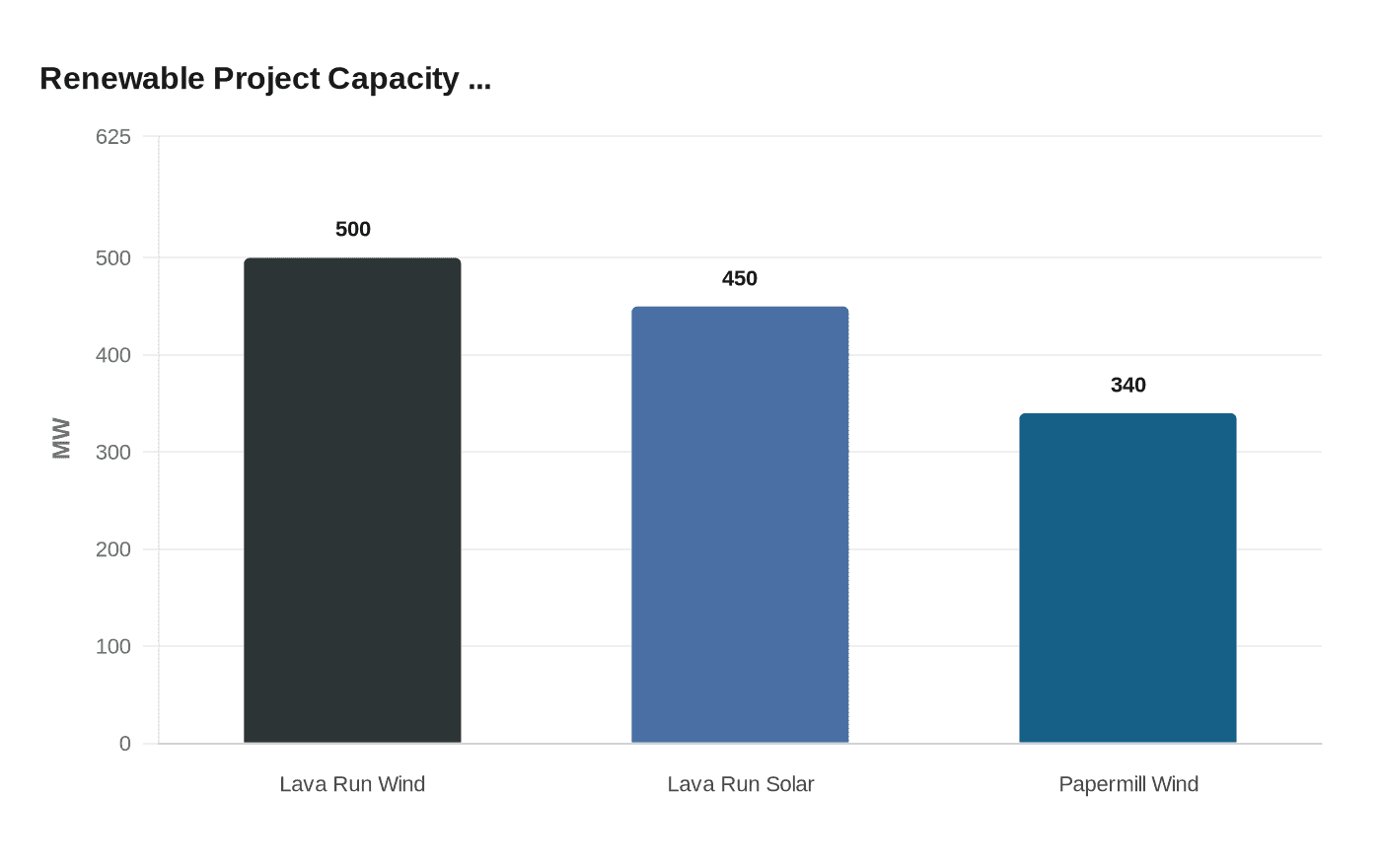
The projects at the center of the fight represent a combined capital outlay of roughly $2.1 billion. Repsol Renewables, a Spanish multinational that has been collecting wind data from six devices across the site since 2019, is developing the 500-megawatt Lava Run Wind Project along approximately 10 miles of U.S. Route 60 between Vernon (mile marker 370) and Springerville (mile marker 380). A companion 450-megawatt Lava Run Solar Project on Arizona State Trust land adds $1.1 billion more. Together, Repsol projects the two facilities would power more than 190,000 Arizona homes annually, generate $31.5 million in new Apache County property tax revenue over 35 years, contribute $373,000 in construction-phase sales taxes, and send more than $146 million in state land lease payments toward K-12 public education and Arizona universities. Triple Oak Power's Black Ridge Renewable Project and BluEarth Renewables' 340-megawatt Papermill Wind Project near Herber-Overgaard, owned by a Canadian company, add further scale to what developers describe as the county's renewable replacement economy.
The opposition has genuine local leadership but mirrors a documented national pattern. Save Arizona White Mountains and the affiliated AZ White Mountains Save Open Spaces have organized residents around concerns about scenic corridors along U.S. Route 60 and State Route 61, where travelers currently see pronghorn and volcanic mesas. Hundreds turned out to an Arizona Corporation Commission Line Siting Committee hearing at the Springerville Airport. Monica Boehning, a Round Valley resident who has become the opposition's most detailed technical voice, challenged reliance on average wind speed maps, arguing that gusts above 55 mph force turbines to shut down, and raised concerns about transmission infrastructure costs for projects sited far west of existing grid connections. Of Repsol specifically, Boehning said the company is "trying to get by with doing less than the bare minimum required in the permitting process."
Turbine cut-out speeds at high winds are a real engineering consideration, and the transmission cost argument deserves scrutiny from county planners. But Arizonans for a Clean Economy warned that proposed rule changes to Apache County's wind ordinance, Article 750, could "functionally ban wind energy by making development infeasible," effectively delivering the moratorium opponents want through regulatory means rather than a formal vote. The group also noted that wind and solar carry no ongoing fuel costs and that solar uses 140 times less water than coal-fired generation, a figure that carries weight in a county where aquifer protection was also raised as an opposition concern.
The Columbia Law School Sabin Center tracks this fight as part of a national wave of local wind restrictions. In January 2025, Tama County, Iowa enacted a wind moratorium and was promptly sued by developer Salt Creek Wind, LLC — a precedent that signals what formal action in Apache County could invite. With no county engineer in place and a P&Z commission now formally queued to debate zoning changes, the board faces pressure from both directions: proceed and absorb the political heat, or pause and absorb the legal and fiscal consequences.
This article was produced by Prism’s automated news system from verified source data, official records, and press releases, then run through automated quality and moderation checks before publishing. The system is built and supervised by the people who set the standards it runs under. Read our full AI policy.
Did this article answer your question?