Atchison’s Amelia Earhart home anchors historic river bluff neighborhood
Start at the Earhart birthplace on Atchison’s Missouri River bluff, then follow a walkable district where aviation history and downtown preservation still shape the town’s identity.

Amelia Earhart’s home is more than a museum stop in Atchison. It is the anchor for a river-bluff neighborhood where a single afternoon can connect the Earhart story, downtown architecture, and the town’s long habit of turning local history into something visitors can actually walk.
Begin at the birthplace house
The clearest starting point is the Amelia Earhart Birthplace Museum, the Victorian home built in 1861 by Earhart’s grandfather, Judge Alfred G. Otis. The house sits on a bluff overlooking the Missouri River, and the setting matters as much as the biography: this is where Earhart was born and raised, in the southwest bedroom on the second floor. Trinity Episcopal Church of Atchison records place her birth on July 24, 1897, and the National Park Service says she considered Atchison her hometown even after living elsewhere.
That personal geography gives the house unusual force. It is one of the few tangible links to Earhart’s life, and the restored interior helps visitors see her story as something rooted in a real neighborhood, not just a famous name. Visit Atchison describes the museum as restored to its turn-of-the-century condition and filled with exhibits on her life, flights, and legacy.
Follow the district, not just the house
The stronger walk is the one that expands beyond the front door. The Amelia Earhart Historic District was listed on the National Register of Historic Places on February 1, 2002, and the Kansas Historical Society says the district reflects the varied architectural tastes of Atchison’s early residents. The district includes architecturally significant buildings dating from 1860 to 1928, which gives the route a layered feel rather than a single-theme stop.
That range is what makes the district matter to Atchison today. You are not only looking at one woman’s birthplace, you are moving through a preserved river town that still shows how wealth, taste, and civic ambition were expressed over several decades. For residents showing out-of-town guests around, that mix turns the district into a ready-made argument for why Atchison’s historic core still deserves attention.
Read the streets like an architecture walk
Visit Atchison says the town is home to more than 47 buildings listed on the National Register of Historic Places, and the downtown area includes Richardsonian Romanesque, Italianate, and Second Empire architecture. Those styles give the walk its visual rhythm. Richardsonian Romanesque buildings bring the heavy stone and rounded arches; Italianate structures are more restrained and vertical; Second Empire buildings add the distinctive rooflines that make a block stand out.
That means the district is useful even if you are not a dedicated aviation fan. A slow walk reveals how Atchison presented itself during its growth years, and the Earhart home becomes part of a larger civic landscape rather than a standalone shrine. The district’s value is practical as well as symbolic, because it packages a compact lesson in local preservation that can be experienced without leaving town.
Connect the neighborhood to the river and downtown
The birthplace’s bluff-top setting makes it easy to pair the district with nearby downtown and riverfront stops. The Missouri River is part of the story here, and so are the streets that lead back toward Downtown Atchison and the Atchison Riverfront. The result is a route that feels like a real afternoon in town rather than a formal tour.
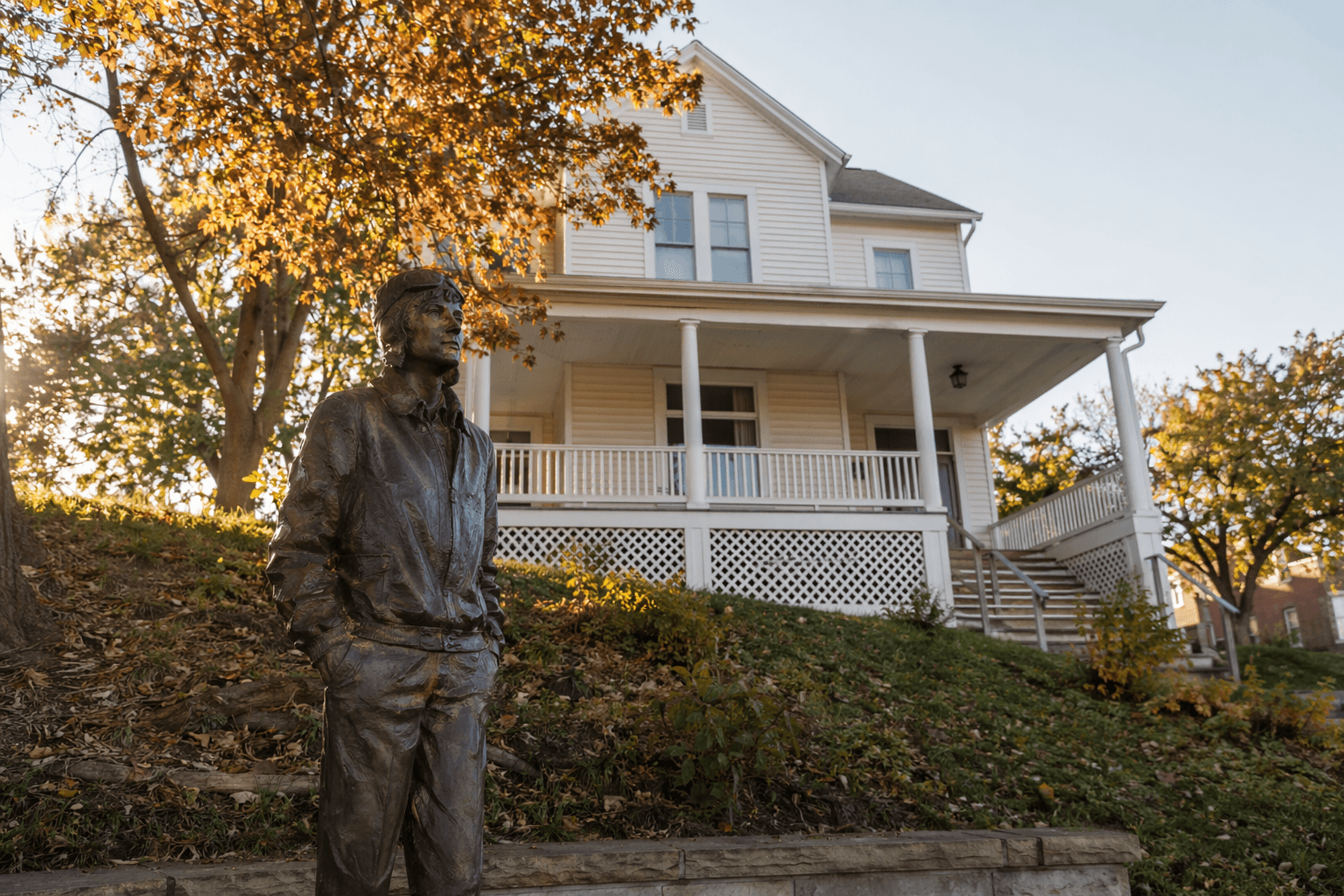
That local geography helps explain why the Earhart story endures in Atchison. Her family home sits close enough to the river to remind visitors that the town grew from a specific place, with a specific view, in a specific era. For residents, it is also a neighborhood identity marker, the kind of place that makes it easy to explain Atchison to relatives, school groups, and first-time visitors in a way that sounds lived-in rather than promotional.
The museum is tied to a larger women-pilots legacy
The birthplace museum is owned and operated by The Ninety-Nines, the international women-pilots organization Earhart helped found in 1929 and served as its first president. That matters because it keeps the site connected to aviation history in an active way, not just as a memorial to one pilot. Earhart’s role in founding the group gives Atchison’s museum a direct line to a broader national story about women in flight.
That connection also deepens the appeal for visitors who care about civic heritage. The house is not only where Earhart began; it is also part of a living institutional legacy that still gives the site purpose. For Atchison, that helps turn heritage tourism into something more than nostalgia, because the museum links a hometown figure to an organization that still carries her influence forward.
The district still matters on the festival calendar
Atchison is not treating Earhart history as static. Visit Atchison says the 29th Annual Amelia Earhart Festival is scheduled for July 17-18, 2026, and the 2026 Amelia Earhart Pioneering Achievement Award is going to astrophysicist Duilia De Mello. That shows the town continues to use Earhart’s name to frame public celebration, recognition, and visitor interest.
The festival also helps explain why the district remains economically and culturally relevant. It gives Atchison a recurring reason to draw people downtown, back toward the birthplace house, and into the larger historic setting that supports tourism year after year. When a town can combine a National Register district, a museum owned by The Ninety-Nines, and a major annual festival, the result is a heritage asset with real civic value.
What a good afternoon in Atchison looks like
A practical visit starts at the birthplace museum, moves through the historic district, and then continues into downtown where the architecture gives the town its visual signature. Along the way, the Earhart story stops being abstract and becomes place-based, tied to the 1861 home, the 1897 birth record, the Missouri River bluff, and the block-by-block character of the neighborhood around it.
That is why locals keep pointing guests to this part of town. The Earhart district is one of Atchison’s strongest shared identity assets because it combines a nationally known name with a walkable historic setting and a downtown that still rewards looking up. In a town built on river, memory, and preservation, the Earhart home remains the clearest place where all three meet.
This article was produced by Prism’s automated news system from verified source data, official records, and press releases, then run through automated quality and moderation checks before publishing. The system is built and supervised by the people who set the standards it runs under. Read our full AI policy.
Did this article answer your question?