Farmington Christian Church marks 1897 rebirth after frontier beginnings
Farmington Christian Church rose from a 1867 schoolhouse gathering to a 1897 rebuilt sanctuary, and it is now set to carry Bleeding Kansas history into the county’s rural present.
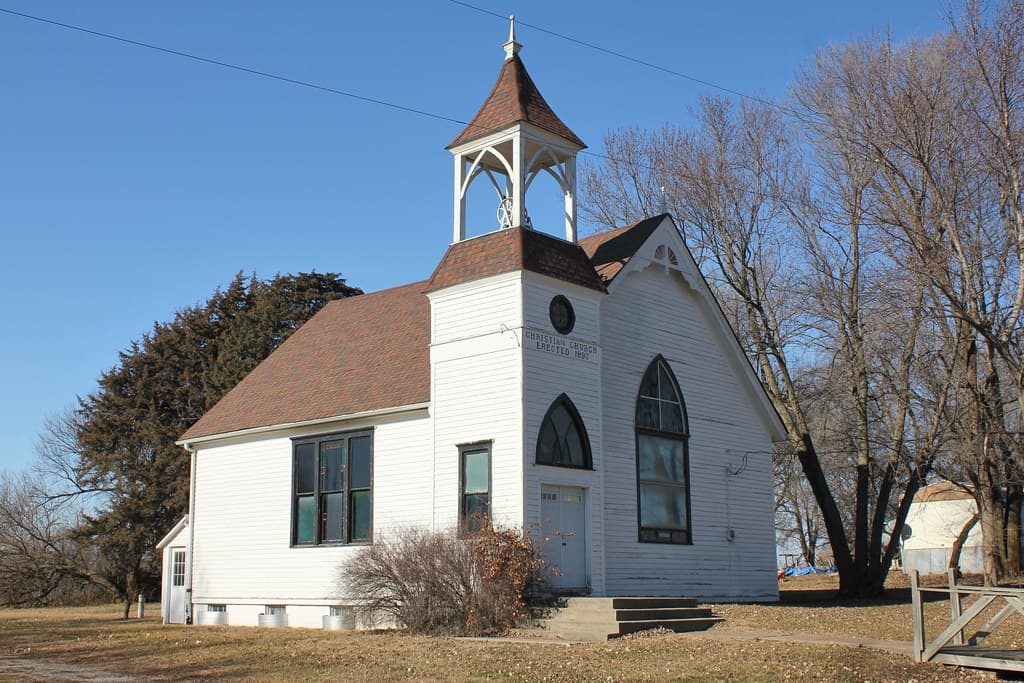
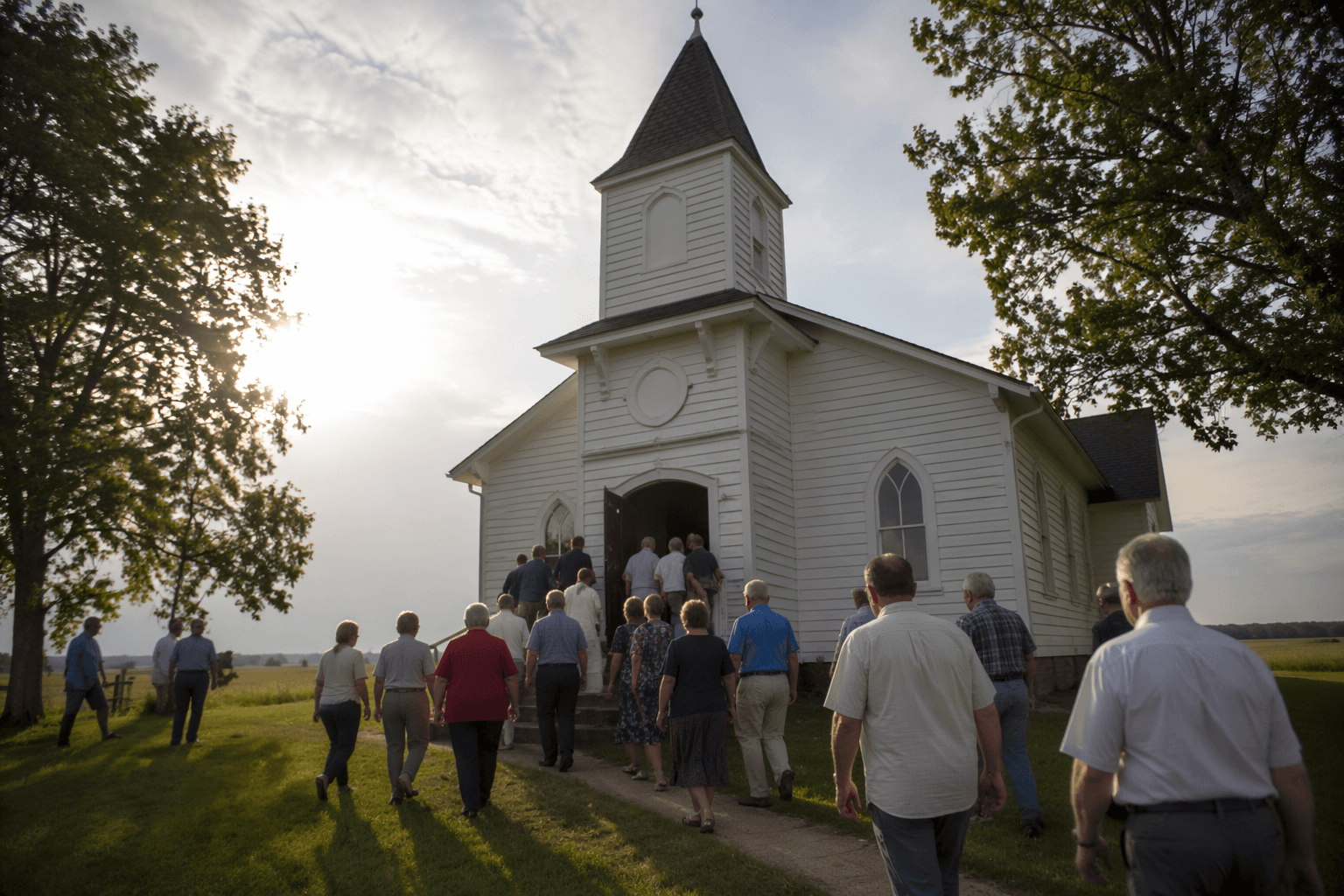
Farmington Christian Church ties Atchison County’s rural life to one of Kansas’ most hard-fought chapters. What began with 23 charter members meeting in a district schoolhouse in 1867 later grew into a church that counted 222 members by 1890, then rebuilt itself in 1897 with donations, labor, and determination that still shape the site’s meaning today.
A frontier congregation that took root in Farmington
The church’s first chapter began on Oct. 6, 1867, through the efforts of Elder Pardee Butler, with members drawn from families that became fixtures in the Farmington area. The Atchison County Historical Society timeline names the Johnsons, Butlers, Mays, Campbells, McElvans, Allisons, and McBrides among the founding families, and it identifies Butler and David Johnson as the first elders, with J.B. McCleary serving as the first evangelist.
That early roll call matters because it shows the church was never just a brief stop on the way west. By 1890, membership had climbed to 222, a number that points to a settled rural community with enough continuity to sustain worship, leadership, and gathering over time. In a county where churches often doubled as social anchors, Farmington Christian Church became a place where local identity and frontier memory took shape together.
The story also starts with where people met: the local district schoolhouse. That detail grounds the church in the practical realities of post-territorial Kansas, where congregations often began in borrowed rooms before they had a building of their own. The shift from schoolhouse to sanctuary would become one of the site’s defining marks.
The 1897 rebirth that put the building back on its feet
After the church ceased functioning in 1892, Farmington’s congregation reorganized in 1897 with 15 charter members. From there, the rebuilding moved quickly and with the kind of local cooperation that still defines rural communities in Atchison County.
A church and building committee took shape, Wm. Gillen agreed to donate lots, and the railroad company donated rock for the foundation. The congregation raised $240 for construction, a modest sum that still reflects the scale of the effort for a small rural church. The contract went to J. L. Jones for $1,000, giving the rebuild a concrete price tag and a clear sense of the investment required to restore worship on site.
The timeline records the work step by step: the foundation was finished on Sept. 5, 1897, the first regular business meeting in the unfinished building was held on Oct. 3, and Rev. T. M. Meyers led dedicatory services on Oct. 20. Those dates are more than archival markers. They show a congregation determined to meet, organize, and dedicate its space even before the building was fully complete, which says as much about the people as it does about the structure.
That 1897 rebirth is what gives the church its present-day force. The building is not simply a relic from the past. It represents a second beginning, one carried out by neighbors, donors, and church members who treated the place as worth rebuilding after the congregation had gone dormant. In a county shaped by small towns, farm roads, and family networks, that kind of persistence still resonates.
Pardee Butler’s story gives the church its broader Kansas meaning
Farmington Christian Church is inseparable from Pardee Butler, whose life connected this corner of Atchison County to the politics and violence of Bleeding Kansas. The Kansas Historical Society says Butler came to Kansas Territory in 1855, settled along Stranger Creek near Farmington, and became an abolitionist minister. His role in the region was not symbolic. He lived the conflict that defined the territory and then stayed in it long enough to help shape what came next.
The same history recounts the notorious 1855 incident in which pro-slavery men forced Butler onto a crude log raft on the Missouri River. He survived, and his later work helped organize the Republican Party in Kansas. He also remained important to the Christian Church in the West until his death on his Farmington farm in 1888.
That arc matters in Farmington because it gives the church a human link to the Free-State struggle. Butler was not a distant name attached to a plaque. He lived nearby, preached in the territory, and spent his final years in the same rural landscape where the church later rose and rebuilt. For residents, that makes the site more than a denominational landmark. It is a place where local ground and state history meet.
Why the site still matters on the ground now
The Atchison County Historical Society says Farmington Christian Church will serve as a rural extension with exhibits about the Bleeding Kansas era and Butler’s role in the early Kansas Free-State movement. That plan gives the church a second life that reaches beyond Sunday worship and into public memory, helping anchor a story that can otherwise feel distant from daily life in northwestern Atchison County.
The preservation angle is especially important because the church connects two versions of rural Kansas at once. One is the settlement era, when families met in a schoolhouse and built a congregation from scratch. The other is the county’s present-day identity, where people still value places that make local history visible without having to leave town or drive to a museum in a larger city.
What remains compelling about Farmington Christian Church is how physical the story is. The 1897 dates, the donated lots, the railroad rock, the $240 raised by members, the $1,000 contract, and the Oct. 20 dedicatory service all point to a building that was assembled through local effort. Paired with Butler’s abolitionist legacy and the early Free-State struggle, the church now stands as a marker of both perseverance and memory.
For Atchison County, that combination gives the site unusual weight. It is a rural landmark, a rebuilt congregation, and a direct line to Bleeding Kansas, all on the same ground.
This article was produced by Prism’s automated news system from verified source data, official records, and press releases, then run through automated quality and moderation checks before publishing. The system is built and supervised by the people who set the standards it runs under. Read our full AI policy.
Did this article answer your question?