Farmington church preserves Atchison County’s Bleeding Kansas history
Farmington Christian Church turns a rural building west of Atchison into a Bleeding Kansas stop, tying Farmington to Atchison County’s shared frontier story.
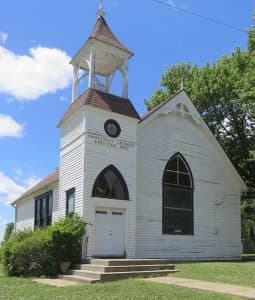
Farmington Christian Church gives Atchison County a historical stop that is easy to overlook if you stay in the county seat. About 12 miles west of Atchison, the church now stands as a rural extension of the Atchison County Historical Society, with exhibits planned around the Bleeding Kansas era. That makes the building part of a countywide story, not just a church restoration in a small agricultural town.
Why Farmington belongs in the county story
Bleeding Kansas is often told through the better-known landmarks in Atchison, but Farmington shows how deeply that conflict reached into the county’s rural communities. The historical society describes the church as one of the most historically significant buildings in Atchison County, and that framing matters because it widens the map beyond the river town and its downtown museums.
Farmington’s place in the story also reflects how frontier communities formed. Churches were more than places of worship in 19th-century Kansas: they served as meeting points, social anchors, and places where political and religious lines often overlapped. In that setting, a church exhibit about Bleeding Kansas does more than preserve one building. It explains how settlement, belief, and conflict shaped the county’s identity from the ground up.
A building with two layers of history
The church’s own timeline helps explain why the site has such staying power. The congregation was organized and started by pioneer minister and Kansas legend Pardee Butler on October 6, 1867, when the site was known as The Church of Christ. That founding date places the congregation squarely in the post-war frontier period, when the state was still absorbing the social and political fallout of the Bleeding Kansas years.
The present building is newer. A separate historical record identifies the current Farmington Christian Church structure as having been constructed in 1897. That distinction matters for visitors and local historians alike: the congregation’s origins reach back to the immediate aftermath of Bleeding Kansas, while the building itself reflects a later era of community continuity in rural Atchison County.
Preservation moved from concern to action in 2024
The preservation effort around the church is not a casual one. In January 2024, Friends of Farmington Christian Church, a group made up of Atchison County citizens and former church members, began the process of saving what the historical society calls one of the county’s most historically significant buildings. The work is tied to collaboration with the Atchison County Historical Society, which has positioned the site as a rural extension of its mission rather than a stand-alone project.
That partnership gives the building a future beyond repair work alone. A restored or stabilized church can still function as a local landmark, but the historical society’s approach adds interpretation, context, and a reason for people to stop in Farmington instead of passing through on the way to somewhere else. For county history, that shift is important because preservation becomes a way to keep the rural half of the story visible.
What visitors can actually connect to today
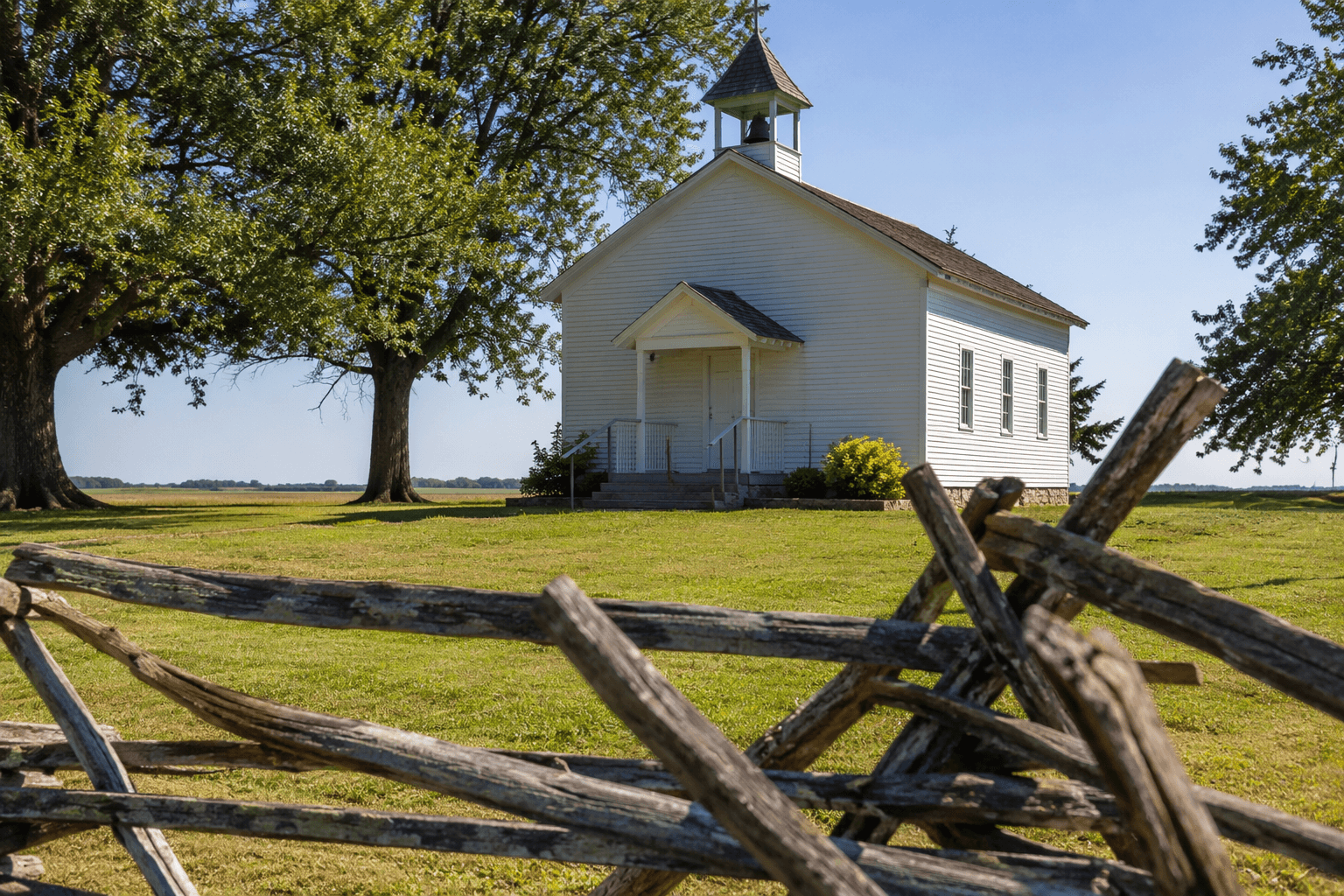
The most immediate value of the site is that it gives residents and visitors a place to stand while thinking about a countywide conflict that can otherwise feel abstract. Farmington sits in the small agricultural landscape west of Atchison, and the church makes that landscape part of the heritage route. Instead of treating Bleeding Kansas as something that happened somewhere else, the site anchors it in a place people can still visit and point to on a county map.
The historical society’s Farmington Christian Church page says the church will serve as a rural extension of the society and offer Bleeding Kansas exhibits. That is a practical promise, not just a preservation slogan. It means the site is meant to help teachers, family-history researchers, heritage travelers, and longtime county residents understand why Farmington belongs in the same historical conversation as the county seat.
A public event points to continuing interest
Public interest in the church is already visible on the county calendar. The historical society promoted a Farmington Christian Church event for Saturday, October 11, 2025, from 1:00 PM to 4:00 PM at 5628 Hodgeman Rd. in Farmington. The posting framed the gathering as a celebration of the church’s historic Kansas legacy, showing that the preservation effort is not locked away in a filing cabinet or a private project. It is being presented as something the public can see and support in person.
The historical society also lists a contact email, gowest1854@gmail.com, and a phone number, 913-367-6238, on its website. Those details matter because they show the project is being run as a community-facing effort, with a clear path for people who want to follow the site’s interpretation work or ask about its future.
Why this place matters now
At a time when small rural communities can disappear from public memory, Farmington Christian Church keeps one part of Atchison County from being flattened into a downtown-only history. The site shows that the county’s Bleeding Kansas legacy did not stop at the city limits of Atchison, and that the institutions that survived were often the ones rooted in the countryside.
That is why the church’s role as a rural extension of the Atchison County Historical Society matters. It gives the county a place where local identity, preservation, and frontier history meet in the same building. For Atchison County, remembering Farmington is not a side note to the larger story. It is part of what makes the story complete.
This article was produced by Prism’s automated news system from verified source data, official records, and press releases, then run through automated quality and moderation checks before publishing. The system is built and supervised by the people who set the standards it runs under. Read our full AI policy.
Did this article answer your question?