Oak Mills, Atchison County lost community traced through old maps and records
Oak Mills is long gone as a town, but old maps, cemetery lists and a county history still place it in Walnut Township along the Missouri River.
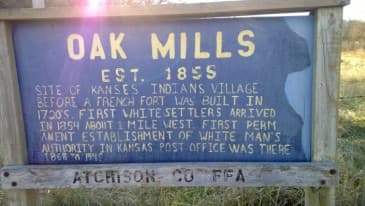
Old maps, family records and township histories still pin Oak Mills to Walnut Township along the Missouri River, where a river landing and a railroad stop once gave the place its reason to exist. Oak Mills is gone as a conventional town, but it never disappeared from Atchison County’s paper trail.
How Oak Mills was reconstructed
The Chapman Center for Rural Studies at Kansas State University included Oak Mills in its Lost Kansas Communities project. Hannah Grape’s December 19, 2013 report is titled Mosaic of a lost community: Oak Mills, Walnut Township, Atchison County, Kansas 1855-1945, and that date range gives the place its full arc, from early settlement to its fade from everyday prominence by the mid-20th century.
The report draws on historical journal references, genealogical archives, investigative local folklore, maps spanning several decades and photographs, along with the author’s own knowledge of the site. Oak Mills survives most clearly in records after it stops functioning as a visible town center. The Lost Kansas project places it within a wider pattern in rural Kansas, where communities can vanish from the commercial map but remain legible in county documents.
Where it sat, and why it mattered
Oak Mills stood in Walnut Township in Atchison County, Kansas, along the Missouri River. River access shaped settlement in northeastern Kansas, and Oak Mills fit the same logic that built many small communities in the county: transportation, trade and land use clustered where water and movement met.
The place was also on the Missouri Pacific Railroad, which added a rail connection to its river geography. River and rail made Oak Mills part of the transportation network that mattered in the county’s settlement era, even if the town later faded as routes, habits and local commerce shifted elsewhere.
Atchison County was organized in 1855, the same year range that opens the Oak Mills report. An 1880 Kansas State Gazetteer entry put the county at 409 square miles, or 261,760 acres, with a population of 16,770 and the county seat at Atchison.
Names that keep the place on record
One of the most useful surviving traces of Oak Mills is the county’s own naming of residents. Cutler’s Atchison County history lists John M. Blankenbeker in Walnut Township with “P. O. Oak Mills,” and says he came to Kansas in December 1870 and located at Oak Mills, where he lived thereafter. The entry shows Oak Mills functioning as a postal and residential marker, a place name that still organized daily life years after initial settlement.
Blankenbeker links a household to a township, a post office and a specific settlement pattern.
Cemetery records preserve the place in another way. Searchable burial lists tied to Oak Mills identify four cemeteries there: Hays Cemetery, Sacks Family Cemetery, Sapp Cemetery and Zacharias Cemetery. Small remote cemeteries in the county often have incomplete records.
What Oak Mills tells Atchison County now
The town name remains visible in old township references, in family listings, in cemetery files and in the layered maps historians used to piece it together.
The Missouri River has always shaped settlement, movement and risk in Atchison County. River communities in Atchison County were built in a landscape that rewarded access and punished overconfidence, and Oak Mills belonged to that geography. Its surviving records, from railroad alignment to burial grounds, show how land use shifted.
This article was produced by Prism’s automated news system from verified source data, official records, and press releases, then run through automated quality and moderation checks before publishing. The system is built and supervised by the people who set the standards it runs under. Read our full AI policy.
Did this article answer your question?