Santa Fe Freight Depot Museum links Atchison’s railroad past and present
The depot still turns Atchison’s rail history into a working stop, with a museum, visitor center, and downtown gateway tied to the town’s railroad identity.
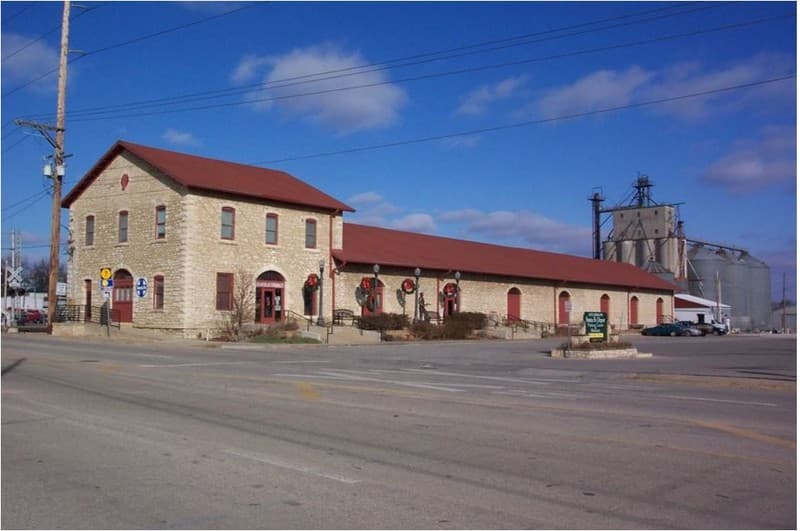
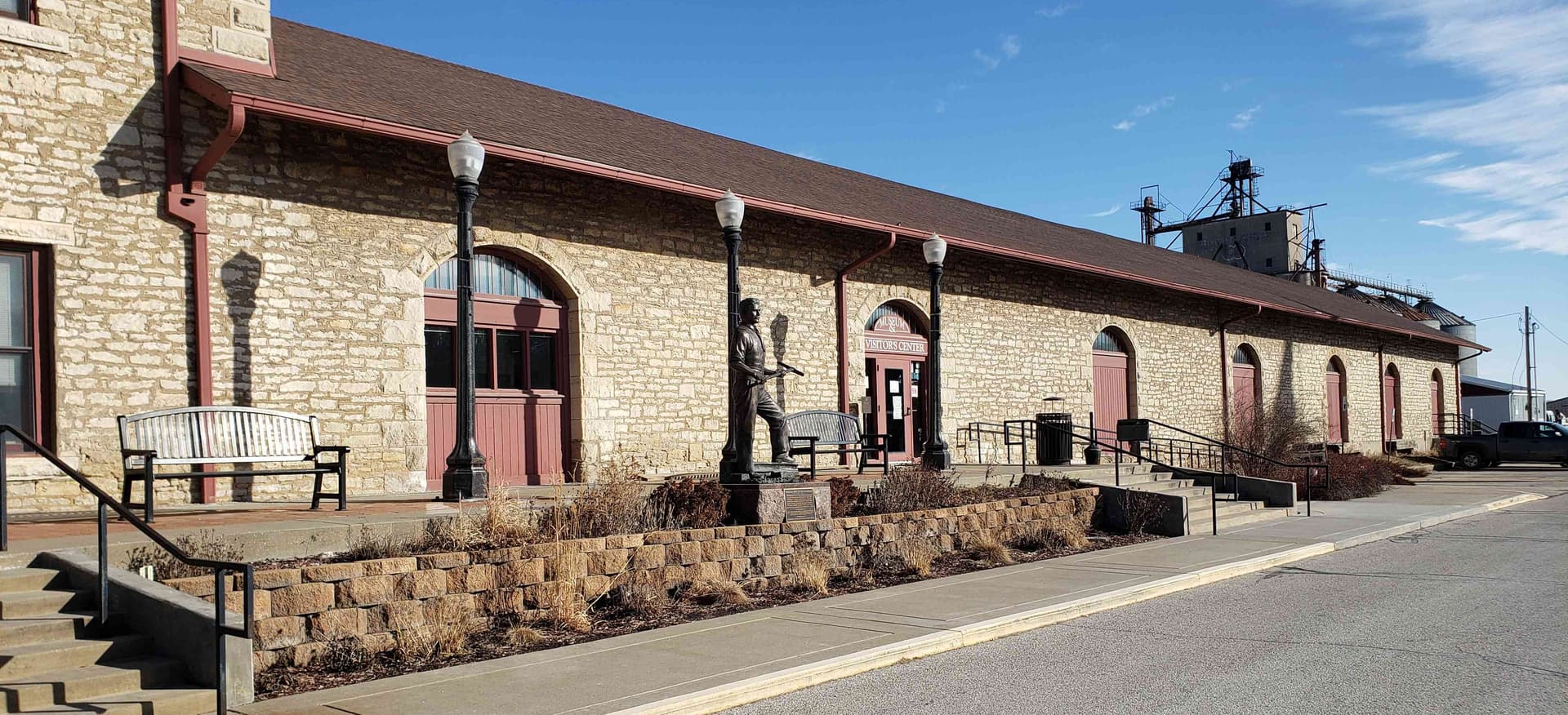
The Santa Fe Freight Depot Museum still looks like the transportation landmark it was built to be. Set west of downtown Atchison at 200 S. 10th St., the 1880 freight depot now serves as both a museum and the Atchison County Chamber of Commerce Visitor Center, tying the town’s railroad past directly to the way people find their way around it today.
A freight depot built to last
The Kansas Historical Society describes the building as a masonry depot made of quarry-faced ashlar stone with contrasting corner quoins and fenestration surrounds. Its form still reads as railroad architecture first, museum second: a two-story office anchors the west end, while a one-story freight section extends to the east. The historic listing names the Atchison, Topeka & Santa Fe Railroad Company as the architect, a reminder that the railroad itself shaped the building’s design and purpose.
That physical presence matters. The depot was listed on the National Register of Historic Places on Oct. 11, 2001 as part of the Historic Railroad Resources of Kansas, which places the structure inside a broader preservation effort rather than isolating it as a local curiosity. Outdoors, the site adds railcars and a narrow-gauge rail line, so the setting still feels like a working transportation landscape instead of a generic exhibit hall.
Why Atchison’s railroad story still starts here
The Santa Fe Freight Depot helps explain why Atchison mattered so much in the railroad era. The Atchison County Historical Society frames the city as the birthplace of the Atchison, Topeka and Santa Fe Railroad and a significant rail hub in the early years of westward expansion. That story reaches back beyond the depot itself, because the National Park Service says Lewis and Clark celebrated their first Independence Day of the expedition in present-day Atchison in 1804, years before the town was founded in 1854 and incorporated as a city in 1858.
By the mid-1870s, Atchison was already moving at a pace that matched its rail ambitions. Clio’s history notes that eight railroads passed through the city and more than 700 men worked locally in machine shops, freight work and passenger service. The Atchison and Nebraska Railroad went further and promoted the city as the "railroad center of the West," with 66 trains arriving and departing daily. Those numbers capture the scale of the place that produced the depot and the community that grew around it.
Inside the museum: more than trains alone
The depot now functions as the Atchison County Historical Society Museum, and the scope inside is broader than a single railroad exhibit. The society says the museum occupies about 6,000 square feet, packed with thousands of artifacts, and includes a research library for public use. It is open to the public 350 days a year, which makes it a steady part of civic life rather than an occasional stop.
Kansas tourism materials show how wide that collection reaches. Exhibits include Native American artifacts, Lewis and Clark materials, early business history, railroad maps and photographs, and a Black history exhibit featuring prominent Atchison personalities. That range matters in a town where transportation history is only one strand of the local story. The depot lets the county’s past show up in multiple forms, from commerce and migration to community identity and memory.
A downtown stop that still shapes first impressions
The building’s present role may be as important as its preservation value. Because it houses the Chamber of Commerce Visitor Center, the depot still helps shape how travelers encounter Atchison when they arrive. Visitor materials describe the restored depot as a place where guests can pick up brochures, maps and help from staff, which turns a historic site into a practical entry point for downtown and the surrounding county.
That dual use gives the depot unusual staying power. It is not preserved simply to be looked at from a distance. It remains part of the day-to-day movement of visitors through Atchison, linking the city’s rail heritage, its museum work and its tourism traffic in one place. On a street west of downtown, the old freight house still does what rail buildings once did best: it connects people, goods and destinations, only now the cargo is local identity.
This article was produced by Prism’s automated news system from verified source data, official records, and press releases, then run through automated quality and moderation checks before publishing. The system is built and supervised by the people who set the standards it runs under. Read our full AI policy.
Did this article answer your question?