Autauga County pottery roots trace to Alabama’s earliest alkaline glazer
Autauga County may sit at the start of Alabama’s alkaline-glaze story, and the Coosada Jug at Pebble Hill gives that claim a rare, visible anchor.

A small pottery near Pine Level puts Autauga County at the front of Alabama’s stoneware story. Auburn University’s Pebble Hill materials say John Presley opened a shop there in the early 1820s, and describe him as the earliest alkaline glazer in the state. That claim matters because it places this county not on the edge of the tradition, but at its beginning.
Why the Autauga County claim is strong
The historical case rests on timing, technique, and surviving evidence. The Encyclopedia of Alabama describes Alabama folk pottery as growing from two major stoneware traditions, salt glazed and alkaline glazed, and notes that pottery shops once turned out crocks, churns, chamber pots, pitchers, and storage jars for everyday life. It also says hundreds of folk potters worked across Alabama until the early twentieth century, often as family operations that moved south from South Carolina through Georgia and into Alabama or Mississippi.
That broader timeline makes Presley’s Autauga County shop stand out. Alabama Stoneware says salt-glaze pottery appears in the 1830s along Mobile Bay, while other potters brought alkaline and salt-glaze traditions west from the Atlantic Piedmont. If John Presley was making alkaline-glaze wares in Autauga County in the early 1820s, the county’s claim sits earlier than the Mobile Bay salt-glaze record and early enough to mark one of the first known Alabama alkaline shops.
The point is not simply that pottery was made here. It is that Autauga County sits at an origin point in a state craft tradition that helped furnish homes long before electrification or mass-produced containers changed how people stored food, mixed ingredients, and moved liquids.
The Presley line and the Coosada connection
Autauga County’s pottery history does not end with John Presley. Auburn’s Coosada Jug materials tie the story to Evan Presley’s pottery in Coosada, giving the county a second, more tangible link to the same craft lineage. Auburn says the jug was likely made at Evan Presley’s shop and that the Presley pottery story belongs to a broader Edgefield, South Carolina tradition, where Landrum is credited with beginning the pottery industry before related methods moved west into Alabama.
That connection matters because it shows how craft knowledge traveled. The Presleys were not isolated makers inventing in a vacuum; they were part of a regional network of technique, family labor, and movement that shaped the state’s earliest ceramics. The vessel itself, however, keeps the story local. Coosada and Pine Level are not abstract dots on a map here. They are the places where one of Alabama’s oldest pottery traditions took root.
The labor history behind that work is impossible to separate from the pottery itself. Auburn says census records show Evan Presley enslaved 36 people in 1850 and 52 people in 1860. Freedmen’s Bureau records then show that in 1865 he asked formerly enslaved potters Edmond, Richmond, Joe, and Jim to run his pottery. Those details turn a craft story into a fuller account of how the work was made, who made it, and who was forced to make it.
What the Coosada Jug reveals
The Coosada Jug gives the county a surviving object that historians can hold up against the paper record. Auburn describes it as an intact, mid-19th-century vessel made by a formerly enslaved potter, likely one of the Presley potters named Edmond, Richmond, Joe, or Jim. Jack and Leda Foley donated the jug, and it is now on display at Pebble Hill in Auburn.
That display gives the Autauga County story a present-day home. The Caroline Marshall Draughon Center for the Arts and Humanities, part of Auburn’s College of Liberal Arts, uses the Pebble Hill collection to preserve Black history through material culture. Mark Wilson, the center’s director, frames the collection as a way to display the artistry and humanity of enslaved Alabamians. The jug is not just an artifact of household use. It is evidence of skill, labor, and continuity across slavery and emancipation.
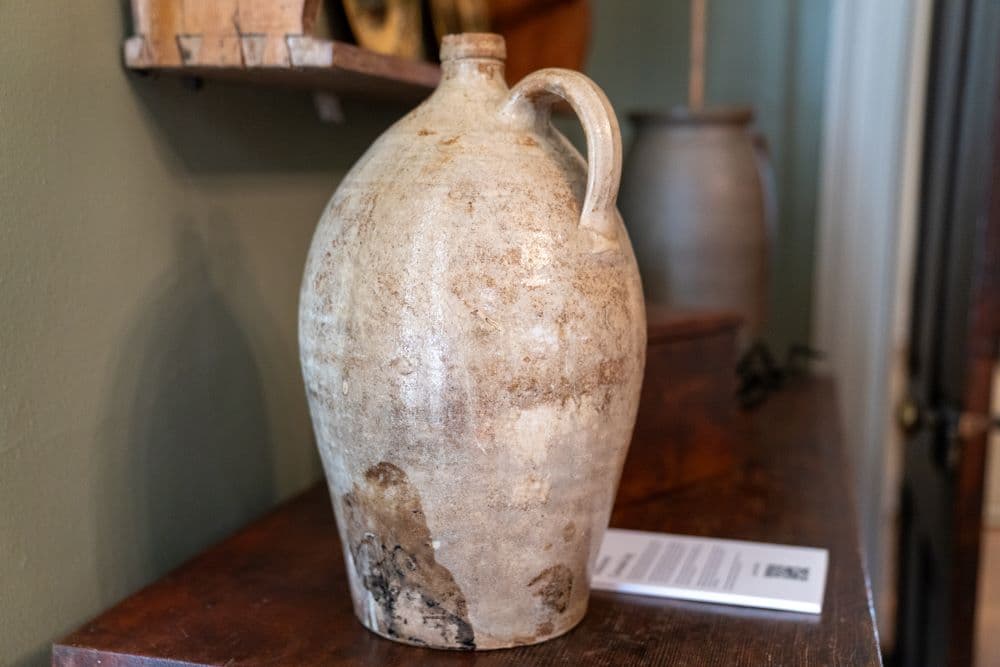
For readers trying to understand what remains visible from Autauga County’s pottery past, the answer is concrete: the surviving vessel at Pebble Hill, the county places of origin at Pine Level and Coosada, and the archival trail that connects them.
What still remains on the map today
Autauga County’s role now is mostly historical and interpretive rather than industrial. The Alabama folk pottery tradition survives today in only a few traditional potteries, including Jerry Brown of Hamilton in Marion County and the Miller family in Bibb and Perry counties. That makes the county’s early shops even more important, because they belong to the front end of a tradition that has narrowed over time.
The local value today lies in access and preservation. Pebble Hill gives the public an actual place to see the Coosada Jug, and Auburn’s materials keep the Presley story in circulation as part of a larger explanation of Alabama material culture. For Autauga County, that means the best evidence is not a standing pottery district or a crowded museum trail. It is a small number of named places, one surviving jug, and a documented chain of people whose work helped define Alabama’s earliest stoneware identity.
In a county often associated with riverfront growth and courthouse history, the pottery record offers something more specific: proof that Autauga County helped start a statewide craft tradition, and that part of that history still survives in one vessel on display in Auburn.
This article was produced by Prism’s automated news system from verified source data, official records, and press releases, then run through automated quality and moderation checks before publishing. The system is built and supervised by the people who set the standards it runs under. Read our full AI policy.
Did this article answer your question?