Local spending keeps more money circulating in Autauga County
Every receipt in Autauga County has a civic price tag: buy close to home, and more of that money helps pay for roads, schools, and jobs.

Why the checkout line matters
Money spent in Prattville, Millbrook, and Autaugaville does not vanish once it hits the register. Ann Harper, Millbrook’s economic development director, says the difference comes down to where the money stays and how many times it keeps moving through nearby businesses, employees, and services. That circulation is what turns an ordinary purchase into part of the county’s economic base, helping fund the public systems people rely on every day.
The practical question is simple: does the dollar stay in Autauga County, or does it leave? Purchases at locally owned stores, and at national retailers that have a physical presence in the community, generate sales tax and other local benefits. Those dollars help support schools, road maintenance, public safety, and the infrastructure that keeps daily life running. By contrast, online purchases are taxed too, but Harper’s point is that the money is generally redistributed statewide, so only a small portion comes back to the city or county where the purchase began.
How the multiplier works
The story behind local spending is not just about one transaction. It is about what happens after the first swipe of a card. In a strong local economy, a $100 purchase close to home can ultimately generate between $150 and $200 in broader economic impact through wages, reinvestment, and secondary spending.
That multiplier matters because a local business does not stop at the cash register. It pays workers, buys supplies, hires services, and often expands again if demand holds up. Those next steps create a chain reaction that can be felt in nearby storefronts and service providers, not just in the original shop. In that sense, buying local is less a slogan than a distribution decision, one that shapes how long a dollar keeps working inside the county.
For a fast-growing area like Autauga County, that distinction is critical. New rooftops and retail can look like growth on paper, but the article’s argument is that growth only becomes durable when residents keep supporting the businesses and services physically rooted in the community. A county can add sales-floor space quickly; building a thicker base of local employment and reinvestment takes repeated choices at the checkout line.
What the tax structure means for your receipt
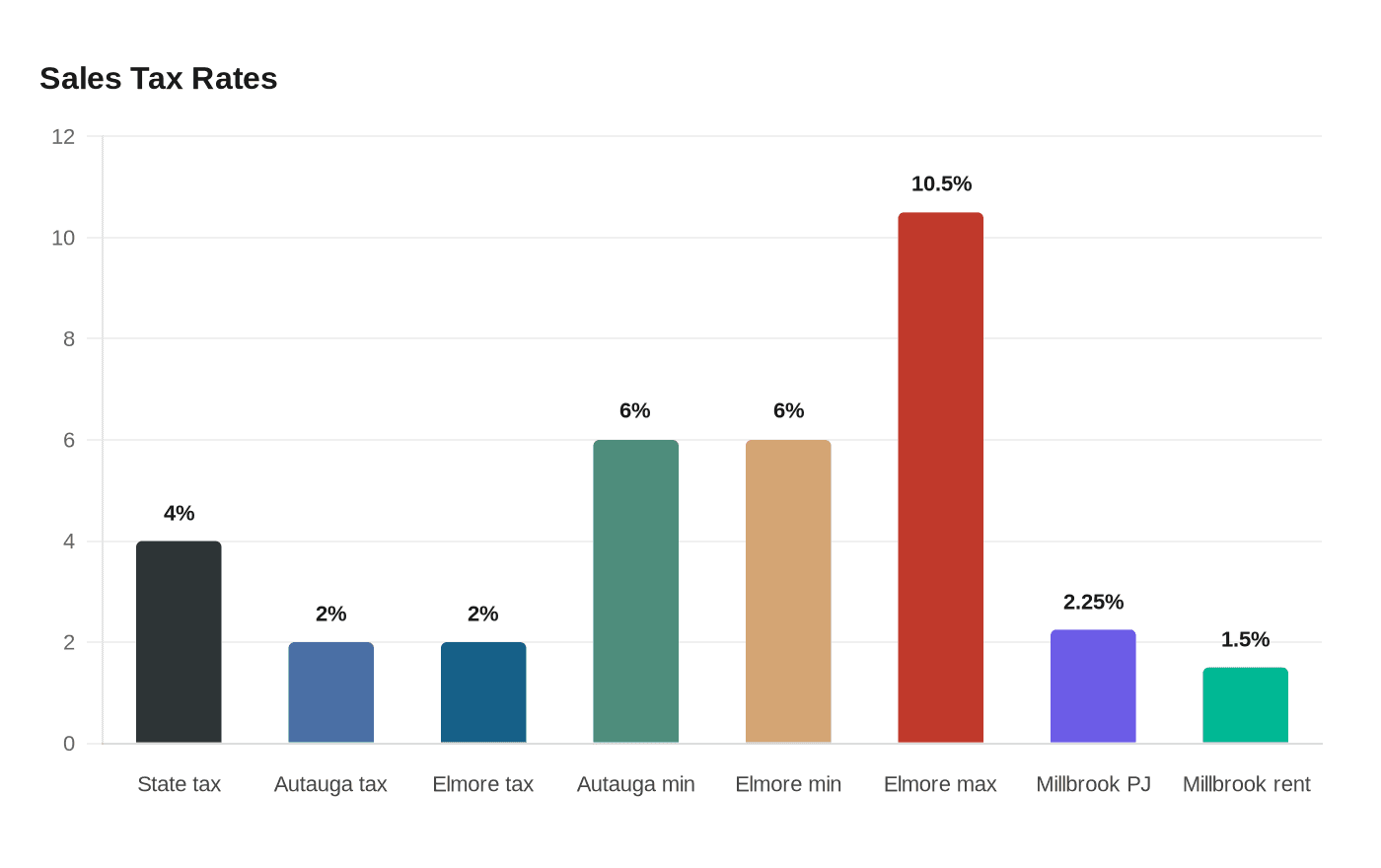
Alabama’s Department of Revenue says local sales taxes are added on top of the state sales tax, and the state administers more than 200 different city and county sales taxes. Counties and municipalities may levy local sales taxes ranging from 0.10% to 5%, which is why the final total on a receipt can change from one jurisdiction to the next. The state sales tax is 4.0%, and third-party 2026 rate references put Autauga County’s county sales tax at 2%, for a minimum combined sales tax rate of 6% countywide.
Elmore County shows the same basic structure, with a 2% county sales tax and a minimum combined 2026 rate of 6%, but local add-ons can push some places higher. In some Elmore County jurisdictions, combined local rates reach as high as 10.5%, depending on city taxes. That spread underscores a basic point for border communities such as Prattville and Millbrook: the final tax bill depends not just on the item, but on the exact place where it is sold.
Alabama Revenue also says police-jurisdiction rates are typically one-half of the corporate-limits tax rate, though some municipalities use different rates. A 2025 Elmore County rate PDF shows that pattern at work in Millbrook, including a 2.25% police-jurisdiction rate and a 1.50% corporate-limits rental tax rate in that document. For shoppers and merchants near city edges, those differences can shape where business clusters and how much revenue each side of the line collects.
Food taxes and local budgets
The state tax holiday on food adds another layer to the county’s revenue picture. Alabama’s state homepage says Act 2026-604 suspends the state sales and use taxes on food items from May 1 through June 30, 2026. City and county sales and use tax rates on food are not affected.
That means families may see relief from the state portion at the grocery store, but local governments still depend on their own share. For county and city budgets, the local piece of each food receipt remains part of the revenue stream during the suspension. For households, that difference shows up in the total at checkout; for officials, it means the local tax base still matters even when the state eases off.
The county tax debate raises the stakes
Autauga County’s own tax discussion makes the local impact even clearer. Reporting in April said a county tax package would add a half-cent sales-tax increase and a new 3% rental tax if signed into law, with the proceeds going to the county general fund. The same reporting said Prattville’s total sales tax would rise to 10% and that the change would begin September 1, 2026, if enacted.
That proposal matters because it shows how tightly public revenue is tied to everyday spending. A grocery run, a repair bill, a rental payment, or a purchase at a local shop all sit inside a larger debate about how the county pays for services. Once rates change, the location of the transaction becomes more than a convenience issue, it becomes part of the public budget.
Why Millbrook’s growth story fits the math
Millbrook gives the argument a concrete local example. Recent local reporting has described continuing activity at 17 Springs and other commercial projects, showing that development is still shaping the corridor between Prattville and Elmore County. In January 2026, Elmore-Autauga News reported that Big Mike’s Steakhouse would open in downtown Millbrook and bring 35 to 40 full- and part-time jobs.
That kind of opening matters well beyond one storefront. A restaurant with dozens of jobs does not just serve meals, it creates paychecks, supplier demand, and foot traffic that can help neighboring businesses survive. It is the same local cycle Harper described: money moves from customers to employers, then into wages, then back into the county through rent, groceries, repairs, and other purchases.
The same logic applies across Autauga County, whether the stop is a hardware store, a boutique, a restaurant, or a national chain with a local address. The more often spending happens inside the county, the more often sales-tax revenue, wages, and reinvestment can recirculate there. In a county still adding rooftops, retail, and development, that is what turns growth into staying power.
This article was produced by Prism’s automated news system from verified source data, official records, and press releases, then run through automated quality and moderation checks before publishing. The system is built and supervised by the people who set the standards it runs under. Read our full AI policy.
Know something we missed? Have a correction or additional information?
Submit a Tip