Adler House Museum preserves Leo Adler’s legacy in Baker City
Leo Adler’s restored 1889 Main Street home turns Baker City history into a place you can walk through, tying a self-made fortune to a legacy still funding local life.

The Adler House Museum gives Baker City a place where the story is still visible from the sidewalk: a preserved 1889 Italianate home at 2305 Main Street, set in the historic district and tied to Leo Adler’s long life. Adler lived in the house for 94 years before his death in 1993, and the rooms inside still carry the imprint of a man who began selling magazines as a boy and ended up shaping Baker County’s civic life.
A Main Street house with a name attached
The house itself is the first thing that makes the museum work so well for local visitors. It is not a reconstructed exhibit or a vague nod to the past. It is a completely renovated and restored Italianate home, and it stands as a contributing property in the Baker Historic District, which is listed on the National Register of Historic Places. That places the Adler House inside a larger protected landscape rather than isolating it as a stand-alone curiosity.
The interior helps explain why the building still feels lived in. The downstairs parlor has been restored with period wallpaper, and furniture, artwork, and light fixtures remain original. Those details matter because they let the house communicate through objects and rooms, not just wall text. The result is a museum that looks like a home because it was one.
After Adler’s death, the house and its contents were bequeathed to the Baker County Museum Commission. A committee of four then oversaw a five-year restoration project, turning private property into a public preservation effort. That sequence gives the building a clear local stewardship story: one man’s residence became a community asset through organized restoration rather than neglect.
Leo Adler’s path from street-corner seller to county benefactor
Leo Adler’s story starts in Baker City in June 1895, when he was born as the youngest of three Adler children. His father, Carl Adler, owned Adler’s Crystal Palace, a store that sold jewelry, books, music, candy, and cigars, so the family name already had local recognition. Leo then built his own path, starting at age nine by selling magazines from a single paper bag on a Baker street.
From there, he built a magazine and newspaper business that made him a self-made millionaire. His life was not only about business success. He was also a visible civic figure, active in the chambers of commerce and in the Anti-Defamation League, and he remained tied to Baker through a long public identity as a booster for the town that later became Baker City again.
That local identity matters. Baker City voted in 1989 to restore its name from Baker back to Baker City, and Adler’s life bridges the town’s commercial rise and its later effort to hold onto its own history. The house, the name change, and the restored historic district all sit inside the same civic story: Baker City choosing to keep its landmarks legible instead of letting them fade into background scenery.
Adler’s legacy also carries a number that still gets attention. Travel Oregon notes that he amassed a $21 million fortune and left it to Baker County. The size of that bequest helps explain why his name still appears in local civic life long after his death in 1993. It was not a symbolic gift. It created a durable philanthropic footprint that can still be traced today.
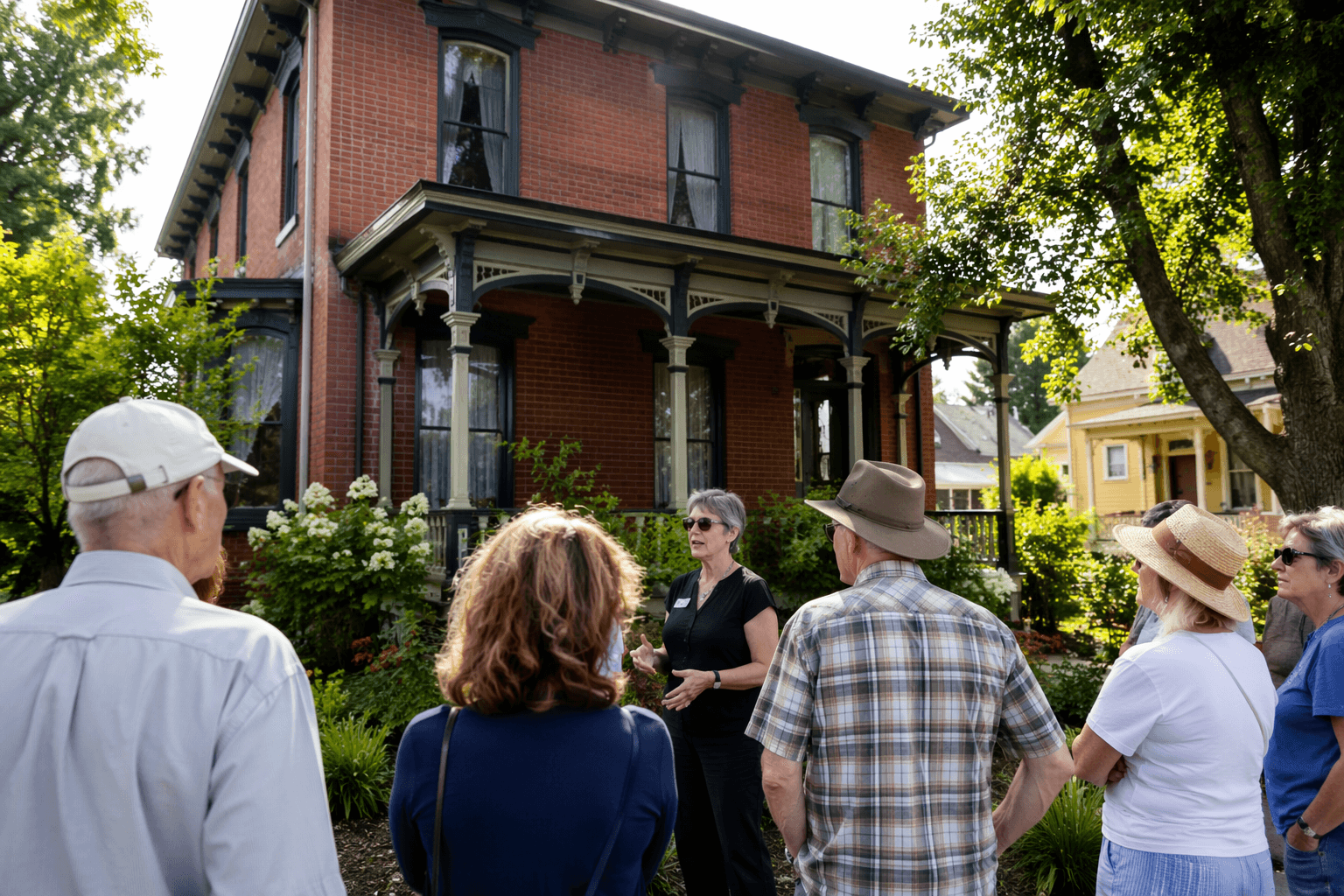
What a visit looks like
The Adler House Museum is typically open Memorial Day through Labor Day, Wednesday through Saturday from 10 to 3. Volunteer docents lead tours and provide background on both the Adler family and the house itself, which turns a walk-through into a guided local history lesson rather than a self-directed room-by-room look.
A visit also connects naturally to the broader Baker Heritage Museum, which is housed in the historic 1920 Natatorium. That connection matters because the Adler House does not stand alone as a one-off preservation piece. It sits within a larger museum network that interprets Baker County’s past through a physical setting, a historic downtown, and a preservation program that still depends on local hands.
- Open Memorial Day through Labor Day
- Wednesday through Saturday
- 10 a.m. to 3 p.m.
- Volunteer docents provide tours and background on the Adler family and house
The museum gift shop adds one more practical link. It sells copies of The Spark and the Light: The Leo Adler Story, and proceeds benefit both museums. That gives visitors a direct way to connect a house tour with the institutions that keep the collection open and interpreted.
Why the Adler legacy still reaches beyond the house
The name Leo Adler still carries weight in Baker County because the philanthropy did not stop with the house. The Leo Adler Foundation’s mission is to enrich the quality of life and expand opportunities in Baker County and North Powder through grants and scholarships. That means the family legacy reaches into school support, local giving, and community aid rather than remaining fixed in a display case.
The foundation’s continued work helps make the house more than a preserved residence. It becomes the most visible address in a larger network of local investment, one that links a Main Street landmark with present-day grantmaking. Baker County residents do not have to treat Adler as an abstract benefactor from another era. His name still appears in the institutions, scholarships, and civic routines that shape daily life.
That is what gives the Adler House its staying power. It is an intact 1889 home, a museum with volunteer guides, a preserved part of the Baker Historic District, and a direct reminder of how one Baker City entrepreneur turned a childhood paper route into a fortune and then into a legacy. In a town where the built environment still reflects the late 19th century, the house keeps the story grounded in one address that still rewards a visit.
This article was produced by Prism’s automated news system from verified source data, official records, and press releases, then run through automated quality and moderation checks before publishing. The system is built and supervised by the people who set the standards it runs under. Read our full AI policy.
Did this article answer your question?