Baker City's downtown showcases one of the West's best historic districts
Baker City’s core still reads like a 19th-century commercial map, with more than 100 listed buildings and a hotel revival that kept Main Street alive.
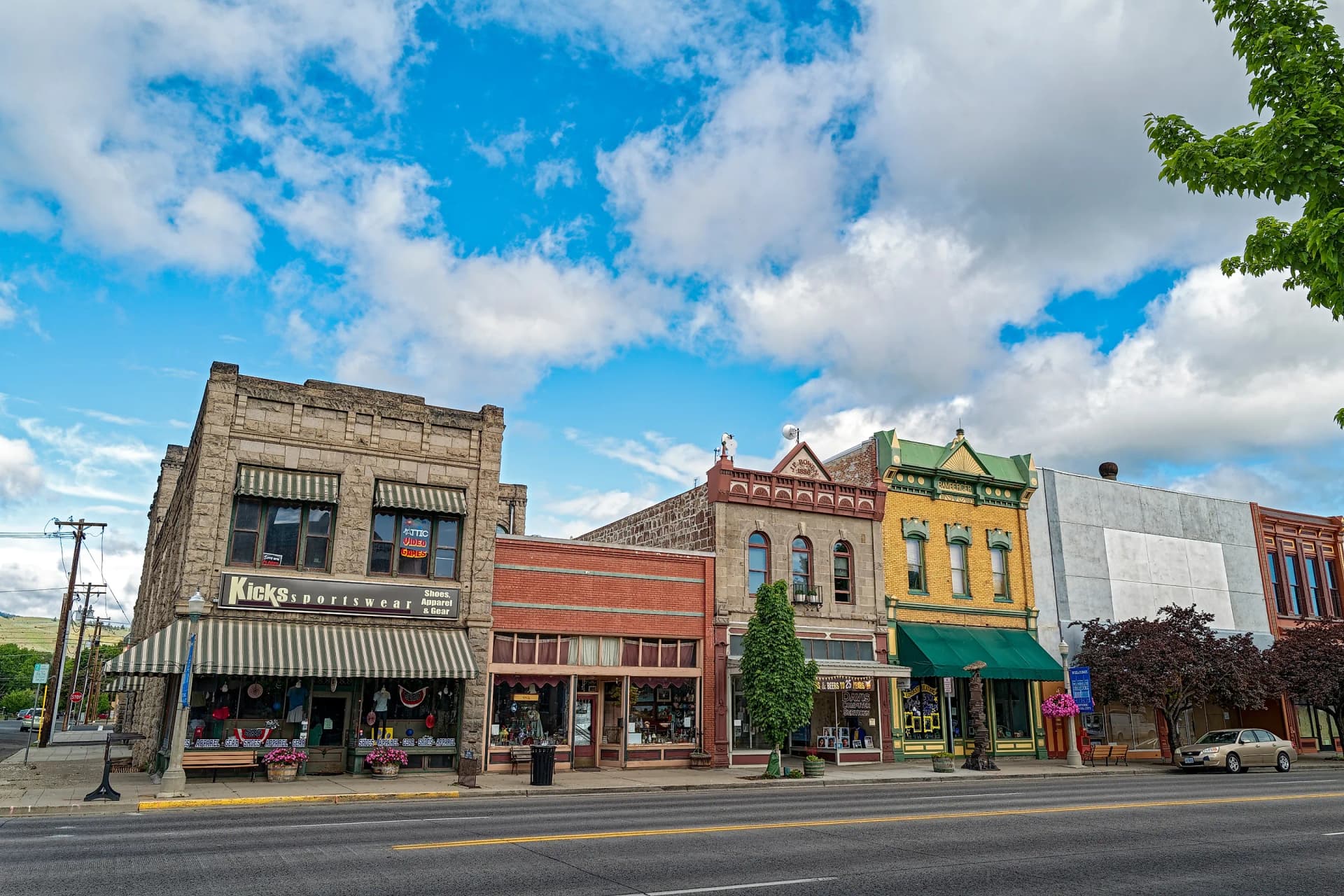
Baker City’s downtown has something many rural main streets lost a long time ago: a whole commercial district that still reads as one place, not a patchwork of replacements. More than 100 buildings in the area are listed on the National Register of Historic Places, and the district is widely described as one of the largest intact historic commercial districts in the West. That scale matters because it tells the story of Baker County’s growth in the architecture itself, from the late 1800s boom years through the early 20th century.
A downtown built during Baker City's rise
Baker City was incorporated in 1874, and by the turn of the century it had become a major regional center tied to mining, ranching, timber, rail travel, and the broader Oregon Trail era. That history still shows up in the way the blocks fit together: dense storefronts, prominent commercial façades, and a street pattern that served a busy county seat rather than a sleepy crossroads. The district was nominated to the National Register in 1978, a formal recognition that helped define the area as a preserved commercial landscape instead of a collection of isolated old buildings.
What makes the downtown unusually legible is that it tells the story of local prosperity through scale and continuity. This is not a single landmark surrounded by newer construction. It is a surviving downtown core where the buildings, their materials, and their styles all point back to the same period of expansion, when Baker City was acting as the service center for a much larger rural economy.
The stone and the styles tell the story
The National Park Service identifies Baker Historic District as one of the best collections of stone buildings in Oregon, and the defining local material is volcanic tuff. Builders saw-quarried the tuff while it was still soft, then let it harden after exposure to air, which gave the district a cohesive look that is hard to mistake for any other western town. The result is a streetscape that feels unified without being monotonous, because the same material was used across buildings with different functions and different eras.
That variety matters. The district’s architecture ranges from Commercial Italianate to Moderne, so a walk down Main Street becomes a quick survey of changing American commercial design. The older buildings bring taller windows, heavier cornices, and the kind of ornamental confidence that fit a boomtown. Later façades flatten out, simplify, and move toward the cleaner lines associated with the Moderne era, showing how Baker City adapted instead of freezing in one moment.
For a self-guided walk, the best approach is to slow down and compare one block to the next. Look for the volcanic-tuff walls, the shifts in window size, the different rooflines, and the way a storefront addition or remodel marks a new phase of use. The district rewards attention because the history is not hidden in a museum case. It is embedded in every façade that still faces the street.

The Geiser Grand Hotel anchors the route
The Geiser Grand Hotel is the most useful place to start because it captures both the ambition and the fragility of Baker City’s downtown. The building opened in 1889 as the Washauer Hotel at a cost of $65,000, a major investment for the time. It was built with a volcanic-tuff foundation and outfitted with plate glass windows, electric lights, baths, an elevator, and a dining room that seated 200 guests. Its illuminated clock tower became one of Main Street’s signature sights, a visible sign that Baker City’s commercial district was aiming to look modern, not merely functional.
The hotel’s later history is just as important. It closed in 1968 and then sat through a long decline before reopening in 1998. That arc shows why historic preservation in a place like Baker City is not only about appearance. Buildings survive when someone decides they are worth repairing, reusing, and putting back into service, even after decades of disinvestment. The hotel’s comeback gave Main Street a landmark with enough weight to draw attention back to the whole district.
From an economic standpoint, the Geiser Grand also shows why preservation decisions often come down to costs and expectations. A building that once represented a $65,000 gamble only stays relevant if later owners are willing to spend real money and accept a long payoff. That is the basic math behind many successful historic downtowns: reuse is expensive, but demolition and replacement can erase the very character that gives the district value in the first place.
What preservation means for a working downtown
Baker City Downtown describes its mission as preserving and enhancing the vitality and character of the historic downtown through beautification, promotion, and development. That framing matters because the district is not a frozen exhibit. It is a working commercial area that has to support businesses, welcome visitors, and remain usable for daily life in Baker County.
That active use is what keeps the district intact. A historic downtown survives when storefronts still matter, when owners see value in restoration rather than replacement, and when the buildings continue to serve as places to shop, eat, work, and gather. The district’s National Register status helps protect its identity, but the day-to-day outcome depends on ownership decisions and on whether the buildings continue to earn their place in the local economy.
For current businesses, that means the downtown’s oldest assets are also its strongest branding tools. The stone façades, the clock tower, and the layered architecture give merchants a setting that newer commercial strips cannot easily copy. For residents, it means downtown Baker City remains a place where the county’s history is visible without having to leave the street.

How to read the district on a walk
A walk through downtown is easiest to appreciate if you treat it like a set of clues rather than a single attraction.
- Start with the materials. Volcanic tuff is the signature stone, and it helps explain why the district feels so unified.
- Then look at the styles. Commercial Italianate and Moderne façades show how the downtown evolved over time.
- Pay attention to the Geiser Grand Hotel. Its original luxury, long closure, and later reopening make it the clearest example of preservation and reuse.
- Keep in mind the scale. With more than 100 historic buildings on the National Register, the district is a broad streetscape, not a lone landmark.
That is what makes Baker City’s downtown unusual in the West. It still functions as a commercial center, yet it also preserves the architecture of the era when Baker County was becoming a regional hub. The result is a downtown that carries its history in plain sight and still has to make economic sense every day.
This article was produced by Prism’s automated news system from verified source data, official records, and press releases, then run through automated quality and moderation checks before publishing. The system is built and supervised by the people who set the standards it runs under. Read our full AI policy.
Did this article answer your question?