Churchill School Screens The Librarians, Highlights Librarians' Resistance to Book Bans
Churchill School Arts Center hosted a free screening of the 2025 documentary The Librarians on Feb. 26, 2026, arranged by Perry Stokes, drawing more than 50 people for a filmed intro, series preview, and discussion.

Churchill School Arts Center screened The Librarians, a 2025 documentary directed and produced by Kim A. Snyder, for a free community event arranged by Perry Stokes on Feb. 26, 2026. More than 50 people attended the 90-minute film at the Churchill School, which opened with a filmed introduction by Snyder, included a preview of the next three films in the series, and concluded with a post-screening discussion.
Snyder’s film frames librarians as front-line defenders of access to information, a thesis the University of Chicago synopsis summarized as “Librarians emerge as first responders in the fight for democracy and our First Amendment Rights.” The documentary opens with Ray Bradbury’s lines from Fahrenheit 451, “It was a pleasure to burn. It was a special pleasure to see things eaten, to see things blackened, and changed”, and traces a narrative that begins in 2021 when the Krause List of 850 targeted books was issued to Texas school libraries.
The film follows scenes in Texas, Florida, and New Jersey and documents concrete harms facing librarians. On screen, the film shows harassment, threats, and job losses; Midbrow’s coverage notes that in one area featured the film shows 20 out of 40 librarians being let go. The documentary includes archival footage of a 2022 Mt. Juliet book burning, and it presents clips of accusations that librarians were “dealing porn to children” and a line shown in film footage: “I’m doing a criminal investigation into some of your staff.”
Audience reactions varied across screenings described in coverage. At the Churchill School showing, applause followed the on-screen line “Our story is still being written,” one interviewee says, “But now it’s everyone’s story.” At the Belcourt Theater screening in Tennessee, viewers reacted with scoffs, gasps, and tears; attendees at that Dec. 10 event told reporters, “I feel like I just watched a horror movie based on a true story,” and “I just keep crying.” Tennessee librarians who spoke to reporters asked to remain anonymous out of fear of retaliation.
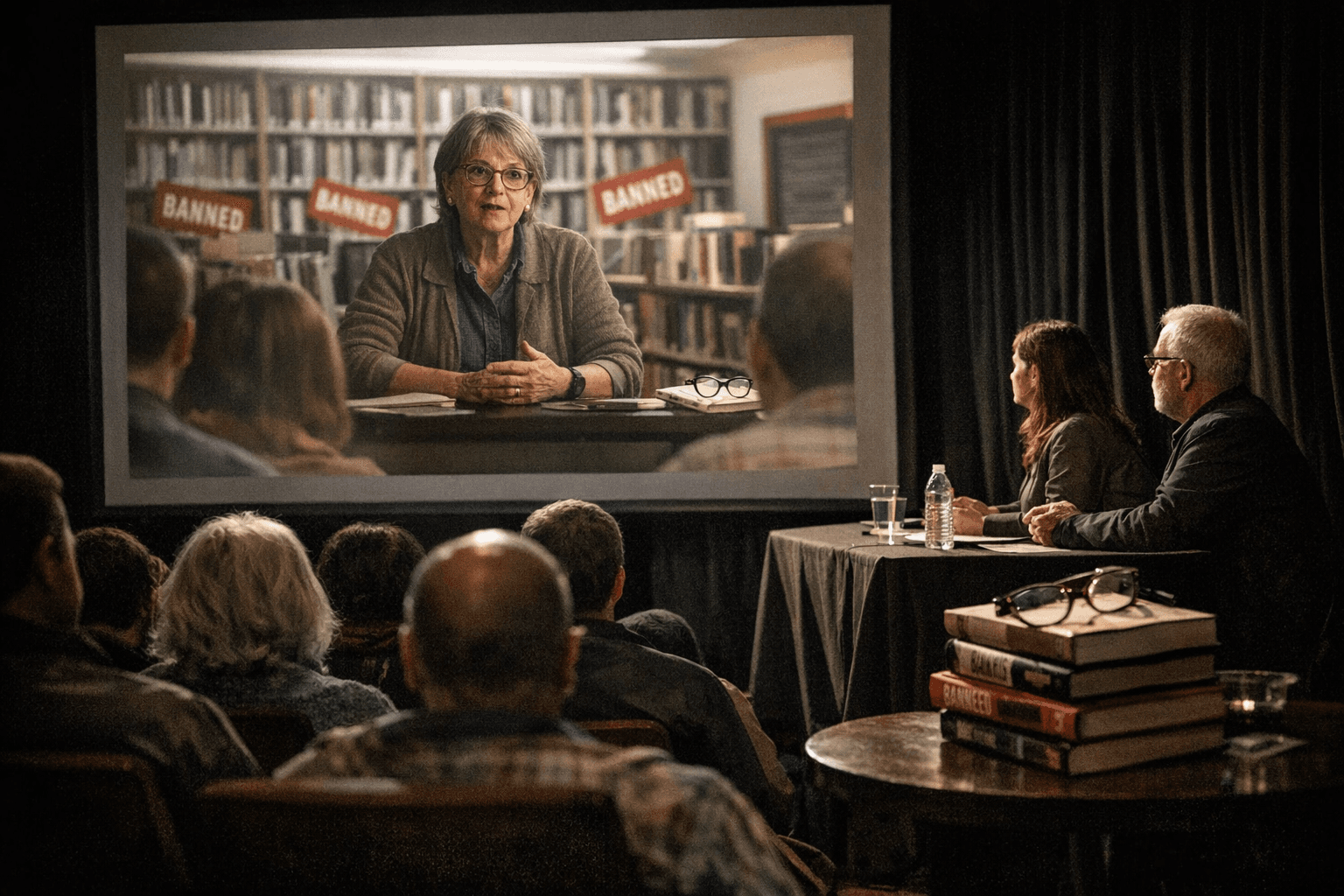
Local screening organizers and attendees tied the film’s narrative to national data. PBS and PEN America reporting cited in coverage place the story in a broader landscape: PEN tracked more than 6,800 book bans in the 2024–25 school year and found that of 87 districts impacted by bans this year, 70 showed evidence of public responses against censorship. PEN’s “Everyday Banning” analysis also catalogs tactics such as elected leaders issuing “explicit” lists, districts creating “do not buy” lists, and administrators preemptively removing books.
Churchill’s event connected Baker County residents directly to those stakes. The film’s premiere and early theatrical rollout remain documented elsewhere: a Nov. 5 premiere and Q&A with Snyder, Martha Hickson, and Courtney Gore, followed by a Nov. 14–20 theatrical window at Alamo Wrigleyville were listed in event materials. Locally, Perry Stokes’ free screening and the discussion that followed brought the national debate over censorship, librarians’ jobs, and community rights to the Churchill School Arts Center.
This article was produced by Prism’s automated news system from verified source data, official records, and press releases, then run through automated quality and moderation checks before publishing. The system is built and supervised by the people who set the standards it runs under. Read our full AI policy.
Did this article answer your question?