Jury Seated in Baker County for Second Idaho Power Easement Trial
A 12-member jury was seated in Baker County Circuit Court Tuesday for Idaho Power's second condemnation trial, where a jury, not the company, decides what landowners get paid.

A 12-member jury was seated at 11:25 a.m. Tuesday, March 31, in Baker County Circuit Court after three and a half hours of questioning by Judge Matt Shirtcliff and two attorneys, opening the second condemnation trial tied to Idaho Power's $1.15 billion Boardman to Hemingway transmission line. Opening arguments were scheduled to follow a lunch recess, around 2 p.m.
The case is one of roughly 15 condemnation lawsuits Idaho Power filed in Baker County in 2023 and 2024 to secure easements across private land for the 293-mile, 500-kilovolt power line, which cuts through Baker, Union, Umatilla and Morrow counties on its way from Boardman, Oregon to Hemingway, Idaho. Idaho Power holds a 45% stake in the project, with PacifiCorp owning the rest, and the partners hope to complete construction by the end of 2027 or early 2028.
For Baker County landowners in the line's path, condemnation gives Idaho Power the legal authority to cross private property without the owner's consent. Judge Shirtcliff granted the company advance occupancy on affected parcels last year, meaning towers are already going up on some properties while the compensation lawsuits proceed. What these jury trials decide is not whether Idaho Power can use the land, but how much it must pay.
The first Baker County trial, decided earlier this month, illustrated how far apart the two sides can be. A jury awarded Mark and Savannah Kerns, owners of a 1,050-acre grazing property on the east side of Baker Valley about 5 miles northeast of Baker City, $56,000. Idaho Power had proposed $27,810; the Kernses had asked for $215,694. The company had already paid the couple $26,070 in advance occupancy fees while the case was pending. The Kernses' attorney, David Auxier, argued that Idaho Power's offer treated the power line as affecting only the roughly 25.5 acres within the easement itself, about 3% of the parcel, while ignoring its effect on the property's broader value. Idaho Power's attorney, Tim Helfrich, countered that once built, the towers "basically sit there" and the company would make infrequent use of the land.
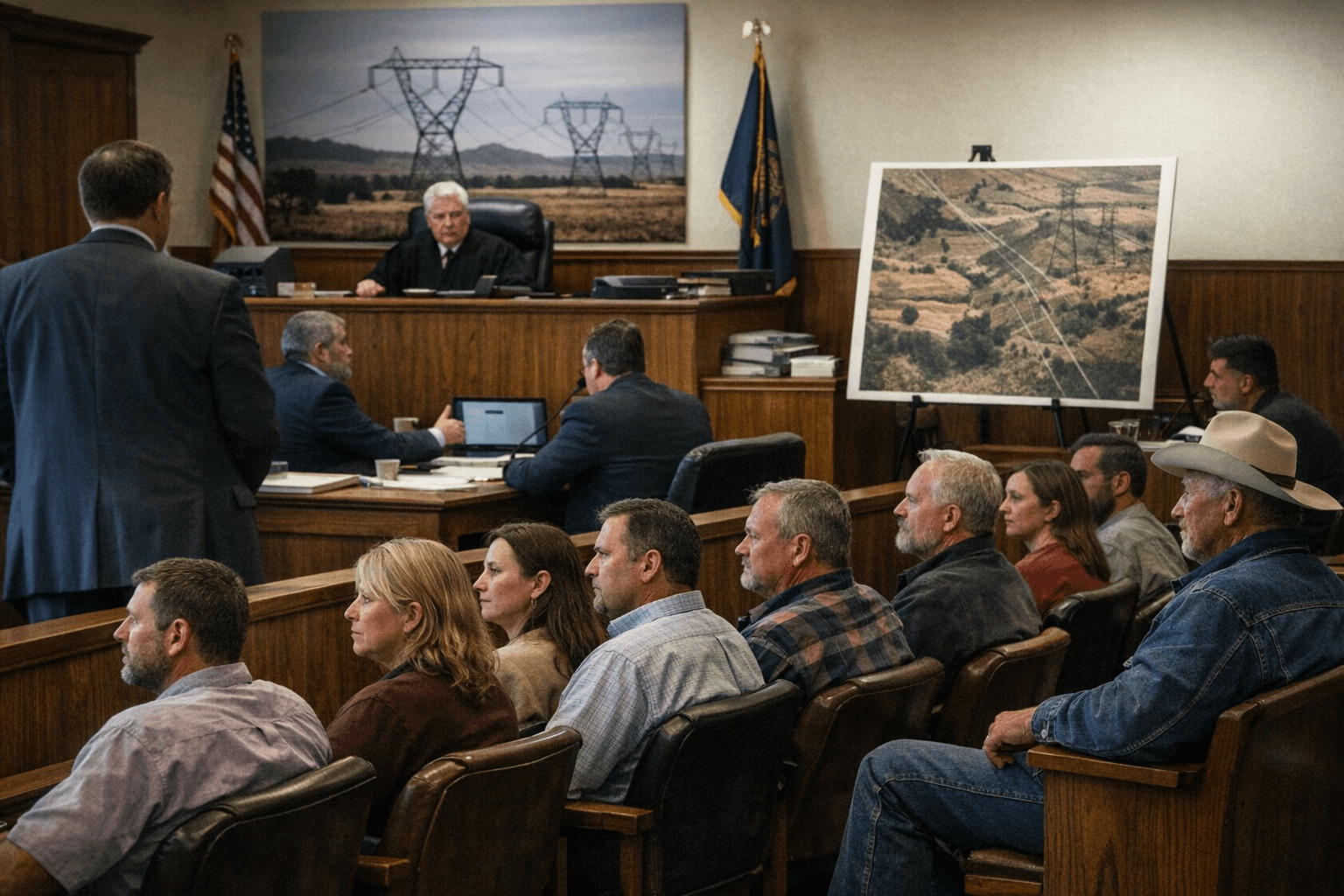
Idaho Power is actively building towers in Baker County right now, including in the Pleasant Valley area east of Baker City and on the east side of Baker Valley. For farming and ranching operations, easements typically restrict structures within the right-of-way, constrain where equipment can operate, and can complicate rotational grazing. High-voltage transmission lines crossing dry grassland also raise fire concerns during summer months.
Idaho Power and PacifiCorp have consistently argued the B2H line is essential to meeting rising electricity demand across the West and shoring up regional grid reliability. Idaho Power says it expects to offset part of its construction costs by selling transmission capacity to Bonneville Power Administration customers in Idaho, Wyoming and Montana.
With roughly a dozen condemnation suits still moving through Baker County courts, each jury verdict now functions as a data point in a running argument over what the B2H right-of-way is actually worth to rural landowners. The outcome of this second trial will add to that ledger, shaping leverage for both sides as the remaining cases head toward settlement tables or further jury rooms.
This article was produced by Prism’s automated news system from verified source data, official records, and press releases, then run through automated quality and moderation checks before publishing. The system is built and supervised by the people who set the standards it runs under. Read our full AI policy.
Did this article answer your question?