National Historic Oregon Trail Interpretive Center Sits Atop Baker County's Flagstaff Hill
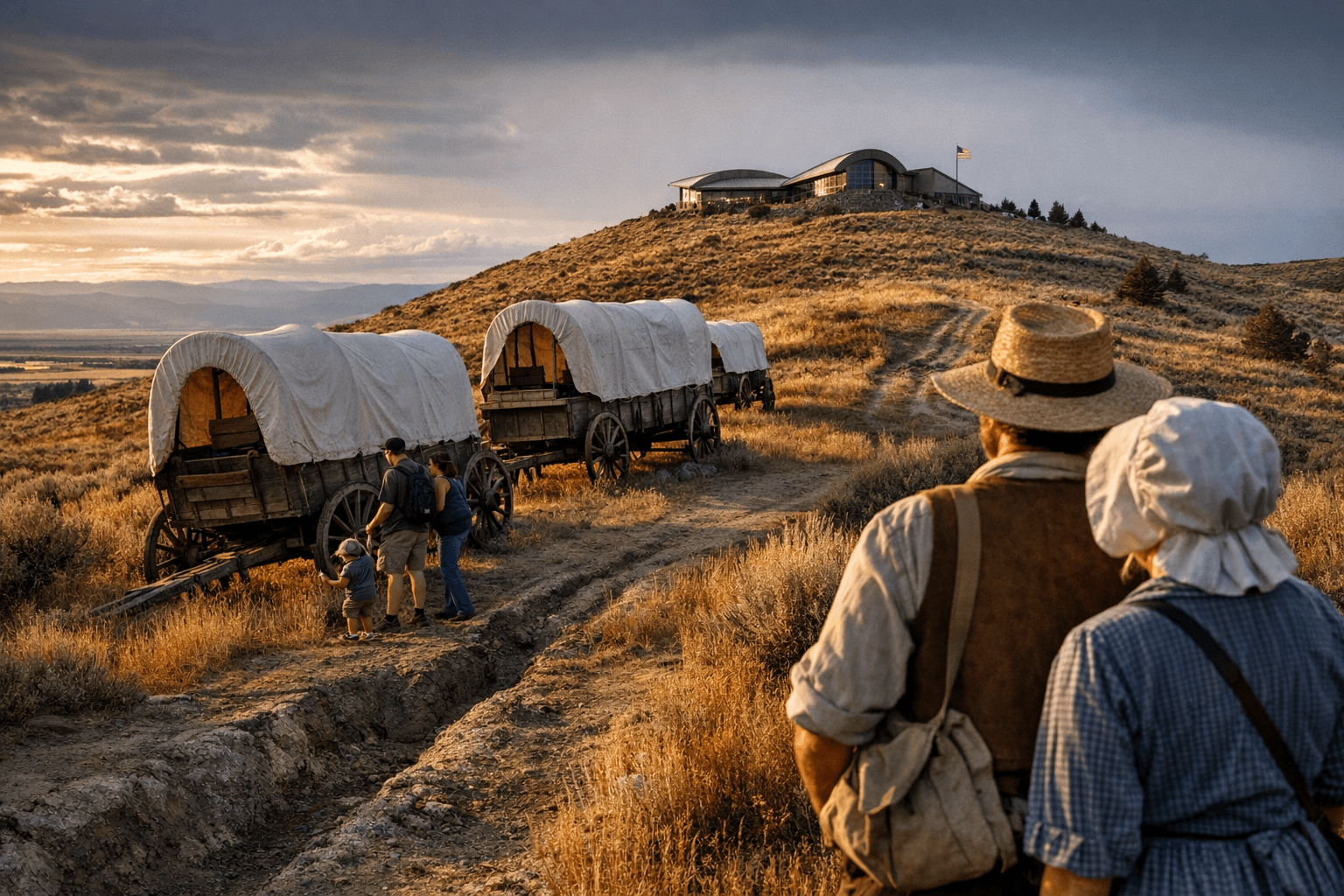
Perched atop Flagstaff Hill, this BLM-managed center puts visitors steps from original pioneer wagon ruts and a full-scale replica wagon train.

Perched on Flagstaff Hill about five to six miles east of Baker City along Highway 86, the National Historic Oregon Trail Interpretive Center is one of the most substantive heritage sites in the American West. The 23,000-square-foot facility sits on a site reported as either 500 or 509 acres depending on the source, and it commands panoramic views of the Elkhorn Mountains and the Baker Valley below, where the actual ruts of Oregon Trail wagons are still visible from the hilltop. This is not a static collection of artifacts behind glass. It is a living, interactive experience built on original ground, and after a major renovation and grand reopening in 2024, it is ready to welcome visitors again in full.
How It Came to Be
The center's origins trace back to 1987, when a group of community leaders in Baker City began talking about what could anchor a tourism economy in a region whose natural-resource industries had fallen into decline. They formed the nonprofit Oregon Trail Preservation Trust, cultivated partnerships with local, state, and federal government agencies, and ultimately forged a formal agreement with the U.S. Bureau of Land Management to build a major visitor facility on public land. Within just five years, that conversation became a reality. The center opened in 1992, and the timing was significant: it opened in time to participate in the Oregon Trail Sesquicentennial Celebration of 1993. Dorthy Wooters chronicled the full arc of that effort, from early planning through construction and opening day, in her book Trail of a Dream.
The numbers that followed validated the community's gamble. In the first seventeen years of operation, the center hosted 2 million visitors from around the world. That achievement reflects both the site's authenticity and the durability of Baker City's investment in heritage tourism.
What the Site Is and Who Runs It
The center is operated by the Bureau of Land Management in partnership with Trail Tenders, a local volunteer organization, under a long-running cooperative agreement. The Oregon Trail Preservation Trust, the nonprofit that helped bring the project into existence, remains part of the institutional fabric. The site is also designated as part of the National Landscape Conservation System, placing it within a federal framework for protecting landscapes of historical, cultural, and scenic significance.
The center's own mission statement frames its purpose directly: "The National Historic Oregon Trail Interpretive Center at Flagstaff Hill portrays and interprets the Oregon Trail experience and its related themes, while preserving and protecting its historic, cultural heritage, natural, and visual features. The Center serves as a focal point for the cultural heritage traveler, contributes to a viable tourism industry for the area, and is committed to maintaining strong community partnerships."
Beneath Flagstaff Hill itself lie the remnants of the Flagstaff Gold Mine, the historic operation that gave the hill its name. Those remnants are part of what visitors encounter on the grounds, alongside the original wagon ruts that pioneer families carved into the earth while migrating west.
What You Will See and Do
The interpretive experience begins inside the 23,000-square-foot building, where the journey opens with a life-sized replica wagon train. From there, visitors move through interactive galleries featuring hands-on exhibits, life-size displays, a full-scale wagon train diorama, multi-media presentations, and permanent as well as rotating special exhibits. The interpretive themes are wide-ranging: area natural history, pre-emigrant travelers and explorers, Native American cultural connections and collisions with Euro-American emigrants, pioneer life, the history of the U.S. General Land Office and BLM, and the mining and settlement of Northeast Oregon.
The Leo Adler Theater hosts lectures, films, music, and dramatic presentations, giving the site a programmatic depth that goes well beyond a self-guided walk. Elsewhere on the grounds, a replica gold stamp mill and a gold panning demonstration area bring the mining history of Baker County to life in tangible form. Outside the building, more than four miles (about 6 km) of interpretive hiking trails wind across the site, including an easy-access path that leads directly to original ruts carved by pioneer wagons. Access to the historic ruts along Highway 86 is open daily, regardless of the center's operating hours.
Programming runs throughout the year. The center offers living history demonstrations, re-enactments, living history dramas, workshops, educational programming for school groups, and a monthly calendar of events. Both self-guided and facilitated activities are available, and group tours are welcome. The gift shop, Lone Pine Mercantile, rounds out the visitor experience with a curated selection of merchandise.
As one visitor, identified as a Local Guide among the center's 648-plus reviews, put it: "The entire experience is incredible and everyone should visit at least once to get a deeper understanding of this portion of American history."
The 2022-2024 Renovation
The center closed in 2022 for a significant renovation. During that closure, a temporary exhibit was housed at Baker Heritage Museum in Baker City, keeping the story of the Oregon Trail accessible to the community. The center celebrated its grand reopening in 2024 following the completion of multiple energy-efficiency updates. The NHOTIC noted at reopening that it looks forward to expanding exhibits and programs in the years ahead.
Planning Your Visit
The center is located at 22267 Highway 86, reached via I-84 Exit 302 from Baker City, along the Hell's Canyon Scenic Byway. RV and bus parking is available on site.
Admission pricing varies by season. Summer rates are $8 for visitors age 16 and up and $6 for seniors, with the receipt valid for two days. Winter rates drop to $5 for age 16 and up and $4 for seniors, also valid for two days. Federal recreation passes are accepted. Pricing for visitors under 16 is not specified in current BLM materials and is worth confirming directly with the center.
For hours, note that sources vary slightly. Travel Baker County lists spring, summer, and fall hours as daily 10 a.m. to 5 p.m., with winter hours (October 21 through March 30) running Thursday through Sunday, 10 a.m. to 5 p.m. BLM lists winter hours as Thursday through Sunday, 9 a.m. to 5 p.m. Before making the drive, it is worth checking the current schedule at oregontrail.blm.gov or contacting the center directly, since posted hours can shift seasonally. The center is closed on Thanksgiving Day, Christmas Day, and New Year's Day.
Several fee-free days are designated by the BLM: February 16, May 25, June 14, July 3-5, and September 17. Starting in 2026, however, free access on those days applies only to U.S. citizens and residents. Nonresidents will pay the regular standard amenity fee and any applicable nonresident fees on those dates going forward.
Why Flagstaff Hill Matters to Baker County
The center's placement on Flagstaff Hill is not incidental. The hill overlooks the actual route of the Oregon Trail as it crosses Virtue Flat and threads north through the Baker Valley, making the interpretive experience inseparable from the physical landscape it describes. Baker City's investment in this site in the late 1980s transformed the region's economic relationship with its own history, and the 2024 reopening represents a renewal of that commitment. For anyone traveling through Eastern Oregon, the center is among the most grounded and authentic ways to encounter the story of westward migration, not as a distant abstraction but as something you can see, walk through, and stand beside.
This article was produced by Prism’s automated news system from verified source data, official records, and press releases, then run through automated quality and moderation checks before publishing. The system is built and supervised by the people who set the standards it runs under. Read our full AI policy.
Did this article answer your question?