Baltimore honors firefighters, civilians for bravery at Medals Day ceremony
At the War Memorial, Baltimore firefighters and civilians were honored for split-second rescues that showed how often survival depends on whoever is closest.
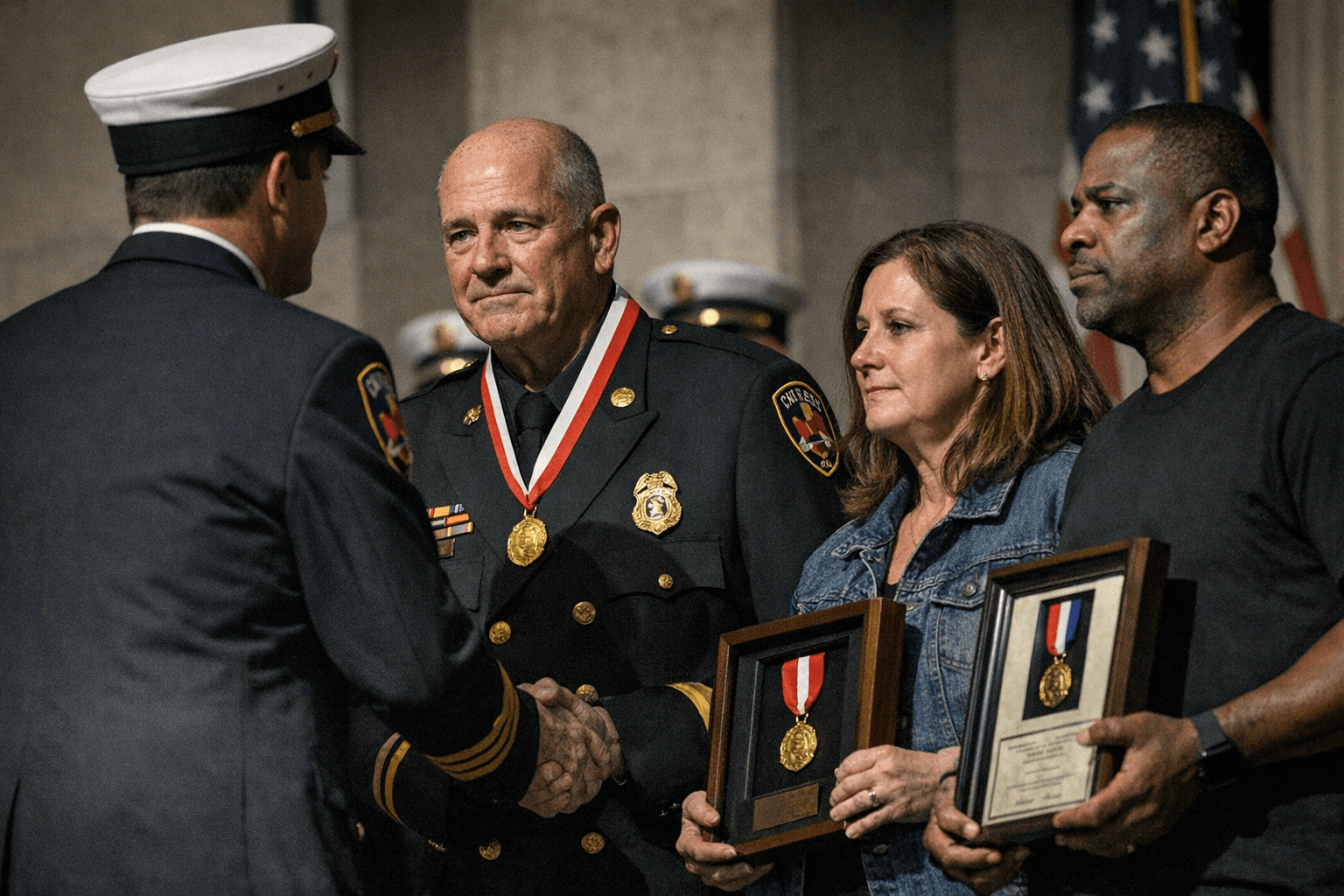
Baltimore’s Medals Day ceremony turned the War Memorial Building into a stage for the city’s most consequential split-second decisions, honoring firefighters and civilians whose actions helped pull people back from the edge of tragedy.
Among the moments recognized were rescues of trapped residents from burning buildings, aquarium employees who used an AED to save a visitor, and a teacher who jumped into the Inner Harbor after seeing a child fall in. The Baltimore City Fire Department also singled out its dive and rescue team for work after the deadly plane-helicopter collision near Reagan National Airport, a reminder that the department’s reach extends far beyond the blocks where most residents know it best.
The ceremony placed those acts inside one of Baltimore’s most historic public spaces. The War Memorial at 101 North Gay Street was first dedicated in 1925 and was designed by Lawrence Hall Fowler as a place for veteran, patriotic and civic organizations. Now co-owned by the State of Maryland and the City of Baltimore and managed by a jointly appointed commission, its Memorial Hall can hold up to 1,100 people, a fitting civic backdrop for a ceremony built around public courage.
The fire department’s numbers help explain why those rescues matter. Baltimore City Fire Department says it responds to more than 270,000 emergencies a year in a city of more than 635,000 residents spread across 81 square miles. Its mission includes fire suppression, rescue, emergency medical services, water rescues and community outreach, a scope that makes bystander action and fast professional response part of the same chain of survival.
That is what made the honored civilians so central to the day. A teacher did not wait at the edge of the Inner Harbor after a child fell in. Aquarium workers did not stand back when a visitor needed a shock from an AED. In both cases, ordinary people moved first, and that immediate response was what the department chose to elevate alongside its own personnel.
The message from the War Memorial was direct: Baltimore’s public safety system depends not only on apparatus, training and dispatch times, but also on the people who are already there when the emergency breaks. In a city where every second can shape the outcome, the fire department used Medals Day to show that bravery is measured both in uniform and out of it.
This article was produced by Prism’s automated news system from verified source data, official records, and press releases, then run through automated quality and moderation checks before publishing. The system is built and supervised by the people who set the standards it runs under. Read our full AI policy.
Did this article answer your question?


