Baltimore Shines Program Brings Free Rooftop Solar to Low-Income Homeowners
Janete Gonzalez's BGE bill dropped from $400 to under $230 after Baltimore Shines installed free solar panels. The program aims to reach 170 Baltimore homes by end of 2026.

When Janete Gonzalez stopped at a Civic Works booth at the Druid Hill Park farmers market in the fall of 2022, she was a new Baltimore City resident who had just fled a house fire that destroyed everything she owned. She came looking for food and maybe some health care products. She left with something she had never expected to be within reach.
"I originally assumed that solar panels were for people who had bigger land or lived in a better neighborhood," Gonzalez said. "I just didn't think it was for us."
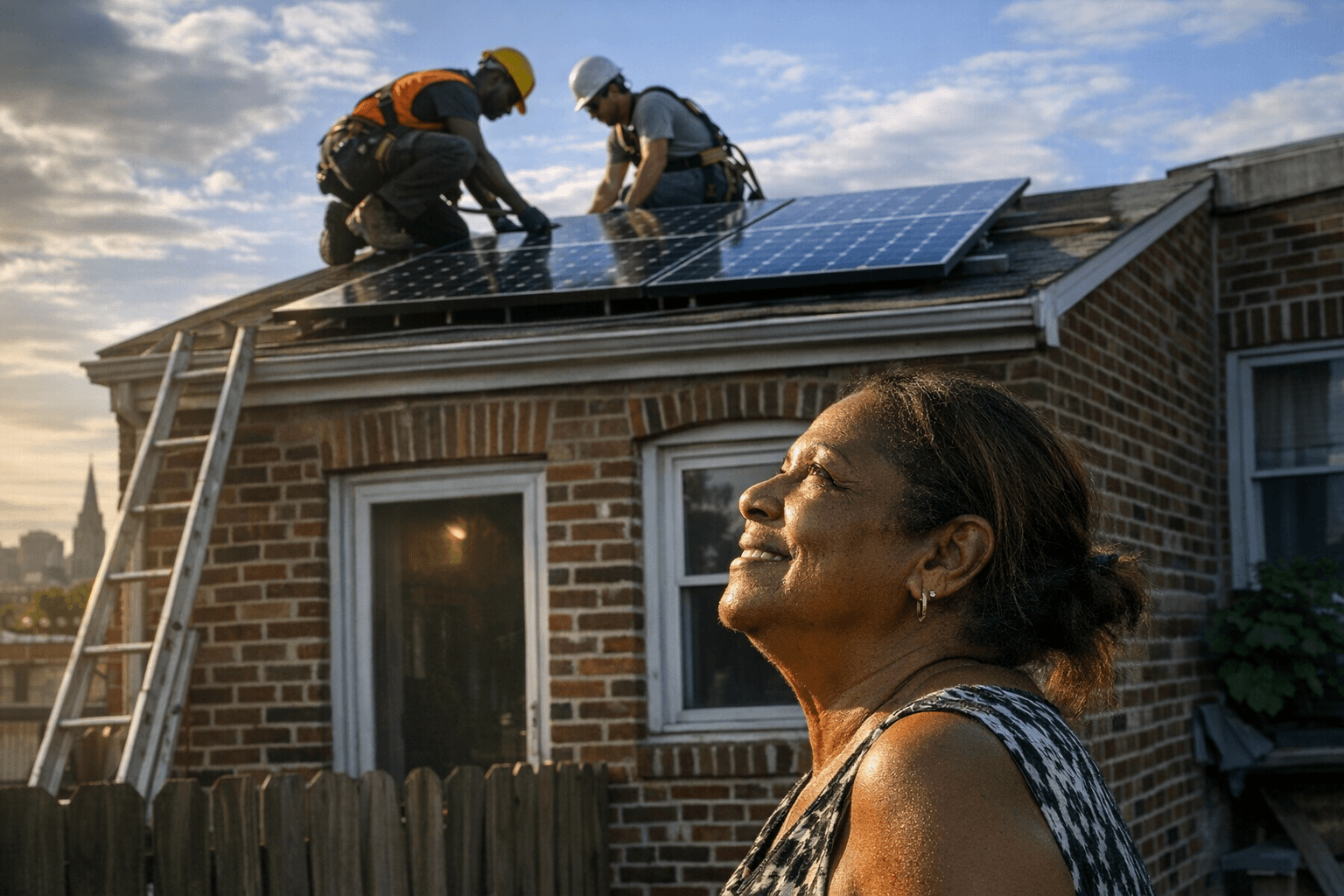
After nearly a year of information sessions, an online application, a roof assessment and multiple house visits, her panels went up in June 2023. By December they were generating power, and her BGE bill, which had run around $400 a month, dropped to between $176 and $230, a savings of roughly 50 percent.
Gonzalez is among the homeowners served by Baltimore Shines, a partnership between the Baltimore City Department of Housing and Community Development and the nonprofit Civic Works that has provided free rooftop solar installations to income-qualified city residents since 2015. The program's current round, which started in 2024, had completed 50 installations as of December. Civic Works aims to reach 170 by the end of 2026.
The savings can be dramatic. In the Forest Park neighborhood of Northwest Baltimore, William Gibson watched his BGE bill, which during winter months could reach $300 to $400, drop to nearly nothing after panels were installed on his 1925 single-family home. BGE now sends him an annual payment for the electricity his system feeds back into the grid. "It was a surprise," Gibson said. "I'm on a fixed income, and this helps my bottom line tremendously."
The program's structure explains its reach: Civic Works owns and operates each system under a 20-year prepaid lease, covering all maintenance and repairs at no cost to the homeowner, with the goal of transferring ownership at the lease's end. Without the program, outfitting an average Baltimore row home with an 11-kilowatt system would cost between $15,000 and $18,000, according to Victor Walters, associate director of outreach and intake at Civic Works.
To qualify, applicants must own their home in Baltimore City and earn below the program's income thresholds: $26,338 for a single-person household, $54,600 for a family of four, or $92,260 for a family of eight.
Eli Allen, senior program director of Civic Works' Energy Programs, said the design prioritizes simplicity for the homeowner. "Our goal is to really make it as easy and worry-free a process as possible for the resident," Allen said.
Civic Works has drawn on more than $4.6 million in grants to fund Baltimore Shines, pulling from the Maryland Energy Administration, Baltimore City, Solar Renewable Energy Credits and the Inflation Reduction Act's solar tax credit of up to 40 percent. As a nonprofit, Civic Works receives those credits and passes the savings directly to participants. Last December, BGE and the Exelon Foundation added a $250,000 grant to fund no-cost installations for up to 30 additional qualifying homeowners.
The federal Solar for All program, which previously supported larger systems, scaled back in 2025, pushing installations in the current round to 5.7 kilowatts rather than the 11-kilowatt capacity a typical row home can handle. Allen has said the program was "designed to benefit from federal funding, but not to rely on federal funding," and its multi-source financing has kept installations moving despite that shift.
Baltimore Shines also doubles as a workforce pipeline, placing paid entry-level solar technician trainees on real installations to prepare them for mid-skill careers in the clean-energy trades. If the program reaches its 170-installation target, Civic Works projects participants will collectively save more than $200,000 a year on utility bills and reduce the city's carbon emissions by more than 700 metric tons annually.
This article was produced by Prism’s automated news system from verified source data, official records, and press releases, then run through automated quality and moderation checks before publishing. The system is built and supervised by the people who set the standards it runs under. Read our full AI policy.
Did this article answer your question?