Baltimore weighs split-rate property tax to spur development
A split-rate property tax could shift Baltimore's burden from buildings to land, easing some improved properties while making vacant lots costlier. Legal and political hurdles still loom.
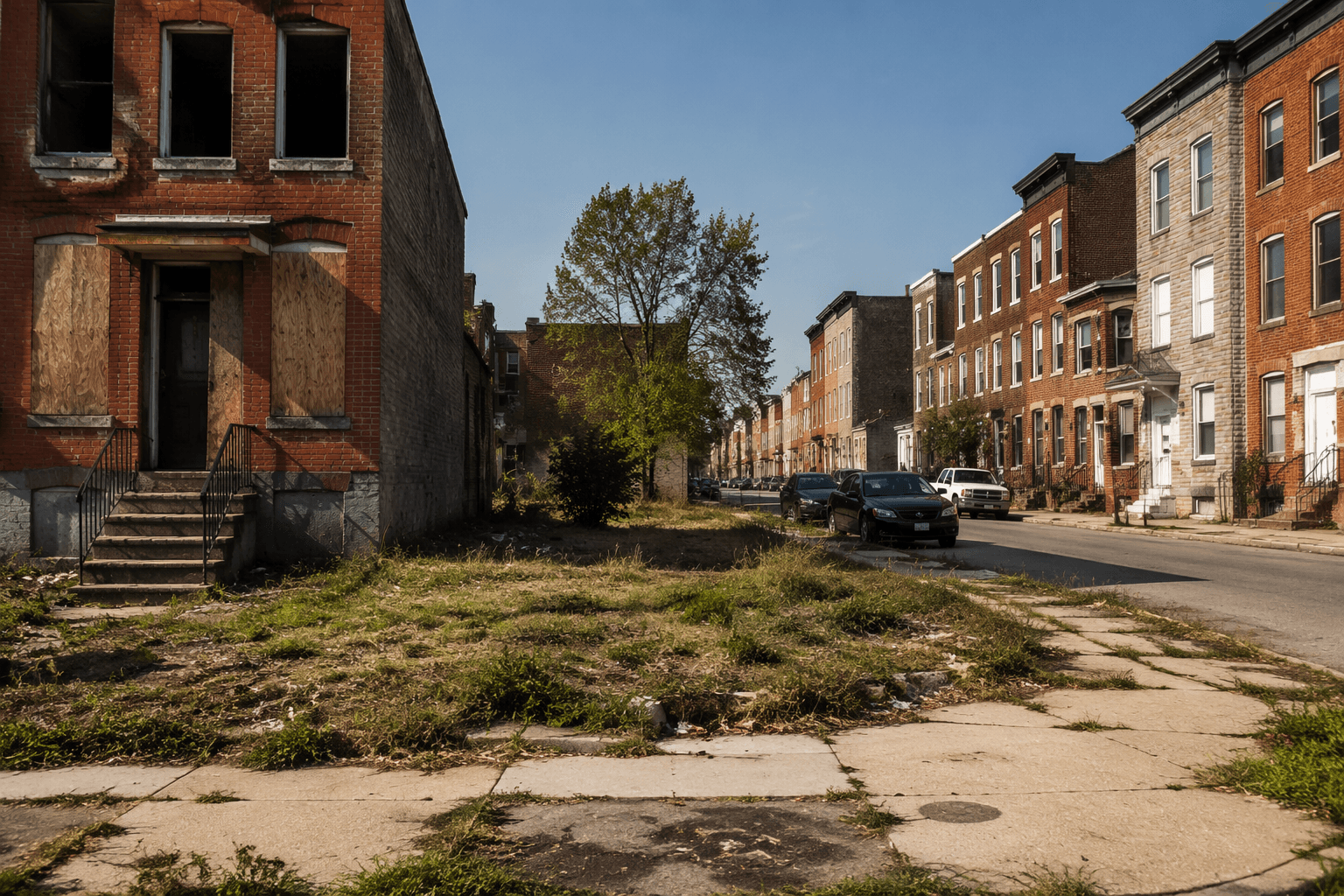
Vacant lots, surface parking and underused parcels in Baltimore would become more expensive to hold under a split-rate property tax, which would push more of the city’s burden onto land and less onto the buildings on it. In a city where empty land still slows redevelopment, the test is whether the tax would reward construction or add another layer to a system residents already struggle to follow.
What a split-rate tax would do
The basic idea is straightforward: tax land and buildings at different rates. Taxing land more heavily than improvements gives owners a stronger reason to build on it, maintain it or sell it to someone who will. That can matter in Baltimore, where long-vacant parcels and deteriorated structures still sit on blocks that city leaders want to see put back to work.
For homeowners, the effect would depend on how the city draws the lines. A property with an existing house, rowhouse or other improvement could see a lower tax burden on the structure itself if Baltimore shifts more of the bill to land. Owners of vacant lots, surface parking and lightly used parcels would likely feel the sharpest pressure because they would be carrying more tax on the value of the site alone.
It could lower the incentive to sit on empty land and wait for values to rise, while also rewarding people who already have buildings in productive use. It could also create a new version of the same tax debate if residents see only a different distribution of the burden rather than real relief.
Why Baltimore keeps coming back to the idea
Baltimore’s property-tax structure shapes whether small homeowners feel squeezed, whether developers see opportunity in vacant parcels and whether neglected blocks are more likely to attract infill construction. The city’s long-running struggle with vacancy makes that especially important, because the cost of holding land idle can influence whether a lot remains a lot or becomes a building site.
Split-rate taxation keeps showing up as a redevelopment tool. In neighborhoods where empty lots, surface parking and worn-out properties have slowed revival, the policy could make it more expensive to leave land underused and more attractive to put it into productive use. If the incentives work, the city could see more pressure on owners to build, sell or improve.
The risk is political as much as fiscal. Baltimore’s housing and development debates already balance affordable homeownership, support for neighborhood investment, and pressure to keep taxes predictable for longtime residents. A split-rate system would enter that mix with no guarantee that homeowners would see the benefit advocates imagine.
What Annapolis would have to change
Baltimore already has a legislative lane for this idea. House Bill 1178 in the 2025 Maryland General Assembly, titled “Baltimore City - Property Taxes - Authority to Set Special Rates,” was introduced on February 6, 2025 and assigned to the House Ways and Means Committee. The bill would have authorized Baltimore City to set special property tax rates for any class or subclass of property subject to the city property tax.
The fiscal note found no effect on the State, but Baltimore City property-tax revenues could change depending on the rate structure the city adopted. The bill was set to take effect June 1, 2025 and would apply to taxable years beginning after June 30, 2025.
The question in Annapolis was whether Baltimore should be allowed to design its own rate structure, not whether a split-rate system is philosophically attractive. BaltPOP supported the bill with amendments, saying it would give local government more tools and bring Baltimore in line with other municipalities in Maryland on taxation tools. Rick Rybeck, director of Just Economics, LLC, testified in favor on February 26, 2025 and described his work as focusing on aligning economic incentives with public policy objectives.
There was also resistance. An unfavorable February 24, 2025 testimony argued that HB 1178 would authorize Baltimore City to set differential tax rates. A split-rate system creates different treatment for land and improvements rather than keeping one flat rate across the property-tax base.
The legal fight around Baltimore’s taxing power
The politics of property tax reform in Baltimore sit inside a deeper legal argument over who gets to change the city’s tax structure. In Benedict J. Frederick, III, et al. v. Baltimore City Board of Elections, et al., the Supreme Court of Maryland held that section 6-302 of the Tax-Property Article, which grants the Mayor and City Council of Baltimore the power to set rates for taxing real and personal property, must be read together with the Baltimore City Charter’s restriction on voter-initiated local laws.
That ruling helps explain why property-tax restructuring keeps moving through both courts and the General Assembly. A 2024 Baltimore property-tax referendum dispute had already reached the Supreme Court of Maryland in related charter-amendment litigation, underscoring how quickly a tax question can turn into a constitutional one in Baltimore. Any split-rate system would have to fit inside that legal framework, not just inside the city budget.
The city’s recent homeowner-relief efforts add another layer. Baltimore City officials have pursued measures that include changes to the homestead property tax credit cap, a reminder that even modest tax changes can trigger deep sensitivity among homeowners. The city’s own property-tax debates have also been shaped by the Department of Legislative Services’ Baltimore City Property Tax Study, published in December 2014.
This article was produced by Prism’s automated news system from verified source data, official records, and press releases, then run through automated quality and moderation checks before publishing. The system is built and supervised by the people who set the standards it runs under. Read our full AI policy.
Did this article answer your question?