Earth Day delivery sends 8,000 pounds of produce to city schools
More than 8,000 pounds of produce reached 12 Baltimore schools on Earth Day, a drop organizers said could help feed over 500 families.
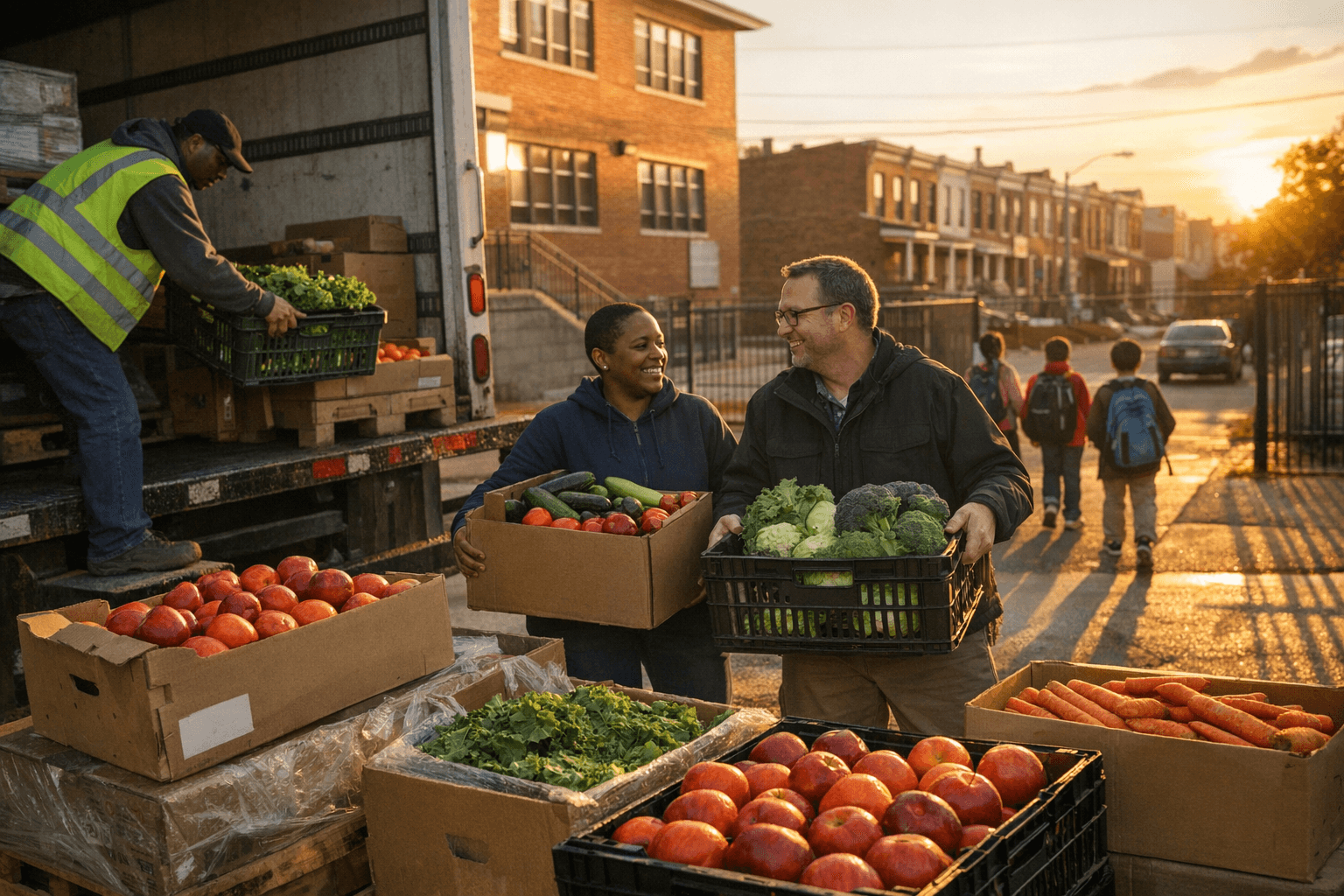
More than 8,000 pounds of surplus produce rolled into 12 Baltimore City elementary schools on Earth Day, a one-day Food Recovery Network delivery that organizers said was their largest single-day distribution ever and enough to help feed more than 500 families.
The scale mattered because the food was not going to a charity shelf or a distant warehouse. It was sent directly into school buildings that Baltimore families already use, turning classrooms and cafeterias into distribution points for fruits and vegetables that would otherwise have been thrown away even though they were still perfectly good to eat. At roughly 16 pounds of produce for each family if divided evenly, the delivery showed how much food can move when waste and hunger are treated as the same problem.
That local need is real. Baltimore City has said a recent study found as many as 28% of residents are food insecure, while Feeding America estimated in October 2021 that food insecurity rose from 18% to 21.7% during the pandemic, with child food insecurity estimated at 33%. Nationally, as much as 40% of the food supply goes to waste each year, a mismatch that makes produce recovery in school buildings less symbolic than practical.
Baltimore’s Department of Planning has tried to address that gap with food maps, data and its Healthy Food Environment Strategy, which is aimed at neighborhoods facing health, economic and environmental disparities tied to limited access to healthy food. The city said it worked with the Johns Hopkins Center for a Livable Future on food-environment research from 2011 to 2018, and its planning work now involves Resident Food Equity Advisors and the Food Policy Action Coalition.
The city has also put money behind the effort. Mayor Brandon M. Scott announced $26.7 million in ARPA investments beginning in 2021 to address food insecurity, including $11.1 million for the Department of Planning for food-system programs such as produce box distribution. Food Recovery Network’s Earth Day delivery fit into that broader push by using a familiar site, the school, as a reliable access point for families who may have trouble buying fresh food elsewhere.
The challenge is scale. Baltimore City Public Schools reported 76,362 students in the 2025-26 school year, far more than any single drop can reach. Food Recovery Network said in August 2025 that it was already hosting free pop-up produce markets for Baltimore school families at Title I elementary schools, a sign that the Earth Day delivery was not just a one-off donation but part of a model that could work again if schools, grocers and distributors keep feeding it with steady surplus.
This article was produced by Prism’s automated news system from verified source data, official records, and press releases, then run through automated quality and moderation checks before publishing. The system is built and supervised by the people who set the standards it runs under. Read our full AI policy.
Did this article answer your question?