How to Visit Baltimore’s Lexington, Hollins and Broadway Public Markets
Walk three of Baltimore’s oldest markets, Lexington (founded 1782), Hollins (1877 building), and Broadway (est. 1786), with addresses, vendors, renovation facts, events and policy notes.
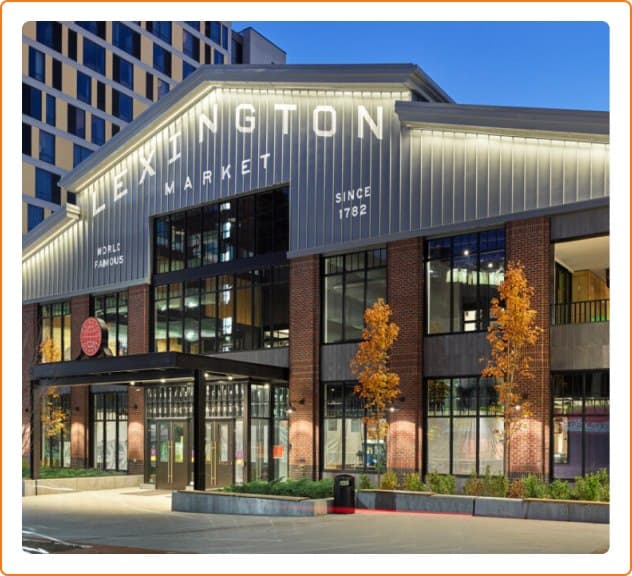
Baltimore’s markets are municipal anchors for fresh food, small business and neighborhood life: Lexington’s 1782 founding and recent expansion, Hollins’s $2.1 million rebuild of seven stalls, and Broadway’s Fell’s Point shed for steamed crabs each illustrate how public investment and vendor mix shape daily access to food and foot traffic.
1. Lexington Market, 112 N Eutaw St Baltimore, MD 21201
Lexington Market was founded in 1782 on land donated by John Eager Howard and is described in market materials as “the oldest continually running market in America.” The site recently underwent a major renovation that added a second market building, a walkable urban plaza, green space and a performance venue, changes intended to boost visits and stall revenue by creating a daytime and evening draw. Longstanding vendors include Faidley’s Seafood and Connie’s Chicken and Waffles; newer BIPOC vendors named in market copy are Dancing Potato, Charro Negro and Deddle’s Donuts, signaling vendor diversification. Lexington’s visitor pages list practical navigation items, Getting Here, Parking, Tours, Neighborhood, FAQ, Contact Info, and programing includes Free Baltimore Yoga sessions (each hosted by a different teacher, 10AM–11:30AM, free); the site’s promotional language calls it “more than a building” and “A MARKET FOR THE PEOPLE.”
2. Hollins Market, 26 S. Arlington Ave Baltimore, MD 21223 (Pigtown / Washington Village)
Hollins Market is identified in sources as “the oldest public market building still operating in the city of Baltimore,” with one account dating the building to 1877 and noting it served as a supply shop during the Civil War. The market recently completed a $2.1 million renovation that revitalized the exterior and reconstructed seven interior stalls; the site is still recruiting vendors to fill those spaces, which has direct implications for local small-business formation and neighborhood food access. An adjacent French‑inspired restaurant, Rooted Rotisserie, provides brunch and dinner options, while Hollins stages live-music programming under the Summer Sounds series, events designed to increase evening foot traffic and broaden the market’s economic footprint. The renovation dollars and ongoing vendor recruitment demonstrate how capital investment translates into both physical preservation and new commercial opportunity.
3. Broadway Market (Fell’s Point), 1640 Aliceanna St Baltimore MD 21231
One of Baltimore’s earliest public markets, Broadway Market was established in 1786 in the historic Fell’s Point district, where farmers once arrived by wagon, boat and ferry to serve immigrants and sailors. Today the market blends “old‑world” vendors, Sophie’s Place European Deli and Sal’s Seafood, with newer culinary concepts like Everest Spice Bar & Grill and local favorites such as Taharka Bros ice cream. The south shed is anchored by Choptank, promoted for steamed crabs, fresh seafood and outdoor libations, which underscores Broadway’s continuing role in both grocery supply and hospitality. That mix of stall types makes Broadway a useful case study in how market spaces adapt to both everyday grocery needs and tourist-oriented food experiences.
- Lexington Market, 112 N Eutaw St, Baltimore, MD 21201; vendors: Faidley’s Seafood, Connie’s Chicken and Waffles, Dancing Potato, Charro Negro, Deddle’s Donuts; events: Free Baltimore Yoga 10AM–11:30AM (free); masks strongly recommended.
- Hollins Market, 26 S. Arlington Ave, Baltimore, MD 21223; building dated to 1877; $2.1M renovation rebuilt seven stalls; adjacent Rooted Rotisserie (French‑inspired).
- Broadway Market, 1640 Aliceanna St, Baltimore, MD 21231; vendors: Sophie’s Place European Deli, Sal’s Seafood, Everest Spice Bar & Grill, Taharka Bros, Choptank (south shed).
- Cross Street Market, recently renovated; longtime tenants include Fenwick Choice Meats and Steve’s Lunch (specific street address not provided in the excerpts).
- Northeast Market, 2101 E Monument St, Baltimore, MD 21205.
- Avenue Market, 1700 Pennsylvania Ave, Baltimore, MD 21217.
Practical directory and quick notes
Governance, outreach and public-health guidance The Baltimore Public Markets organization identifies the system as municipal: one source states it “operates six city-owned markets across Baltimore City,” and leadership messaging highlights Shaina A. Hernandez as the new President and CEO, described as a “former Deputy Chief of Staff of the State of Maryland” with economic development experience. Marketing copy invites vendor applications, “Join our community of vibrant vendors, connect with awesome folks, and let’s grow your business together!”, and encourages newsletter signups for offers and events. Public‑health guidance on event pages is explicit: “Masks are strongly recommended at all times to protect our immunocompromised community members,” a policy choice that affects visitor behavior and the inclusivity of indoor market spaces.
What the numbers and renovations imply Capital projects and programing create measurable flow-on effects: Hollins’s $2.1 million renovation rebuilt seven stalls, which directly creates at least seven vendor opportunities and potential jobs. Lexington’s new plaza and performance venue are designed to lengthen visitor dwell time, beneficial for stall revenues and for adjacent downtown businesses. The city‑owned structure of the market system allows for coordinated investment and vendor recruitment, and the $35 million capital campaign that repurposed the century-old Fish Market into Port Discovery (1998) is an earlier example of how large public or nonprofit financing can transform waterfront assets into higher‑traffic destinations.
Historical claims and reporting nuance Source materials present competing historical claims: Lexington Market is explicitly described here as “founded in 1782” and “the oldest continually running market in America,” while a separate source copy (Edited by Ron Cassie | May 2014) asserts the public market system “predat[es] the Declaration of Independence by more than a dozen years.” Both statements appear in the assembled material; readers should note the discrepancy between the specific founding years and the broader system claim as part of the markets’ layered public narrative.
Final point Visiting Lexington, Hollins and Broadway combines food, history and observable municipal policy: renovations, vendor recruitment and event programming are concrete drivers of neighborhood economic activity and access to fresh food. As Baltimore continues to invest in market infrastructure and diversify vendor mixes, these markets will remain pivotal test cases for how public capital and small-business incubation translate into daily economic outcomes for residents and visitors alike.
This article was produced by Prism’s automated news system from verified source data, official records, and press releases, then run through automated quality and moderation checks before publishing. The system is built and supervised by the people who set the standards it runs under. Read our full AI policy.
Did this article answer your question?


