Iraqi refugee finds belonging, leadership through Baltimore soccer program
A refugee who arrived in Baltimore at 12 turned a free soccer program into a path to leadership, showing how local youth spaces help newcomers belong.
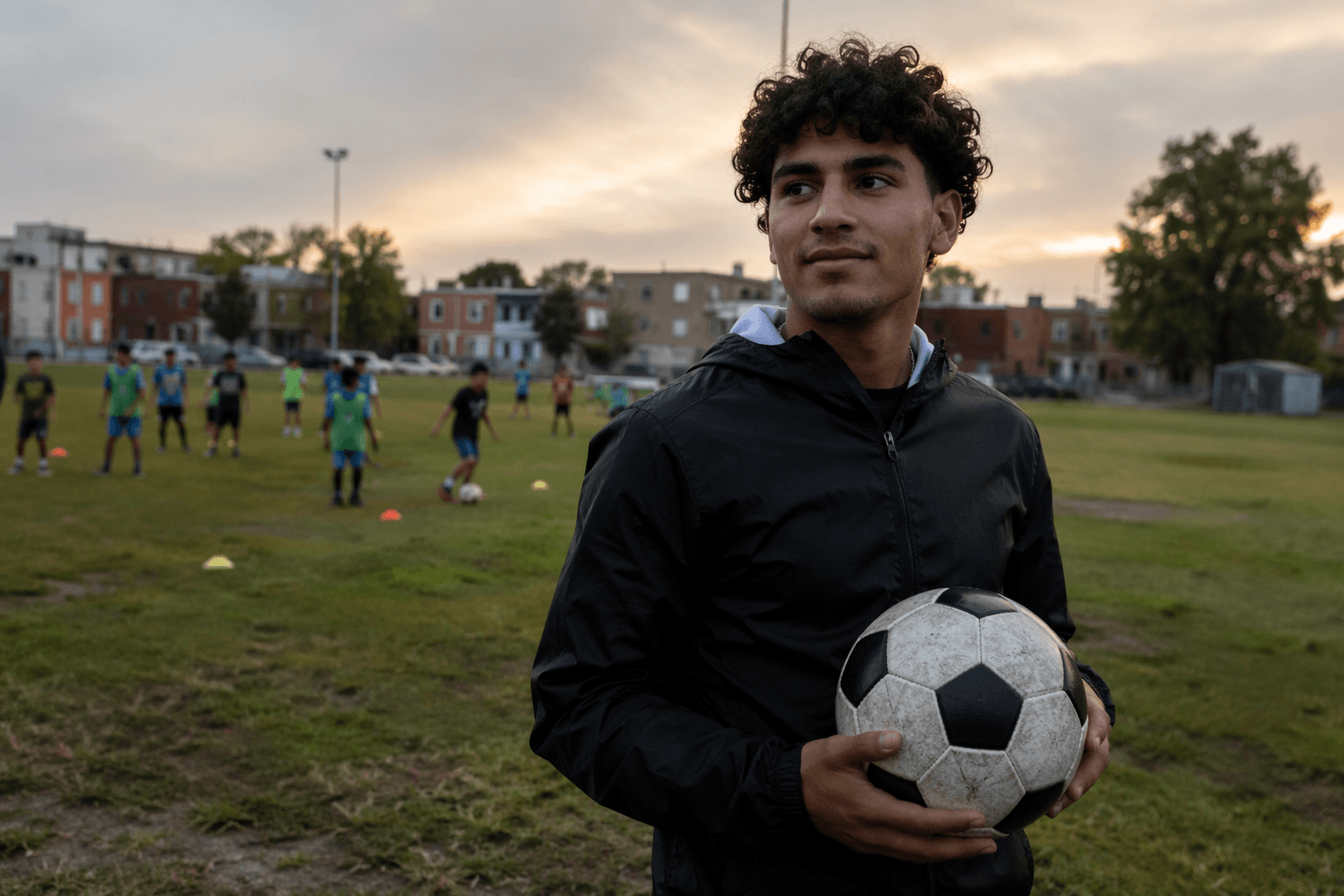
Warshan Hussin’s path through Baltimore soccer is bigger than a sports story. It begins with a family fleeing Iraq, spending four years in Syria, and landing in Baltimore when he was 12, then stretches from a free youth program to a seat on the board of directors at Soccer Without Borders.
That arc matters now because the World Cup is about to put soccer back at the center of American life. In Baltimore, though, the deeper story is not the tournament itself. It is how a city nonprofit uses the game to help immigrant and refugee youth find structure, confidence, and community, then turn that support into leadership.
How a free soccer program became Hussin’s first Baltimore anchor
Hussin arrived in the United States in middle school without speaking English, and by his own account he struggled to find his footing in school. A refugee resettlement program introduced him to Soccer Without Borders, where he found something many newcomers need before anything else: a place to belong.
The program was free, which made it accessible to families who were rebuilding their lives from scratch. On the field, soccer became more than exercise or competition. It gave Hussin a shared language with people from many countries and a way to connect without having to master English first. That kind of entry point can be decisive for a young person adjusting to a new city, new schools, and a new set of expectations.
Hussin initially hoped to become a professional player and stayed with the sport through high school. An injury at Stevenson University ended that dream, but it did not sever his relationship with the organization that helped him settle in. Instead, he came back in a different role, first as a part-time coach and later as a staff member working on finances.
From participant to board member
The turning point in Hussin’s story is not just that he stayed involved with Soccer Without Borders. It is that he moved from participant to leader. In a November 26, 2024 post, the organization welcomed him to its board of directors and said his journey with SWB began more than a decade earlier, when his family resettled in the United States as refugees from Iraq.
That progression says a lot about what a strong youth program can do when it is built for the long haul. It does not just create a team for a season. It develops leaders who know the neighborhood, understand the barriers facing newcomer families, and can guide younger players through them.
Soccer Without Borders also identified Hussin as a University of Baltimore graduate with a degree in International Business. That detail is important because it shows the program’s reach beyond the pitch. Hussin’s experience links recreation, education, and professional development in one local pipeline, a model that can matter as much for workforce readiness as it does for sports participation.
What the Baltimore hub offers young people
Soccer Without Borders Maryland now anchors that work from 3700 Eastern Avenue, which the organization purchased on November 4, 2021 to serve as a youth hub and headquarters. The location gives the group a physical base in the city where participants can connect to staff, mentors, and programming close to home.
The Baltimore City program began in the fall of 2009 after local agencies identified a need for positive recreational programming for refugee youth. That origin story still shapes the organization’s role today. Johns Hopkins SOURCE says the Maryland program directly serves newcomer refugee and immigrant youth in Baltimore City and Baltimore County through out-of-school-time programs during the school year and summer.
The participant mix reflects Baltimore’s broader immigrant community. SOURCE says youth in the program include Eritrean, Congolese, Syrian, Salvadoran, Ecuadorian, and Guatemalan students. In a city where nearly one in 11 residents was born outside the United States, that mix is not incidental. Data USA reports that 9.1% of Baltimore city residents, about 52,200 people, were born outside the country in 2024.
Why the model works for shy or newly arrived kids
Kat Sipes, the program manager for the Maryland hub in Baltimore, says the organization gives shy, non-English-speaking children a place where they can become confident and outgoing. That is the core value of the model: it turns a recreational space into a social one, then a social one into a developmental one.
For many newcomer youth, the barriers are layered. Language, transportation, school adjustment, family stress, and uncertainty about the future can all make a city feel bigger and harder to navigate. Soccer Without Borders answers those pressures by pairing play with stability, regular adult mentorship, and a place where young people can show up consistently.
The value of that structure extends beyond the immediate team environment. When a program like this creates routine, it can support school engagement, social trust, and a sense of belonging that spills into the rest of a child’s life. Hussin’s path, from newcomer to coach to board member, is the clearest proof of how that progression can work.

Baltimore’s larger refugee and immigrant support network
Soccer Without Borders is one piece of a wider support system in Maryland. The Maryland Office for Refugees and Asylees says it coordinates services through public and private providers that include employment services, transitional financial assistance, health assistance, medical screenings, English language and vocational training, case management, youth programming, and more.
That broader network matters because the needs facing refugee families do not stop at the soccer field. Children need access to safe activities and trusted adults. Parents need help navigating employment, language learning, and health systems. Programs that connect those pieces can help families move from emergency resettlement toward long-term stability.
Baltimore has long been one of the places where that work plays out on the ground. The city’s immigrant population, the presence of resettlement and service organizations, and neighborhood-based institutions all shape how newcomers experience the city. Soccer Without Borders fits into that ecosystem by meeting young people where they are and giving them a place to grow.
Why the World Cup brings fresh relevance
FIFA says the 2026 Men’s World Cup is being co-hosted by the United States, Mexico, and Canada and will feature a record 48 teams. U.S. Soccer says there will be 104 matches across 16 host cities in North America, including 78 games in the United States.
For Baltimore, the tournament is less about stadium optics than about visibility. Hussin hopes the World Cup’s arrival in the United States will draw more young people to Soccer Without Borders’ Eastern Avenue headquarters. That is a practical hope, not a ceremonial one. Major events can inspire interest, but the real challenge is turning that attention into local access, especially for youth who need free, reliable, and welcoming spaces.
Hussin’s story shows why that matters. A soccer ball did not just help him pass time after arriving in Baltimore. It helped him build confidence, connect across language barriers, finish school, return as a mentor, and eventually help steer the organization that once welcomed him. In a city shaped by migration, that is what a durable youth pipeline looks like: a small field, a steady program, and a path from newcomer to leader.
This article was produced by Prism’s automated news system from verified source data, official records, and press releases, then run through automated quality and moderation checks before publishing. The system is built and supervised by the people who set the standards it runs under. Read our full AI policy.
Know something we missed? Have a correction or additional information?
Submit a Tip