Bamberg County explains where trash goes and what can be recycled
Bamberg County sends trash from its transfer station to Jackson and accepts a defined list of recyclables at free residential sites across the county.
Bamberg County does not pick up household garbage at the curb, so the county’s trash system starts the moment a resident decides whether to drive to a convenience site, haul debris to the landfill, or call a private hauler. Municipal solid waste is received from municipalities and private waste haulers, loaded onto trailers, and sent for disposal at an approved landfill operated by the Three Rivers Solid Waste Authority in Jackson, South Carolina.
How the system works after pickup
What looks like a simple garbage route is really a countywide transfer network. Bamberg County Public Works runs the solid-waste system as part of its job to improve safety, cleanliness, health and quality of life, and the county’s broader mission ties that work to infrastructure and the business climate. The county also operates a construction and demolition landfill, collects waste tires for recycling, accepts yard debris, and manages eight solid-waste collection and recycling centers.
That matters for households because the county system is designed to sort what can be recovered before the rest leaves Bamberg County for final disposal. If residents mix unacceptable material into a load, the problem is not just personal inconvenience. It can force a wasted trip, slow down the site, or add handling cost that eventually lands in county operations and, by extension, on local taxpayers and ratepayers.
Where residents can take trash and recyclables
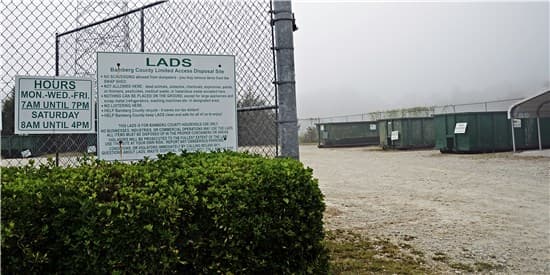
The county’s convenience-site network gives residents a local drop-off option in almost every part of the county: Colston, Govan, Hunters Chapel, Capernaum Road, Midway, Denmark, Public Works/Broxton Bridge, and Rivers Bridge. These centers are for residential use only and are free to use, which makes them the main alternative for households that do not have curbside service.
Hours are consistent at most sites. The convenience sites are generally open Monday, Wednesday and Friday from 7:00 a.m. to 7:00 p.m. and Saturday from 8:00 a.m. to 4:00 p.m., except Broxton Bridge Road. The landfill itself is open Monday through Friday from 7:30 a.m. to 4:30 p.m. For anyone making a special trip, those hours are the difference between a clean drop-off and a truckload that has to sit until the next open day.
What Bamberg County accepts
Bamberg County’s recycling guide makes the accepted items unusually clear, which is exactly what residents need before loading a vehicle. The county accepts:
- aluminum cans
- steel cans
- glass
- cardboard
- used cooking oil
- electronics
- plastics numbers 1 and 2
- white goods
- scrap metal
- tires, with a limit of five tires per person per year
Those details help explain the county’s biggest point of confusion: not every plastic container belongs in the recycling stream, and not every bulky item is treated the same way. Plastics numbers 1 and 2 are accepted, but that does not mean every mixed plastic tray, bag, or foam container is welcome. White goods and scrap metal go in different handling streams, and electronics should be set aside rather than mixed into general trash.
The county also accepts yard debris, and it points residents toward special reuse efforts that stretch the life of materials before they become waste. One of those efforts is a school plastics collection program, and another is composting support through Keep Bamberg County Beautiful. That gives the county a practical second step for items that can be recovered locally instead of buried or hauled away.
What it costs to use the system
County Council sets the tipping fees that shape how much disposal costs once waste reaches the system. Municipal solid waste is $50.00 per ton, while construction, demolition and land-clearing debris is $45.00 per ton. Those rates matter to homeowners hiring contractors as much as they matter to haulers, because a load that could have been sorted more carefully may end up costing more at the scale.
The county’s solid-waste operation is managed as an enterprise fund, which means it is tracked as an ongoing public service with its own revenues and spending. In June 2024, the fund had budgeted revenues of $1,449,735, had collected $1,016,024, and had spent $1,308,337. By January 2025, budgeted revenues had risen to $1,544,940, with $731,538 collected and $871,030 spent. The numbers show a system that is active, expensive to run, and dependent on steady use.
Why the county is expanding collection options
Bamberg County has also pushed for more recycling access beyond the residential convenience-site model. A $50,000 Solid Waste, Increased Collection Grant was set aside to open a Business Recycling Center within the city limits of Denmark so smaller businesses could recycle at an exclusive site. That is an important clue about where the county sees pressure in the system: not just in household disposal, but in the lack of easy recycling access for local commerce.
The county’s geography helps explain why the service has to be spread out. Bamberg County was established in 1897 from Barnwell County and covers about 395 square miles. In a county that size, the difference between a nearby convenience site and a long haul to the landfill can decide whether materials get disposed of properly or end up in the wrong place.
The county’s trash and recycling network is not a background service. It is the part of local government that decides where waste goes, what residents can recover, and how much the system costs to keep working from one end of the county to the other.
This article was produced by Prism’s automated news system from verified source data, official records, and press releases, then run through automated quality and moderation checks before publishing. The system is built and supervised by the people who set the standards it runs under. Read our full AI policy.
Did this article answer your question?