Bamberg County mosquito control ramps up for summer season
Bamberg County’s mosquito crews are back on a rotating evening schedule through September. Clearing standing water now can cut bites and reduce disease risk.

Crews are back on the summer clock
Bamberg County is moving into mosquito-control season now, and the county says spraying typically starts around June 1 and runs through September. Work is usually done two evenings a week on a rotating schedule, which means residents should expect the activity to move from one part of the county to another as the summer wears on.
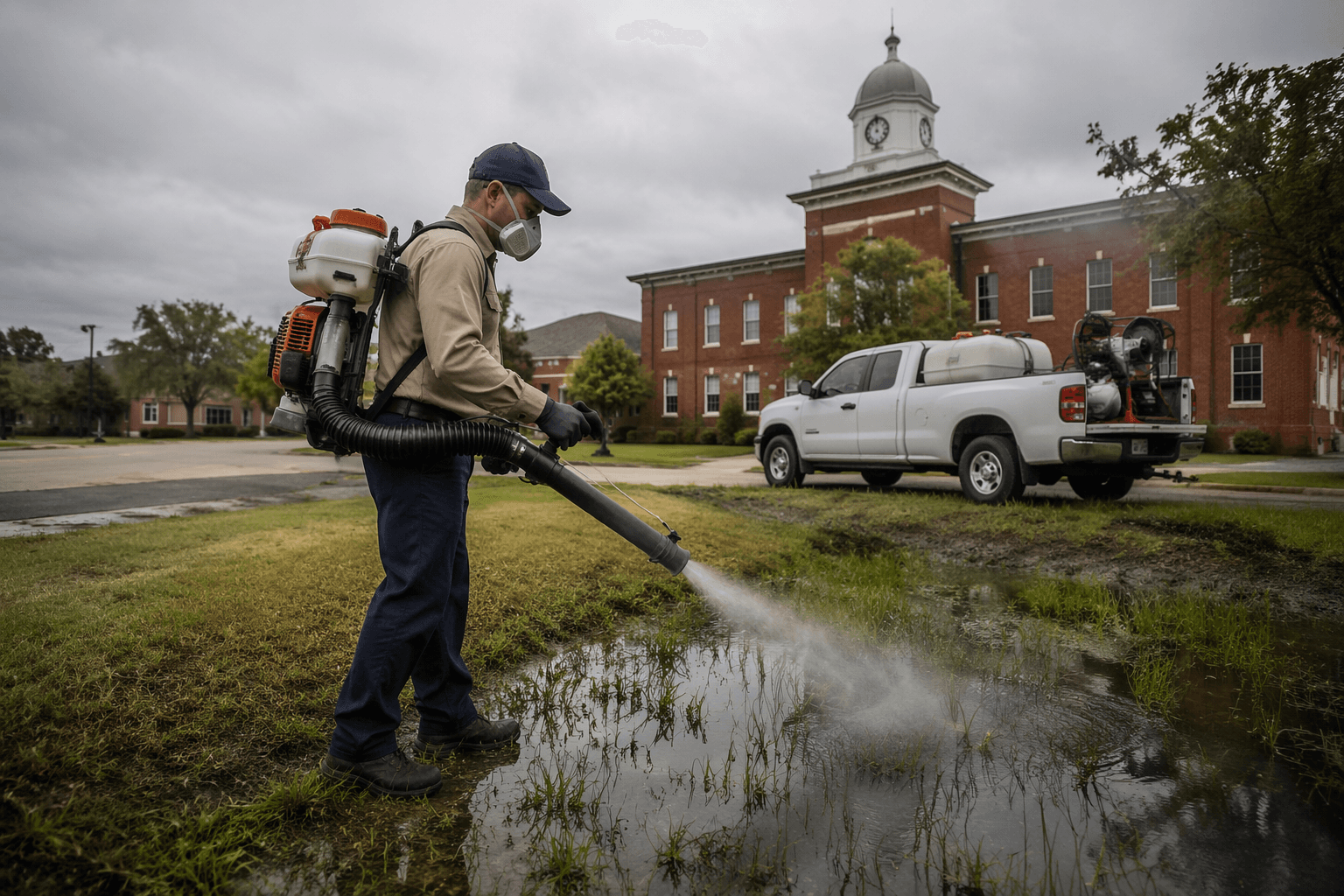
That matters in a rural county where broad open land, drainage areas, standing water and scattered neighborhoods can quickly turn mosquitoes into more than an annoyance. When mosquito pressure rises, it affects whether families can sit outside after supper, whether children can play without constant bites, and whether older residents or people with health vulnerabilities can stay outdoors comfortably.
How the county organizes the work
The county places Mosquito Control inside the Bamberg County Building & Planning Department, and it describes the program as a mix of surveillance and inspections, larval control and source reduction, and adult control. In practical terms, that means the county is not only spraying adult mosquitoes, but also looking for places where they breed and trying to cut off the problem before it grows.
Bamberg County Public Works also lists mosquito control as one of its three divisions, alongside road maintenance and solid waste. That structure is important because it shows mosquito control is handled as a core county service, not a one-time seasonal response that appears only after complaints spike.
For residents, the rotating schedule is the key detail. Crews are not staying in one pocket of the county all summer, and the county’s public-facing information suggests activity will keep shifting as conditions change. If you live near low spots, drainage ditches, culverts, farm edges or other water-holding areas, those are the places most likely to draw attention when the county is deciding where to work next.
Why this is a public-health issue, not just a nuisance
South Carolina has at least 61 different mosquito species, according to the South Carolina Department of Public Health, and mosquitoes in the state can spread West Nile virus, Eastern equine encephalitis, La Crosse encephalitis, Saint Louis encephalitis virus, and dog and cat heartworm. That makes county mosquito control part of everyday disease prevention, especially in warm months when populations grow fast.
The Centers for Disease Control and Prevention says West Nile virus is the leading cause of mosquito-borne disease in the contiguous United States. The CDC also says about 2,000 people in the United States are diagnosed with West Nile virus each year, though the true number is likely higher because many infections are mild or never reported. For local families, that is the clearest reminder that a spray truck on an evening route is tied to a larger public-health system.
South Carolina health officials also emphasize that mosquito control works best when counties are connected to statewide surveillance. The state health department’s Division of Vector-Borne Diseases works with city and county officials, universities and other government partners on surveillance and public health protection, and the department tracks mosquito-borne disease trends through a public dashboard and a local mosquito-control-agencies directory. Bamberg County’s program sits inside that broader network.
What residents can do at home
The county’s emphasis on source reduction is the part homeowners and renters can influence most directly. Mosquitoes need water to breed, so the first line of defense is not just treating the air after insects appear, but removing the places where they start.
A practical checklist looks like this:
- Empty buckets, toys, flowerpots and containers that collect rainwater.
- Check gutters, downspouts and drainage areas so water is not sitting after storms.
- Refresh birdbaths, livestock water and pet water containers often.
- Turn over tires, tubs and other items that can trap rain.
- Look after tarps, boats, equipment and any low spot around the home that stays wet.
That work is especially important before and after spray nights, because new water can collect quickly after an evening thunderstorm or a heavy rain. In a county where the schedule rotates, one neighborhood’s treatment night may be another neighborhood’s turn to focus on cleanup and prevention.
Residents who notice persistent mosquito hot spots can also reach out through county service-request channels. Bamberg County says those requests are documented and evaluated when treatment decisions are made, so the program is not only countywide spraying but also a response to specific problem areas that keep coming back.
A county with a recent warning sign
Bamberg County has already seen how fast mosquito pressure can rise after severe weather. In August 2024, county officials issued a mosquito alert after Tropical Storm Debby, and the county later held a formal debrief on August 12, 2024. That experience is a reminder that wet weather can leave behind a public-health problem long after the storm has passed.
For Bamberg County, the message this summer is straightforward: the county is spraying, but it is also asking residents to do the part that happens around the house, the barn and the yard. The most effective mosquito control in a place like this is still a shared job, and the payoff is safer evenings, fewer bites and less risk when the summer humidity settles in.
This article was produced by Prism’s automated news system from verified source data, official records, and press releases, then run through automated quality and moderation checks before publishing. The system is built and supervised by the people who set the standards it runs under. Read our full AI policy.
Know something we missed? Have a correction or additional information?
Submit a Tip