Denmark landmarks trace Bamberg County’s railroad and telephone history
Denmark’s depot and AT&T building show how a railroad town became a communications hub, and why preserving both still shapes downtown choices today.

Denmark’s most useful landmarks are not just old buildings. Together, the depot and the AT&T building show how Bamberg County’s small city grew around moving people, moving messages, and the decisions that kept both functions visible in the downtown core. The story begins with rail, turns to long-distance telephone service, and lands in the present with restoration work, museum use, and a downtown that still depends on its historic corridor.
From Graham’s Turnout to a town built on rail access
Denmark began in the 1830s as Graham’s Turnout, a name tied directly to the Charleston-to-Hamburg line of the South Carolina Canal and Rail Road Company. Captain Z. G. Graham sold 17 acres in 1830 for that route, and a local marker notes that 16 turnouts, or pull-offs for passing, were spaced along the line. The town was officially chartered as Graham in 1837, which underscores how early the rail connection shaped its legal and physical identity.
That origin matters because Denmark was not simply near a railroad. It was formed by one. The Best Friend of Charleston traveled part of that line before its 1831 boiler explosion, linking this Bamberg County town to one of the most famous early railroad episodes in American history. For present-day readers, that makes the downtown rail corridor more than scenery: it is a surviving record of where transportation first organized the town’s growth.
The name Denmark reflects a later railroad crossing
The switch from Graham to Denmark came in 1893, when the South Bound Railroad established a crossing there and the community coalesced around intersecting lines. One local account says the new name honored B. A. Denmark, a railroad official. That change tells its own economic story: the town’s identity shifted when rail traffic shifted, and the intersection became more important than the original turnout.
SC Picture Project notes that Denmark began as a railroad town in the 1830s and that the tracks later served the Atlantic Coast Line and Southern railroads before becoming an Amtrak line in 1978. That continuity is part of what makes the depot such an important local asset today. Denmark did not lose its rail identity and then reinvent it from scratch. It kept a passenger-rail role, changed the operators over time, and preserved the building that still marks the town’s connection to the line.
The depot now ties rail history to current downtown investment
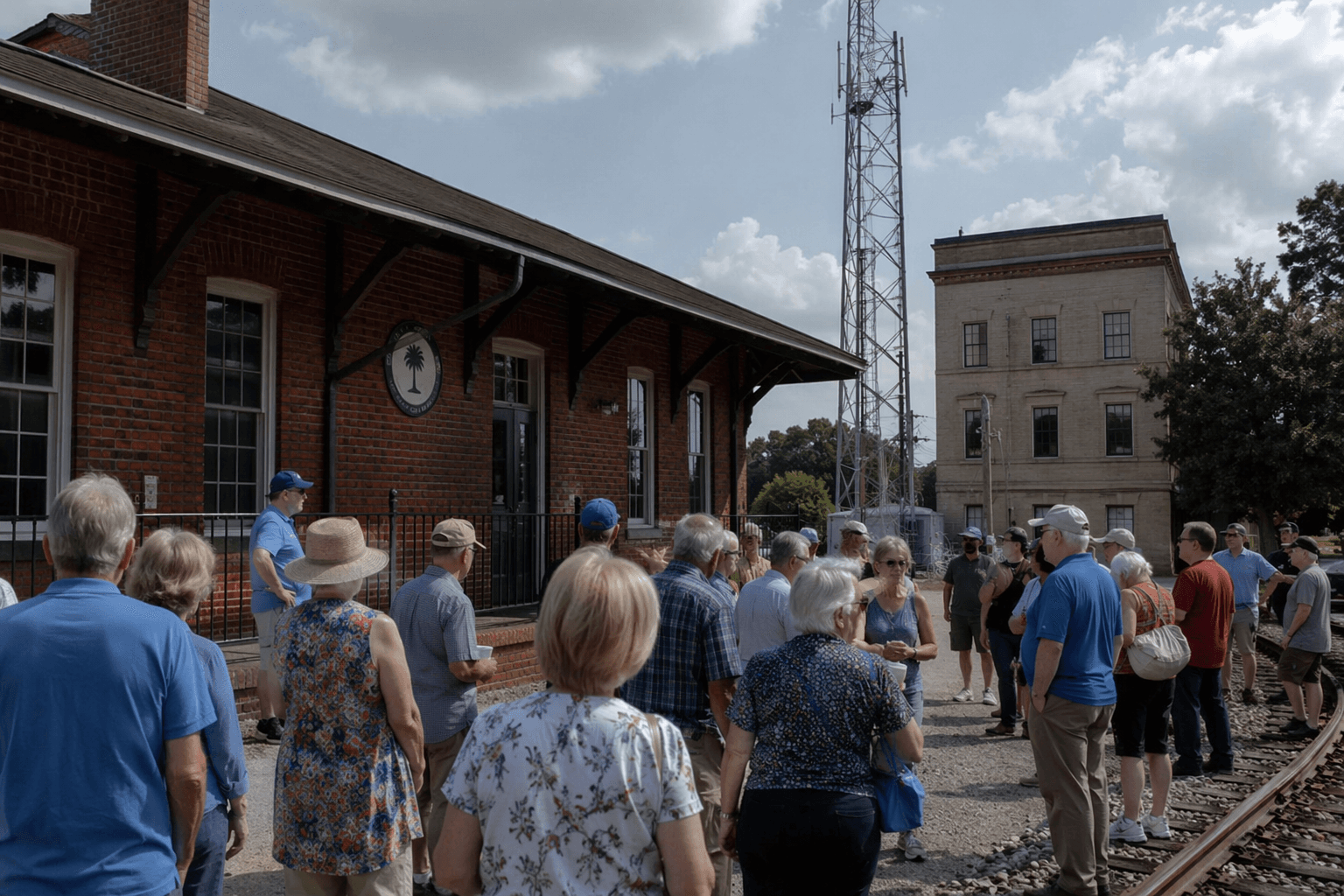
Denmark Depot has become a museum of Denmark history, which makes it useful as both a transportation landmark and a civic exhibit. Amtrak says recent landscaping and renovation were part of the South Carolina Heritage Corridor project, with support from the Denmark Depot Restoration Society and the city. Great American Stations says Denmark received a $200,000 federal Transportation Enhancement grant in 2004 to restore the building, and about 75 commemorative bricks were later laid as part of the fundraising effort.
Those details matter because they show how preservation was financed and who carried it. The depot was not saved by symbolism alone. It took a federal grant, local fundraising, city support, and a corridor project that linked the station to a broader heritage strategy. In practical terms, that means downtown Denmark kept a rail-facing asset that still serves passengers while also functioning as a museum stop for people walking the historic core.
The depot’s location near other walkable landmarks reinforces the point. For residents and visitors alike, the building sits in a part of town where rail history, local memory, and downtown traffic all meet. That makes the depot a case study in the difference between simply keeping an old structure and using it as a working piece of the town’s public realm.
AT&T’s building shows how Denmark became a communications node
Rail was not the only network that put Denmark on the map. The American Telephone and Telegraph Company Building on North Palmetto Avenue shows how the town also became important to communications infrastructure. The Georgian Revival building was completed in 1923 at a cost of $300,000, and it was the third Denmark office of AT&T. It is listed on the National Register of Historic Places, with a listing date of July 8, 1999.
The state historic-property record explains why Denmark mattered so much to telephone service. In 1898, long-distance lines from Virginia to Georgia and from Alabama to Charleston crossed here, making the town a logical switching station. Denmark’s first telephone office opened that same year in a rear room on the second floor of the Guess Building at Palmetto Avenue and 8th Street. That progression, from a back-room office to a purpose-built corporate building, shows how communications investment followed the same pattern as rail: first a crossing, then a node, then a permanent structure.
The AT&T building also broadens the story of downtown preservation. It is not just a handsome old office. It is a physical marker of the moment when Denmark’s local economy connected to regional and interstate communications systems. That gives the downtown corridor a second layer of infrastructure history, one that complements the depot rather than competing with it.
War time security and the value of critical infrastructure
During World War II, soldiers from Fort Stewart guarded both the AT&T building and the nearby depot because the communications node was considered a sabotage target. That detail is easy to miss, but it is one of the strongest signs that Denmark’s rail-and-telephone corridor was not decorative or symbolic infrastructure. It was strategic infrastructure.
The fact that both buildings required protection shows how closely transportation and communications were linked in the town’s daily life and in national defense. Rail movement and telephone switching were both considered essential enough to guard. For modern readers, that helps explain why preservation here is not only about old architecture. It is about retaining the places that once carried services the broader region depended on and still uses in new forms.
Voorhees University adds the campus dimension to the corridor
The corridor’s local meaning extends beyond rail and telephone. Voorhees University was founded in Denmark in 1897 as the Denmark Industrial School for African Americans by Elizabeth Evelyn Wright. The university says its history now spans more than a century, and that places the campus squarely inside the same downtown story of institution-building, access, and long-term local investment.
That matters because the railroad and telephone landmarks are not isolated relics. They sit in a town where education, mobility, and communications developed alongside one another. Elizabeth Evelyn Wright’s school shows another way Denmark functioned as a place where people assembled institutions that outlasted the original transportation boom. The result is a downtown and campus area that still reflects the choices made when the town chose to keep, restore, or repurpose its built environment.
What the corridor tells Bamberg County today
Denmark’s rail-and-telephone corridor offers a clear answer to why the town’s landmarks matter now. The depot shows what the town kept from its railroad past, the AT&T building shows what it gained from its communications role, and the restoration work shows what local leaders and partners decided to invest in for the future. Between the $200,000 depot grant, the brick fundraising, the museum use, the Heritage Corridor project, and the National Register listing on the AT&T building, the town has treated preservation as an active downtown choice, not a passive memory exercise.
For Bamberg County, that is the practical lesson. Denmark still depends on the physical traces of the systems that built it, and the downtown corridor works because those traces remain legible. The rail line, the telephone crossing, the depot, the AT&T building, and Voorhees University together form a compact record of how infrastructure shaped the town, and how preservation now helps define its next chapter.
This article was produced by Prism’s automated news system from verified source data, official records, and press releases, then run through automated quality and moderation checks before publishing. The system is built and supervised by the people who set the standards it runs under. Read our full AI policy.
Did this article answer your question?

