28-Earthquake Swarm Rattles Mauna Kea, No Magma Movement Detected
Twenty-eight tectonic earthquakes rattled Mauna Kea's northeast flank in eight hours Thursday, with no magma movement detected and no damage reported in the Hāmākua region.
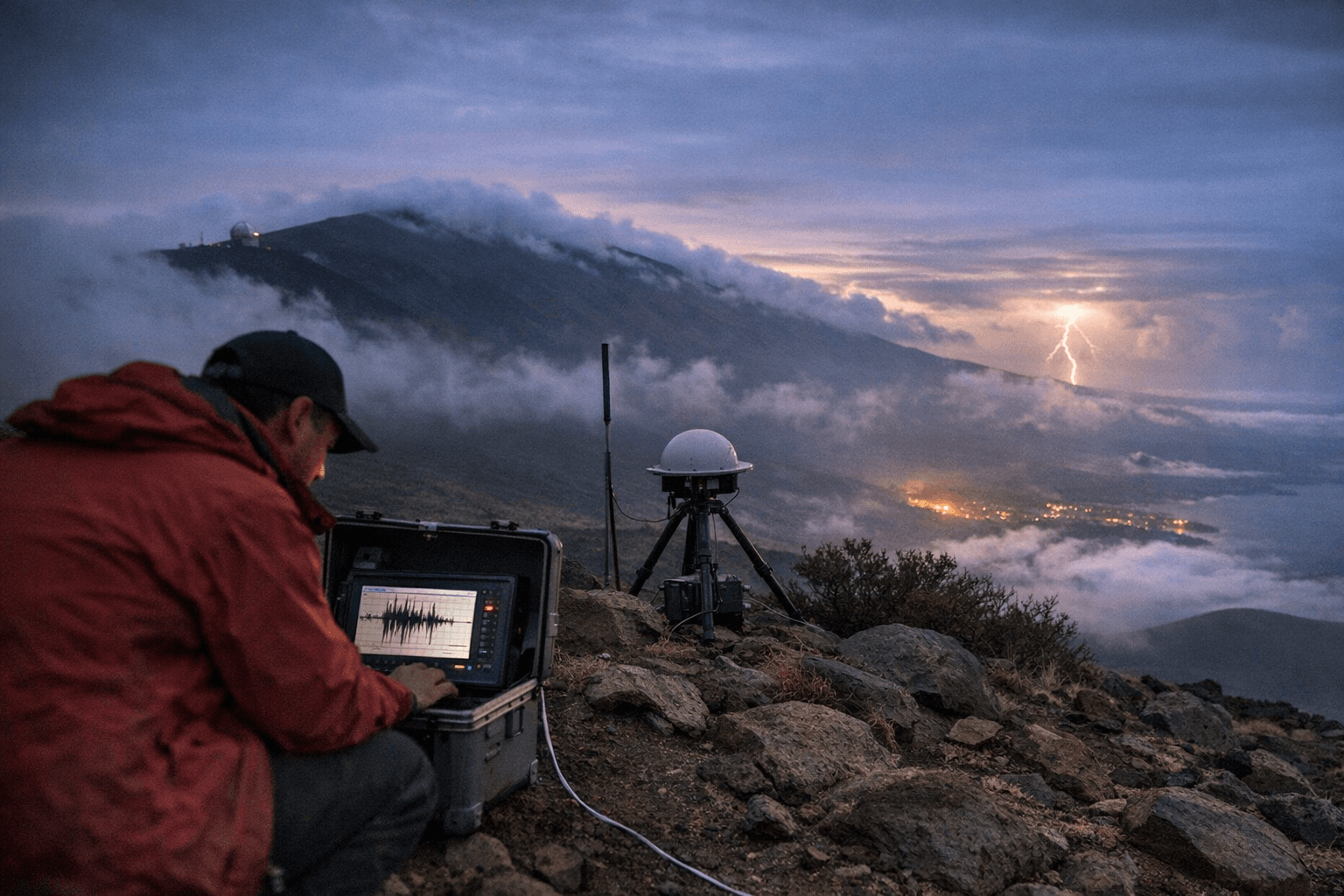
Twenty-eight tectonic earthquakes struck beneath the northeast flank of Mauna Kea on Thursday, March 26, rumbling through the Hāmākua region at depths shallow enough to rattle nerves but not threaten volcanic activity, the U.S. Geological Survey Hawaiian Volcano Observatory confirmed.
The swarm ran from 2:00 p.m. to 10:00 p.m. HST at depths of 5 to 10 kilometers (3 to 6 miles) below the surface. The two largest events, both magnitude-3, struck roughly an hour apart and each produced a couple of felt reports. Earthquake rates stayed lower during the first few hours; after the two magnitude-3 events hit in quick succession, seismic activity stopped entirely for about 90 minutes before resuming.
The word "tectonic" in HVO's official statement, released Friday afternoon March 27, carries specific meaning. A tectonic earthquake means rock is responding to accumulated physical stress, not to magma moving upward. Volcanic earthquakes, by contrast, typically arrive in clusters of hundreds to thousands of small events that originate along the path magma travels before an eruption. HVO confirmed all 28 events are tectonic and "not related to magma movement."
HVO attributed the swarm to stress built up inside the Kohala edifice, the ancient volcanic structure that underlies Mauna Kea at these depths. "These earthquakes appear to be related to periodic release of stress in the elongated Kohala edifice," HVO said, "most likely due to the weight of the island." The 5-to-10-kilometer depth places the events beneath the Mauna Kea edifice and into the underlying Kohala volcano, whose rift zone extends to the submarine Hilo Ridge east of Mauna Kea. HVO specifically ruled out two alternate explanations: the older submarine Laupāhoehoe slump and flexural bending of the oceanic lithosphere beneath the island.
This kind of stress-release event is not new to the Hāmākua region. Nearly identical clusters occurred in 2002, 2004, 2006, 2008, and 2010, with a scattering of isolated earthquakes in between. Every one of those historical swarms stayed within the magnitude-3 range, with most individual events measuring less than magnitude 2.
For the telescopes at Mauna Kea's summit, including the W. M. Keck Observatory and the Subaru Telescope, magnitude-3 earthquakes fall well within operational tolerance. The threshold for significant instrument disruption sits far higher; when the 2006 Kiholo Bay earthquake reached magnitude 6.7, several summit observatories sustained minor damage but returned to operations within days. Thursday's swarm produced no reported disruptions along the Mauna Kea Access Road or Daniel K. Inouye Highway, and no damage, injuries, or emergency declarations were reported anywhere in the region.
Residents in Honokaa, Laupāhoehoe, and surrounding Hāmākua communities can distinguish a dangerous escalation by watching the signals HVO specifically monitors: sharply increasing magnitudes, volcanic tremor (a sustained low-frequency vibration distinct from discrete tectonic snaps), and measurable ground deformation. None appeared Thursday. Mauna Kea carries a "not ranked" volcanic threat classification from HVO, reflecting its dormant status. A change in HVO's color-coded alert level for any active Hawaiian volcano would be the clearest public signal warranting action.
Homeowners near the region's steep terrain should note that a sustained swarm can loosen hillside soils already saturated from winter rains; Hawai'i County Civil Defense remains the first local contact for any structural concerns. HVO's real-time earthquake and volcano updates, including an email alert sign-up, are available through the USGS Hawaiian Volcano Observatory's website.
HVO said it will continue to closely track seismic activity and monitor Hawaiian volcanoes for any changes.
This article was produced by Prism’s automated news system from verified source data, official records, and press releases, then run through automated quality and moderation checks before publishing. The system is built and supervised by the people who set the standards it runs under. Read our full AI policy.
Did this article answer your question?