Big Island Residents: Build Your Emergency Go-Bag and Know Your Evacuation Zone
A 3-day outage after the March 2026 Kona low forced one Oʻahu restaurant to discard $50,000 in food; Big Island households face the same math every storm season.
The Cost of Being Unprepared
One restaurant owner had to throw out roughly $50,000 worth of food because freezers went down during a three-day outage after the March 2026 Kona low hammered the Hawaiian Islands. That was a commercial kitchen. A fully stocked household refrigerator and freezer typically holds $300 to $600 in groceries; add a home-based business, refrigerated medication, or a working week of missed shifts, and the true cost of a single prolonged outage climbs fast. Hawaiian Electric warned affected customers on the Big Island to "plan for prolonged outages" that could drag on for "possibly days," yet most households had no backup plan in place.
The math on preparedness is straightforward: a portable battery backup station runs $150 to $300 at retail. A bag of block ice costs $5. A modest go-bag assembled from things you already own costs almost nothing. Stacked against hundreds of dollars in spoiled food, missed work, or a scramble for last-minute supplies when store shelves are already bare, the investment pays for itself the first time you use it.
Build Your Go-Bag Now
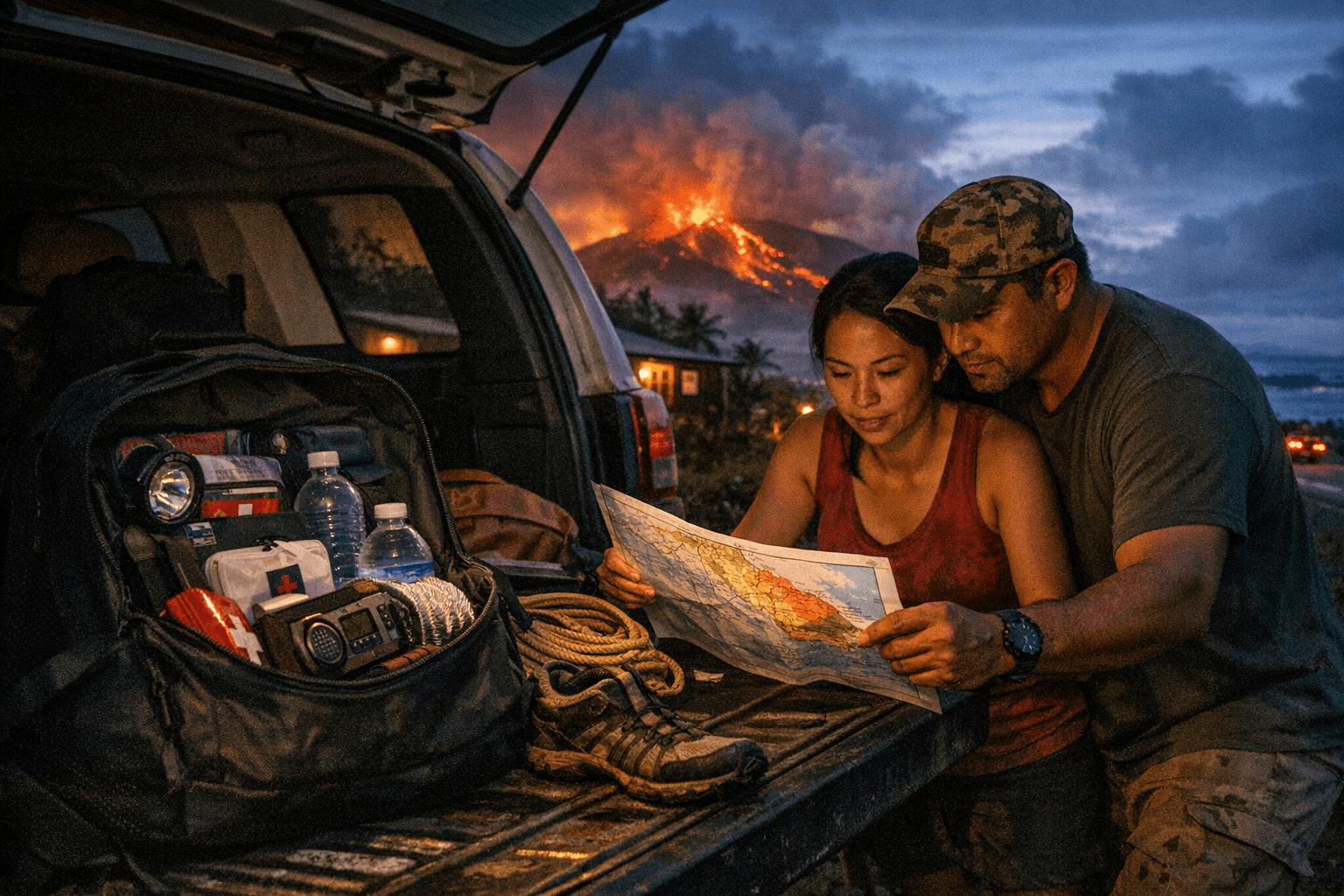
The foundation of any personal emergency plan is a go-bag: a ready-to-grab kit that can sustain your household for the first 72 hours. Store it somewhere you can reach in the dark. Here is what it should contain:
- Water: At least 1 gallon per person per day for three days. People with medical needs, infants, or large pets should plan for more.
- Food: A three-day supply of nonperishable items such as canned goods and energy bars, plus a manual can opener. Electric can openers are useless without power.
- Medications: A seven-day supply if at all possible, with copies of prescriptions. If a medication requires refrigeration, a small insulated cooler and block ice can bridge a short outage; for longer events, consult your prescriber in advance about alternatives.
- Important documents: Paper and digital copies of IDs, insurance policies, and medical records, with originals stored in a waterproof container. A gallon zip-lock bag works in a pinch; a hard-sided waterproof case is better.
- Communications: A battery-powered or hand-crank radio is the single most important item many households skip. Cell networks congest and fail during island-wide events. Add extra power banks, spare charging cables, and a written list of emergency contacts, because a dead phone means nothing if all your numbers are only stored on it.
- Lighting and warmth: LED flashlights with extra batteries and blankets. LED bulbs last far longer per battery charge than incandescent alternatives.
- First-aid kit: Tailor it to your household's specific needs, not a generic drugstore assortment.
- Special items: Infant formula, pet food and supplies, extra eyeglasses, and mobility aids for anyone who needs them.
Where to Buy Supplies on the Big Island
Do not wait until a storm watch is posted to shop. By that point, generators sell out within hours, propane shelves empty, and ice becomes a neighborhood treasure. For everyday preparedness restocking:
- Ace Hardware Hawaii operates two Big Island locations: 74-5500 Kaʻiwi Street in Kailua-Kona, reachable at (808) 329-2981, and 16-586 Old Volcano Road in Keaʻau, reachable at (808) 966-7170, both open Monday through Saturday 7 a.m. to 7 p.m. and Sunday 7 a.m. to 6 p.m. Both locations typically carry flashlights, batteries, propane, and emergency supplies year-round.
- Costco in both Kailua-Kona and Hilo carries bulk water, canned goods, battery banks, and portable generators; stock up during regular shopping, not the night before a storm.
- Home Depot in Hilo stocks generators, propane refill stations, and tarps.
- Most gas stations sell block ice; in Puna and Ka'ū, where distances between stores are longer, keep a supply of ice packs in the freezer so you can replenish a cooler without driving.
The 30/60/90-Minute Pre-Storm Checklist
When a storm watch is issued, time compresses fast. Prioritize in this order:
In the first 30 minutes
Confirm your evacuation zone using Hawai'i County Civil Defense resources and identify your nearest shelter. Fill all vehicle fuel tanks immediately. ATMs and card readers fail during extended outages, so withdraw a modest amount of cash now. Charge every phone, laptop, tablet, and power bank you own.
Within 60 minutes
Bring loose outdoor items inside or tie them down: patio furniture, propane tanks, decorative items, anything wind can turn into a projectile. Clear gutters if it is safe to do so. Elevate irreplaceable items off the floor in any room that floods. Unplug sensitive electronics to protect them from surge damage when power returns.
Within 90 minutes
Fill your bathtub with water for flushing toilets in case water service is interrupted. Gather your go-bag, documents, medications, and special supplies. If you rely on electricity for medical equipment, contact Hawai'i County Civil Defense or Hawaiian Electric to register for medical-needs assistance. If volcanic ash is a possibility, prepare N95 masks, goggles, and plastic sheeting to seal windows and doors, and cover any open water catchment system.
Know Your Evacuation Zone Before You Need It
The March 2026 Kona low's impacts went far beyond power outages: hurricane-force winds and record-breaking rainfall tore roofs off buildings, washed out roads, damaged water mains, caused extensive flash flooding and landslides, and required Hawai'i National Guard tactical vehicles to assist fire and rescue crews in saving residents trapped along Mamalahoa Highway after floodwaters reached over four feet deep.
That is not a hypothetical scenario; it happened here, to people who live here. Hawai'i Island's geography makes this kind of rapid escalation routine: steep rainfall gradients can drop several inches of rain in an hour over one district while the neighboring town stays dry, single-lane roads in Puna and Ka'ū can wash out and sever the only exit route, and communities relying on private water catchment lose their supply the moment rooftop ash or debris contaminates the system.
If Hawai'i County Civil Defense administrator Talmadge Magno issues an evacuation order for your zone, leave early. Roads in coastal and low-lying areas congest within minutes of a warning, as the July 2025 tsunami evacuation along Kaiminani Drive in Kailua-Kona demonstrated. Waiting until the order feels urgent can mean waiting in gridlock.
During the Outage: What Most People Get Wrong
The instinct to use a phone constantly for updates is the fastest way to be left without communication when you need it most. Use text messages rather than voice calls; texts use less bandwidth and are more likely to get through on a congested network. Check in with household members and neighbors, then conserve battery for genuine emergencies.
Do not run a generator indoors or in an attached garage. Carbon monoxide poisoning kills people every storm season across the country. Place generators outside, well away from windows and doors.
After the Storm: The Recovery Phase Nobody Plans For
Do not re-enter flooded or structurally damaged buildings until Hawai'i County Civil Defense declares them safe. Downed power lines can electrify standing water invisibly. Document every item of damage with dated photographs before you touch or move anything: those images are the foundation of both your insurance claim and any application for federal disaster assistance.
Hawaiian Electric customers affected by outage-related damage can file claims directly with the utility. "We're working as quickly as we can. We know it's very frustrating for our customers and we apologize for that," Hawaiian Electric external communications manager Darren Pai said.
Beyond utility claims, local organizations are often the fastest source of practical help in the first days after a disaster. Vibrant Hawaiʻi and other community nonprofits coordinate food, ice, water distribution, and volunteer cleanup efforts following major events; they also maintain aid registration forms for households that need recovery support.
Your Big Island Outage Contacts: Save These Now
Print this list and tape it inside a kitchen cabinet:
- Hawai'i County Civil Defense: Emergency announcements, shelter openings, and evacuation orders. hilo.hawaii.gov/civil-defense
- Hawai'i County Department of Water Supply: Water safety advisories and outage updates. hawaiidws.org
- Hawai'i County Department of Public Works: Road closures and infrastructure damage reports. hawaiicounty.gov/public-works
- Hawaiian Electric (Big Island trouble line): Outage reporting and safety tips, available 24/7. hawaiianelectric.com; outage map at the same address.
- Hawai'i Emergency Management Agency (HiEMA): State-level emergency alerts and hurricane preparedness guidance. dod.hawaii.gov/hiema
- American Red Cross, Hawai'i Chapter: Shelter information and volunteer coordination. redcross.org/hawaii
- Vibrant Hawaiʻi: Community recovery coordination and aid registration. vibranthawaii.org
- National Weather Service, Honolulu: Storm watches, warnings, and forecast updates. weather.gov/hfo
Review Your Plan Every Year
A go-bag packed in 2022 may have expired medications, outdated insurance documents, and a power bank that no longer holds a charge. Set a calendar reminder to audit your kit each June at the start of hurricane season. If a new baby has arrived, an older relative has moved in, or someone in the household now depends on medical equipment, your water, medication, and power calculations all change. Hawai'i Emergency Management Agency advises residents to be prepared to spend several hours or days without power and to have a concrete plan for how to get information, communicate, store food and medicine, cook, light the home, and run medical equipment.
Local emergency management agencies and community organizations hold preparedness workshops periodically around the island; attending one is the fastest way to make sure your personal plan reflects the specific hazards of the district you live in, because the risks facing a Puna homesteader with a water catchment system and a single exit road look nothing like those facing a Kailua-Kona condo owner two blocks from a tsunami inundation zone.
This article was produced by Prism’s automated news system from verified source data, official records, and press releases, then run through automated quality and moderation checks before publishing. The system is built and supervised by the people who set the standards it runs under. Read our full AI policy.
Did this article answer your question?