Big Island Students Run Real Ag Businesses Through Young Entrepreneurs Program
Students at five Big Island schools are running real ag businesses, selling 'ulu chips and skincare made from local taro and honey, with revenue reinvested into their schools.
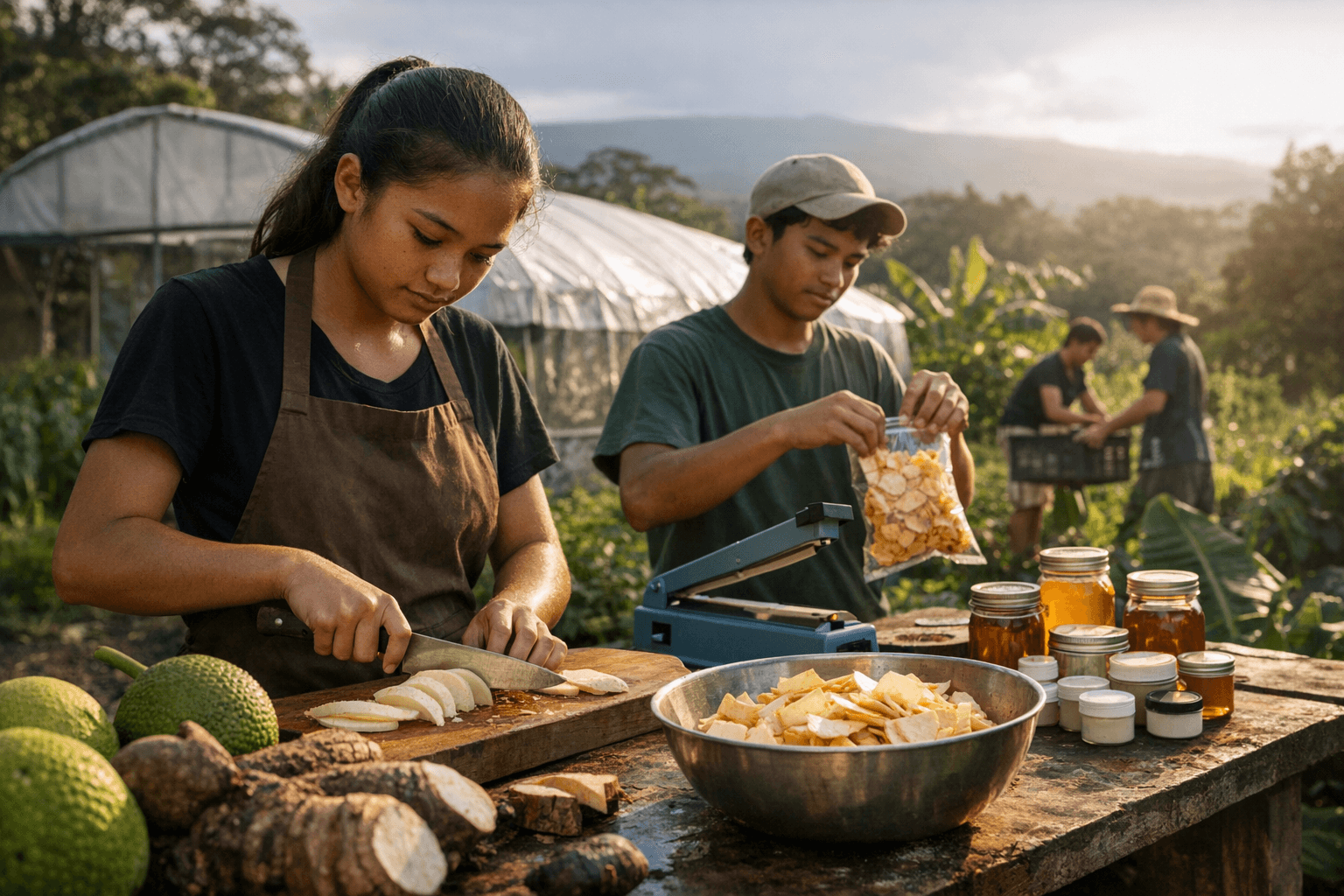
Five Big Island schools are among 24 statewide whose students turned locally grown taro, macadamia nuts, and liliko'i into market-ready products through the Hawai'i Agricultural Foundation's Young Entrepreneurs Program, with the online marketplace closing March 31.
Students at Kealakehe High School, Kohala High School, Honoka'a High & Intermediate School, Pahoa High & Intermediate School, and Ka'ū High & Pāhala Elementary School joined the program's 2025-2026 cohort, which produced more than 50 student-created products statewide. The inventory spans 'ulu chips and lollipops to skincare products made with island ingredients including pineapples, bananas, honey, and macadamia nuts.
The structure mirrors a real business more than a classroom project. Students write business plans, receive start-up funding tied to those plans, then handle production, packaging, marketing, and order fulfillment. Revenue the ventures generate is reinvested into their schools, creating a direct financial return to the communities where students live and study.
For shoppers who missed the online window, an in-person YEP Marketplace is scheduled for April 11 at the KCC Farmers' Market at Kapi'olani Community College, where buyers can meet the students and purchase directly. School pick-up arrangements for online orders can also be made through the Hawai'i Agricultural Foundation.
The program's design targets two persistent economic challenges on the Big Island: food import dependence and a shortage of local career pathways for young people. By requiring students to source ingredients locally and sell into live markets, YEP builds supply-chain capacity and entrepreneurial skill simultaneously. The curriculum covers branding, budgeting, online retail, and farmers' market sales, the full arc of a small agricultural operation.
For rural Big Island districts like Kohala and Ka'ū, where farming has anchored the local economy for generations, a program that treats agriculture as a launchpad for entrepreneurship rather than a fallback carries real economic stakes.
This article was produced by Prism’s automated news system from verified source data, official records, and press releases, then run through automated quality and moderation checks before publishing. The system is built and supervised by the people who set the standards it runs under. Read our full AI policy.
Did this article answer your question?