Bridge repairs begin at Nāhuku, visitor access limited through June
Visitors will still reach Nāhuku during bridge work, but only from the east end, with parking tight and trail access narrowed through June.

Access to one of Hawaiʻi Volcanoes National Park’s most visited stops will tighten just as spring and summer travel ramps up, with bridge replacement work at Nāhuku set to begin Thursday, April 23, and run through the end of June. The lava tube will stay open, but visitors will enter and exit only from the east, or exit, end while the bridge area is closed. The rainforest trail, the stairs leading to it and about 50 feet of the lava tube entrance beyond the bridge will be off-limits, changing the flow at a site where parking is already extremely limited.
Park officials are steering visitors toward early and late arrivals to reduce congestion, recommending trips before 9 a.m. or after 5 p.m. if people want the best chance of finding a space. Nāhuku is lit only from 8 a.m. to 8 p.m., so flashlights are useful outside those hours. If the main lot is full, alternate parking is available at Kīlauea Iki Overlook, about half a mile away, but that means added walking at a time when the trailhead itself will be under construction.
The bridge project lands in the middle of a much larger strain on the summit area. Hawaiʻi Volcanoes National Park is already in a two-year construction period at Kīlauea summit, where officials warn of limited parking, temporary area closures and delays, especially during heavy visitation in June, July and August. The park remains open 24 hours, but access to overlooks and parking lots at the summit can slow when crowds build, and rangers direct visitors to other areas such as Chain of Craters Road and Mauna Loa Road when congestion rises.
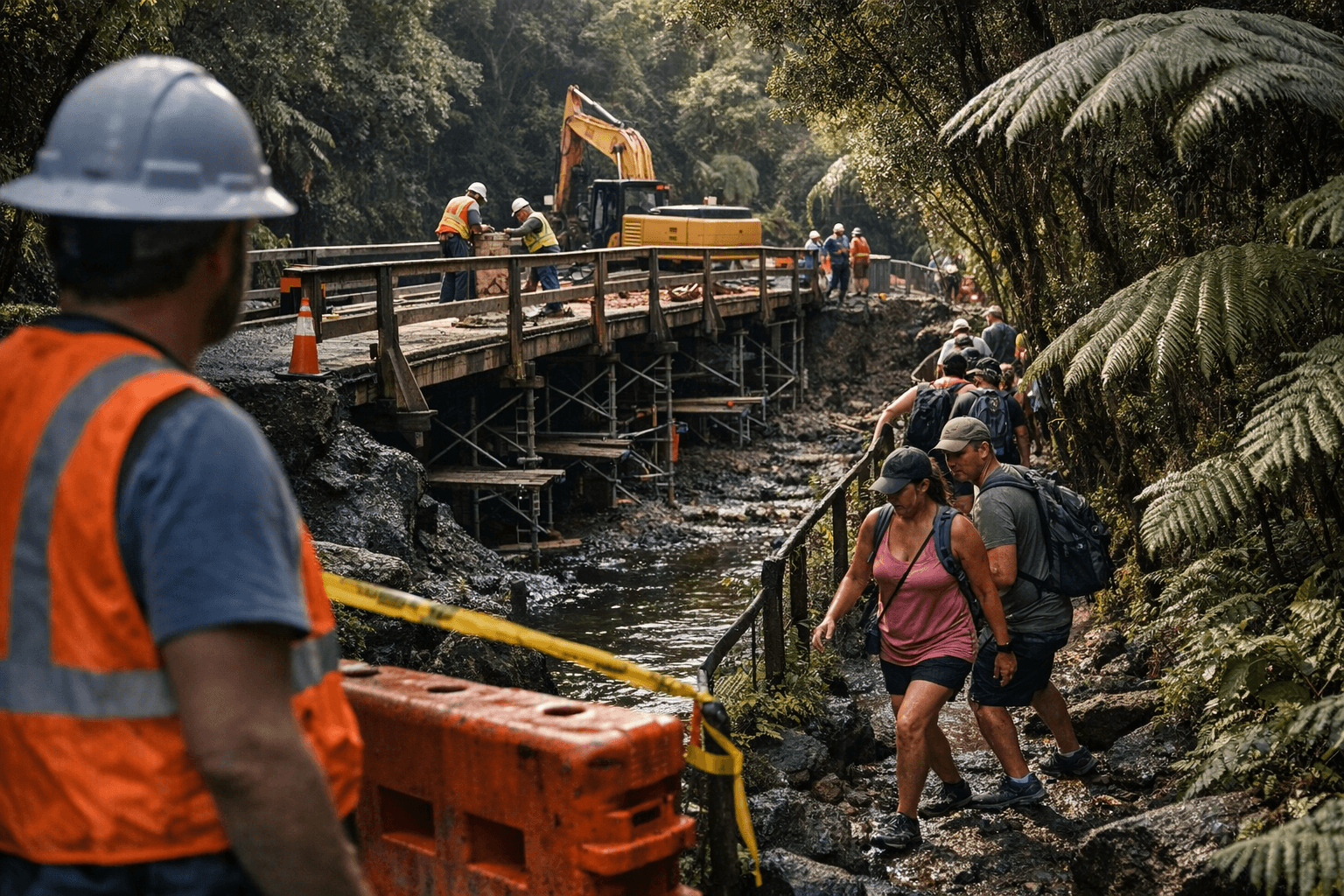
Nāhuku’s draw goes well beyond a single trail stop. The lava tube formed during the ʻAilāʻau eruption from Kīlauea about 500 years ago, and U.S. Geological Survey surveyors discovered it in 1912. Lorrin A. Thurston later publicized the site, helping turn it into a tourist attraction, even as souvenir collecting removed some of the delicate formations. That history helps explain why even a short-term bridge replacement matters to the visitor economy around Hawaiʻi Island.
The stakes are not small. Hawaiʻi Volcanoes National Park drew 1,433,593 visitors in 2024, and those visitors spent $445 million in nearby communities, supporting 3,605 jobs and generating a total local economic impact of $571 million. With Kīlauea still intermittently erupting in Halemaʻumaʻu crater since December 23, 2024, the park’s summit remains a magnet for visitors and a pressure point for traffic, parking and business tied to tourism.
This article was produced by Prism’s automated news system from verified source data, official records, and press releases, then run through automated quality and moderation checks before publishing. The system is built and supervised by the people who set the standards it runs under. Read our full AI policy.
Did this article answer your question?