Hawaiʻi Community College Honors Edith Kanakaʻole Legacy Through Hula Education
Hawaiʻi CC's hula program, born in Hilo in 1973, now sends more than 400 practitioners to lead the Merrie Monarch opening — a stage no other island can claim.
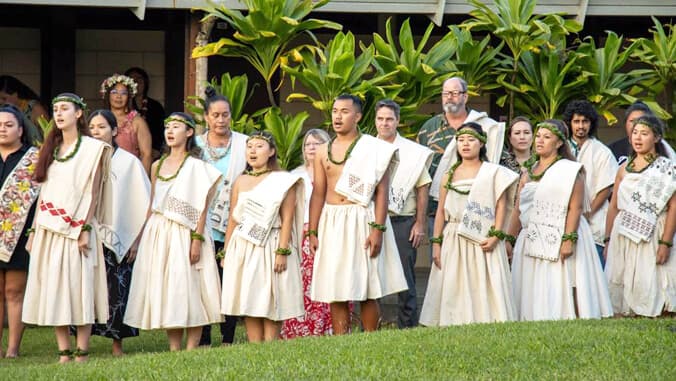
What began with roughly 30 participants in the Merrie Monarch Festival's opening ceremony has grown into a procession of more than 400 ritual practitioners streaming into Hilo's arena each spring. The force behind that growth is Hawaiʻi Community College's Associate in Arts in Hawaiian Studies with a hula concentration, a program that no counterpart on Oʻahu or Maui can replicate — it was built here, for this island, in 1973.
Kumu hula Edith Kanakaʻole established Hawaiian Studies at Hawaiʻi CC that year, guided by a philosophy she kept simple: "Teach all who come to learn." After her death in 1979, her daughter Pualani Kanahele carried the mission forward, envisioning a program that would do more than preserve choreography — it would revive the full ceremonial architecture of hula. Those roots now shape every aspect of the 61-credit, two-year degree that students on Manono Street pursue today.
Kekoa Gabriel is one measure of what that degree produces. The Hilo native graduated in Fall 2025 with honors, earning triple A.A. degrees in Hawaiian studies-hula, Hawaiian studies-Kapuahi foundations, and liberal arts. "Because of this program I feel a lot more connected to my ancestors, my ʻohana, my Hawaiian-ness, who I am as a Hawaiian," Gabriel said. "I have a better look at where I want to go as a Hawaiian, who I want to be as a Hawaiian." His fellow student Kamryn Kanoe Bosque, still working toward her hula-concentration degree, described the experience in similar terms: "I expanded my knowledge more than I ever could have, and I'm deeply grateful to be able to come here and learn more about my Hawaiian culture."
The curriculum extends well past the studio. Assistant professor and kumu hula Pele Kaʻio leads students in making kūpeʻe and lei poʻo by hand, and the program includes learning hula Pele at Kīlauea while the volcano remains active — a classroom available nowhere else on earth. "Studying hula here at Hawaiʻi Community College goes beyond choreography," Kaʻio said. "It exposes the learner to protocol, ceremony, traditional regalia, discipline and leadership." Students demonstrate that preparation each semester during the Hoʻike, a public performance led by Kaʻio.
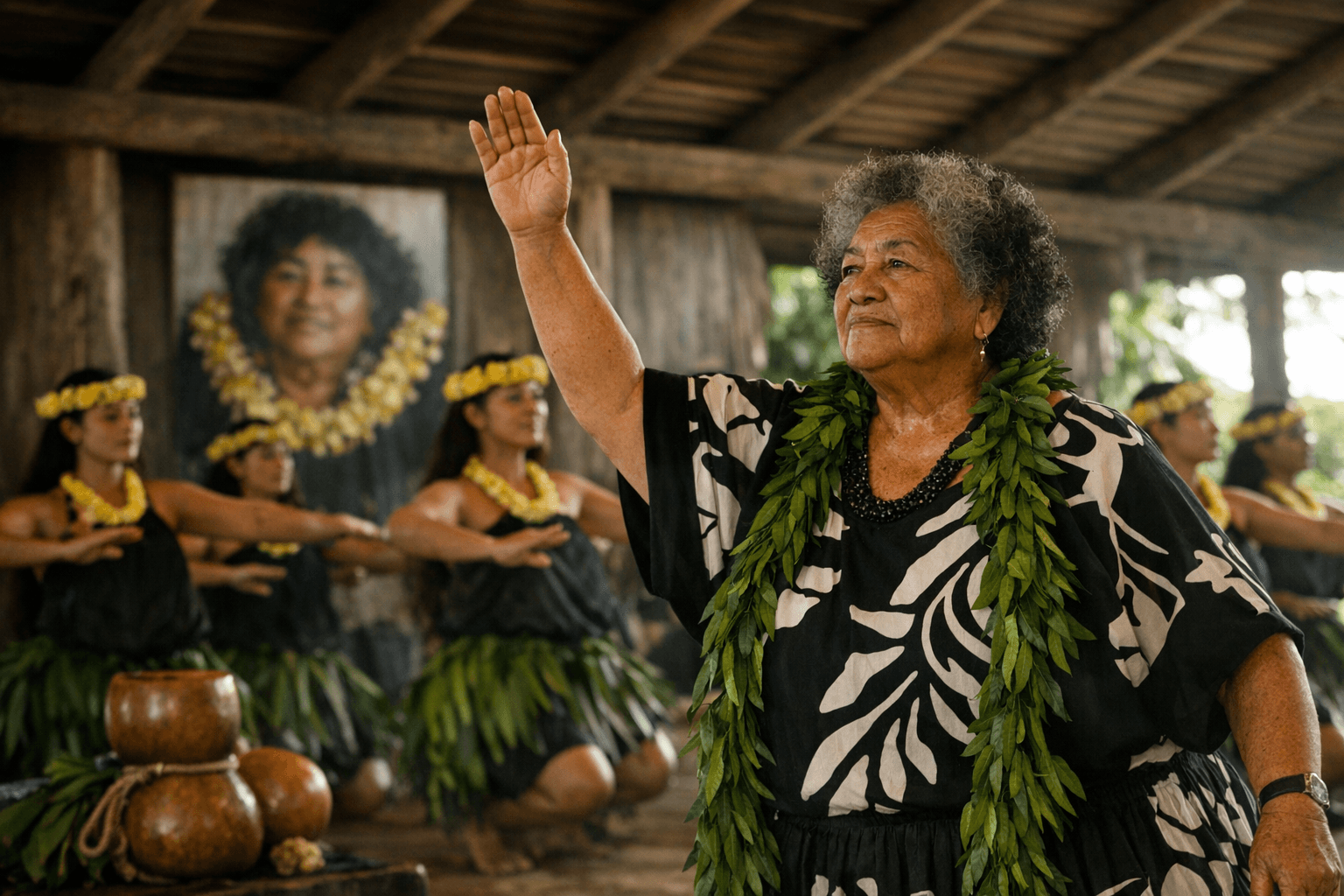
The hālau itself, Unukupukupu, meaning "Shrine of Ferns Rooted in Fresh Lava," is anchored in the volcanic traditions of ʻAihaʻa Pele. Taupōuri Tangarō, who founded Unukupukupu and serves as its advisor, frames the program's purpose in terms Kanakaʻole would recognize: "Hula becomes the doorway through which learners come to know their purpose. Students come to Hawaiʻi CC not simply to learn hula as performance, but to experience hula as a living practice grounded in ritual."
That pipeline from classroom to community is most visible each spring when Unukupukupu members — current students, alumni, and community practitioners — lead the Merrie Monarch opening ceremony. The 13-fold growth in that procession over the program's history is a direct measure of how deeply the Kanakaʻole legacy has taken hold in Hawaiʻi Island.
Those who want to sustain the work can attend Hawaiʻi CC's inaugural E ʻImi Pono: A Celebration of Excellence fundraiser on April 18, running 5 to 8 p.m. in the I Ola Nō Ke Kino Dining Room on the Manono campus. For enrollment inquiries, academic counselors in Hilo can be reached at (808) 934-2720.
This article was produced by Prism’s automated news system from verified source data, official records, and press releases, then run through automated quality and moderation checks before publishing. The system is built and supervised by the people who set the standards it runs under. Read our full AI policy.
Did this article answer your question?