Hilo marks Red Dress Day with call for missing Indigenous women awareness
Hilo advocates said teens in 96720 remain among the most vulnerable as Red Dress Day turned a former Walgreens lot into a call for action. The message was remembrance, but also a demand for visibility.

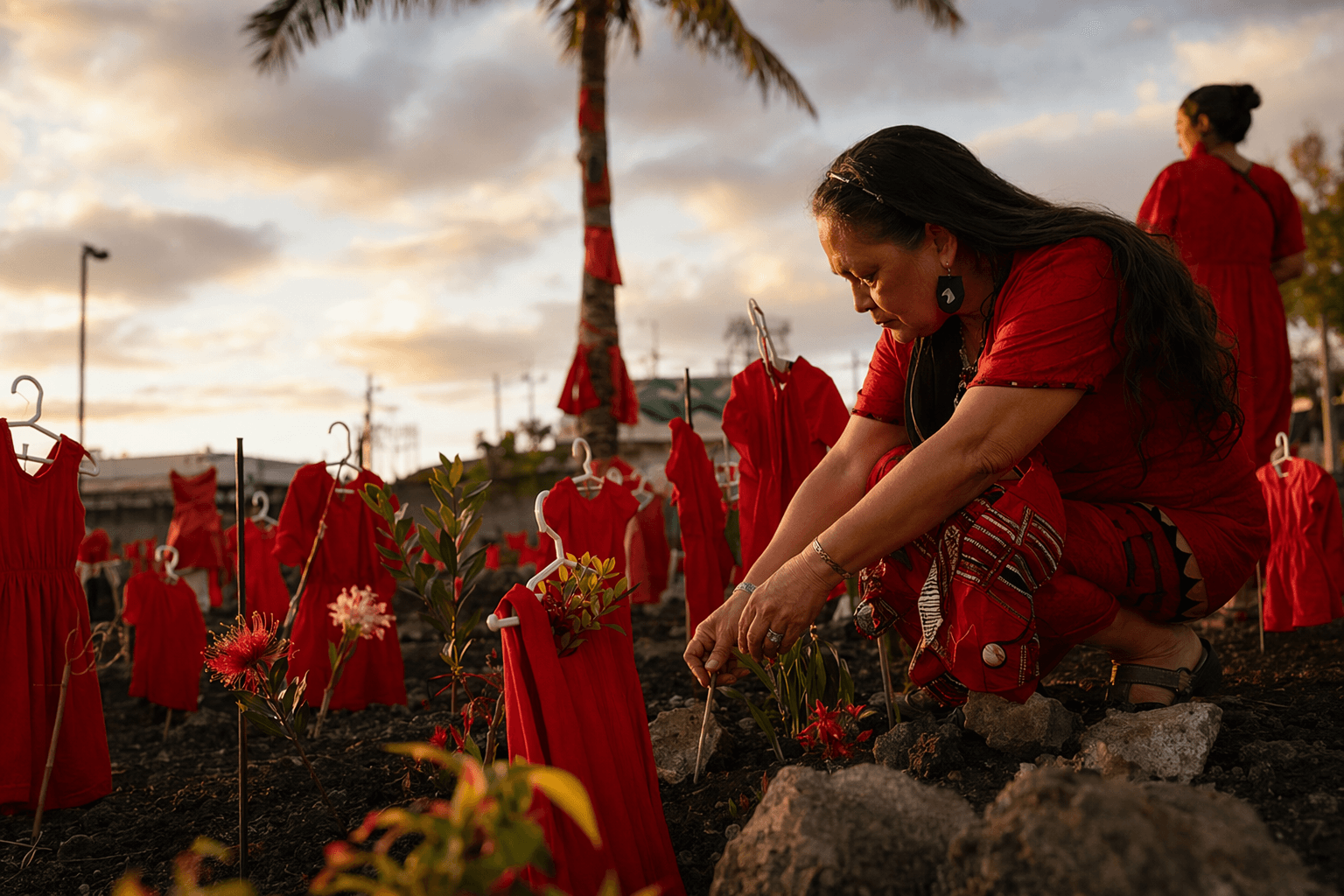
Hilo’s Red Dress Day gathering put a local face on a crisis that advocates say has stayed too invisible for too long. At the grassy area facing Kanoelehua Avenue near the Ross parking lot at the former Walgreens site on E Makaala Street, organizers with He Ho‘omaka Hou Ana O Puna and Kū Ānuenue brought families together to remember missing and murdered Indigenous women, girls and māhū and to press for stronger awareness across Hawaii Island.
Facilitator Dayna Schultz said the movement matters because violence against Indigenous women continues and too often goes unspoken. Renee Rivera, a co-director, said the gathering was meant to create “a community within a community,” giving survivors a place to speak openly about domestic violence and allowing families to recognize missing or murdered relatives without stigma. The event was held Tuesday from 5 p.m. to 6:30 p.m. and fell during the 2026 National Week of Action, which runs from May 4 through May 8.
The local urgency is sharpened by Hawaii data that points to the same communities over and over again. A 2022 report found that the average missing child in Hawaii was 15 years old, female, from Oahu and Native Hawaiian, and that more than a quarter of missing girls in the state are Native Hawaiian. Big Island advocates said in 2024 that Native Hawaiian children ages 15 to 17 represented the highest number of missing children’s cases on the island, with the most cases reported in the Hilo ZIP code area, 96720.
That same 2024 reporting said there were 182 cases of missing Native Hawaiian girls on the Big Island from 2018 to 2021, a figure that has helped turn Red Dress Day into more than a symbolic observance. Organizers have used it to connect remembrance with accountability, arguing that visibility matters in a county where families still describe gaps in support, reporting and public recognition.
The broader pattern reaches well beyond Hilo. The U.S. Department of Justice says addressing missing or murdered Indigenous persons is a priority because Native Americans face some of the highest rates of violence in the country. CDC-based research found 2,226 homicides of American Indian and Alaska Native people in 34 states and Washington, D.C., from 2003 to 2018, with an age-adjusted homicide rate of 8.0 per 100,000. In Hawaii, Office of Hawaiian Affairs has reported that more than two-thirds of sex trafficking victims are Native Hawaiian women and girls, while University of Hawaii material says nearly 40% of adults who experience domestic violence are Indigenous Native Hawaiian and almost half of sex trafficking cases involve Kānaka Maoli girls trafficked in Waikīkī. For Hilo, Red Dress Day was a call to keep those names and numbers in view.
This article was produced by Prism’s automated news system from verified source data, official records, and press releases, then run through automated quality and moderation checks before publishing. The system is built and supervised by the people who set the standards it runs under. Read our full AI policy.
Did this article answer your question?