Keck Spectroscopy Reveals Multiple Lives of Early Massive Galaxies
An international team using the W. M. Keck Observatory on Mauna Kea found that the universe’s most massive galaxies followed multiple evolutionary paths within the first two billion years after the Big Bang. The findings, presented at the American Astronomical Society meeting, rely on Keck/MOSFIRE spectroscopy and multi-wavelength data to separate truly quiescent systems from dusty star-forming galaxies that appear similarly red, underscoring Mauna Kea’s continuing role in frontline astrophysics.
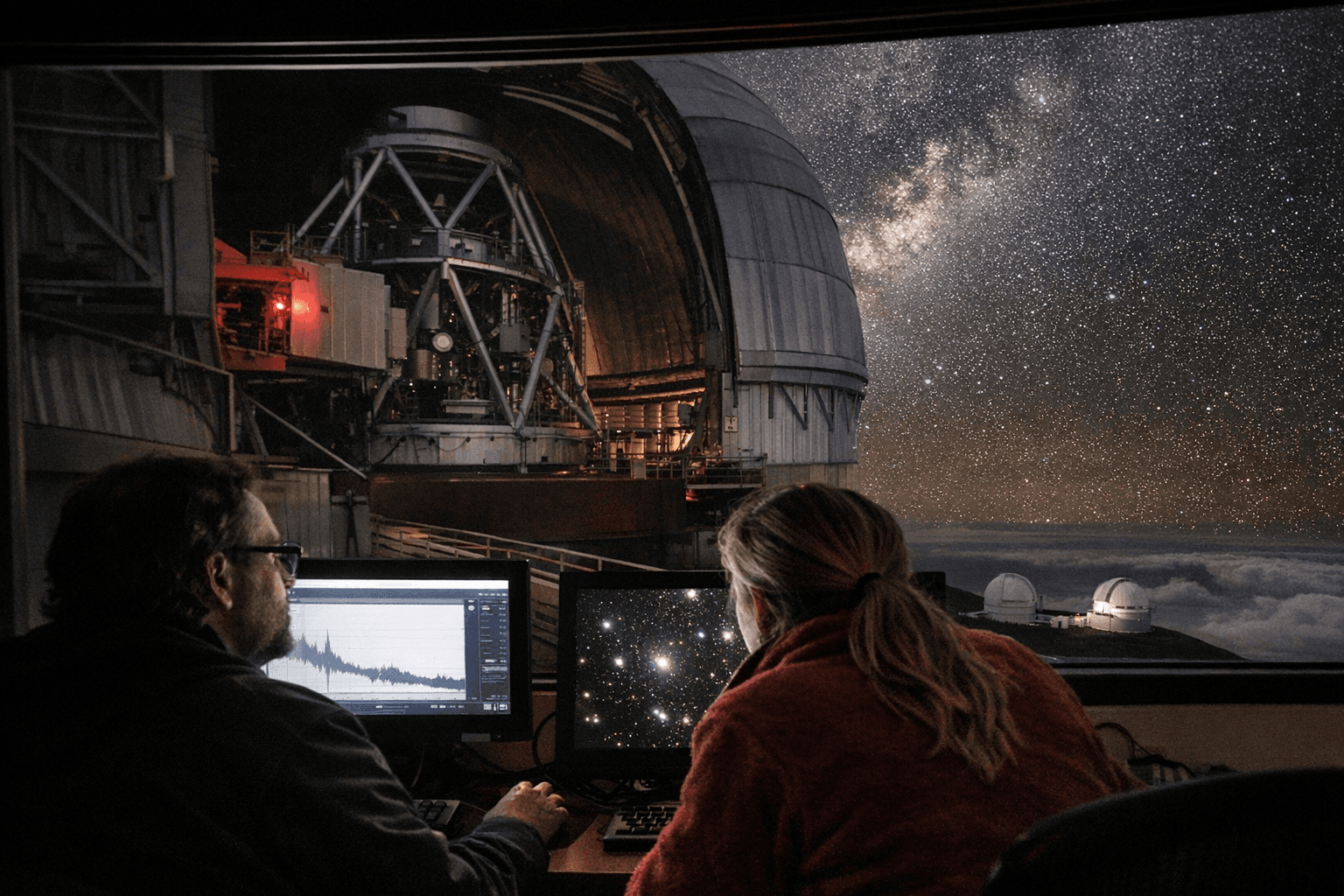
Astronomers working with the MAGAZ3NE survey used near-infrared spectroscopy from the Keck Observatory to show that ultra-massive galaxies in the young universe did not all evolve the same way. By combining Keck/MOSFIRE spectra with far-infrared and submillimeter observations, the team constrained dust content and star-formation activity and distinguished genuinely quiescent objects from those whose starlight is obscured by dust.
The result, presented at the American Astronomical Society meeting on Jan. 5, found populations of both truly “dead” galaxies and systems that were still actively forming stars behind heavy dust. That dual outcome matters because simple color measurements at high redshift can misclassify dusty, star-forming giants as quiescent; spectroscopy plus long-wavelength data reduces that ambiguity and refines estimates of when massive galaxies shut down star formation.
Methodologically, the study leveraged MOSFIRE’s capability to deliver rest-frame optical spectra at high redshift, which provides key diagnostics of stellar populations and ionized gas. Adding far-infrared and submillimeter measurements allowed the authors to measure dust-obscured star-formation rates that optical data alone would miss. The combined approach yields a clearer census of galaxy types in the universe’s first two billion years, improving models of mass assembly and feedback processes that regulate star formation.
For Big Island residents, the research highlights the scientific value produced by Mauna Kea facilities. Observations from W. M. Keck Observatory directly enabled the new classification results, and Keck-supplied images and video accompany the scientific release. Those materials and ongoing studies help maintain local ties to global astrophysics, support educational programming, and attract scientific visitors whose work injects research funding and professional opportunities into the region’s economy.
Longer term, a more accurate accounting of early massive galaxies feeds into cosmological simulations and affects theoretical estimates of when and how the most massive dark-matter halos formed stars and then quenched them. For policy and planning on the island, sustained access to state-of-the-art telescopes yields measurable returns in research output and workforce development, while continuing conversations about stewardship of Mauna Kea will shape how those benefits are realized.
The study’s multi-wavelength approach demonstrates how local observatories contribute essential data to resolve outstanding questions about galaxy evolution, reinforcing the Big Island’s position in global astronomy and its potential to support future scientific and educational investments.
Know something we missed? Have a correction or additional information?
Submit a Tip