Kīlauea summit eruption ties record for lava-fountaining episodes
Kīlauea’s summit eruption reached 47 fountain episodes, tying a volcano record and keeping Hawaii Island on alert for park, air and traffic impacts.
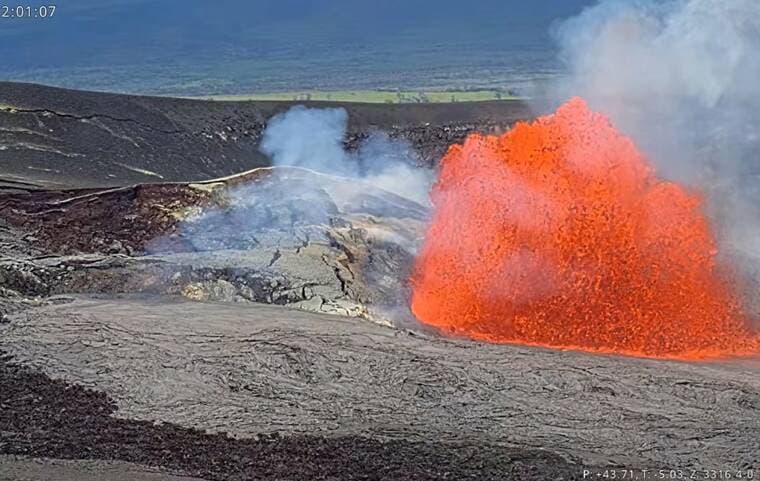
The lava fountains at Kīlauea’s summit have done more than light up Halemaumau crater. The 47th episode tied the volcano’s record for the most lava-fountaining events ever observed, turning a spectacle inside Hawaii Volcanoes National Park into a milestone with real consequences for Hawaii Island.
That tie came with the May 14 episode in the ongoing eruption that began Dec. 23, 2024. U.S. Geological Survey Hawaiian Volcano Observatory scientists said the count matched the 1983 to 1986 initial phase of the Puu Ōō eruption, which also produced 47 fountaining events. Episode 48 was expected early the following week, underscoring that the eruption had not stopped, only paused between bursts.

For people living, working or visiting near Volcano, the significance is practical as much as scientific. The fountains have stayed within a closed area of Hawaii Volcanoes National Park, but each new episode affects park messaging, visitor flow and the constant need to keep people away from unstable ground. Downwind communities also keep watching for air quality problems when volcanic gas and haze shift with the wind.
USGS continues to track ground deformation and earthquake activity beneath Kīlauea, looking for changes that could signal how the next episode unfolds. So far, the record tie points more to a historic but contained pattern than to a sudden jump in danger, but on an active summit crater, close monitoring remains part of daily life.

The broader context is what makes the 47-episode run stand out. The 1959 Kīlauea Iki eruption produced 17 high-fountaining episodes, and the 1969 to 1970 Maunaulu eruption produced 12. Maunaulu, on Kīlauea’s East Rift Zone, began May 24, 1969 and lasted until July 22, 1974. The U.S. Geological Survey said that eruption was, at the time, the longest-lasting and most voluminous eruption on Kīlauea’s flank in at least 2,200 years, while the National Park Service says it sent about 350 million cubic meters of lava toward the sea and reshaped ground around Chain of Craters Road.

That is why the summit eruption has become one of the most closely watched volcanic events on the island in decades. It has already tied one of Kīlauea’s oldest eruption benchmarks, and it has done so inside a closed section of the park where access, safety and tourism all hinge on what the volcano does next.
This article was produced by Prism’s automated news system from verified source data, official records, and press releases, then run through automated quality and moderation checks before publishing. The system is built and supervised by the people who set the standards it runs under. Read our full AI policy.
Did this article answer your question?