Magnitude 4.6 earthquake shakes Pāhala amid ongoing Kīlauea activity
A deep M4.6 quake southeast of Pāhala woke the Big Island before dawn, but HVO said it did not change Kīlauea or Mauna Loa risk.
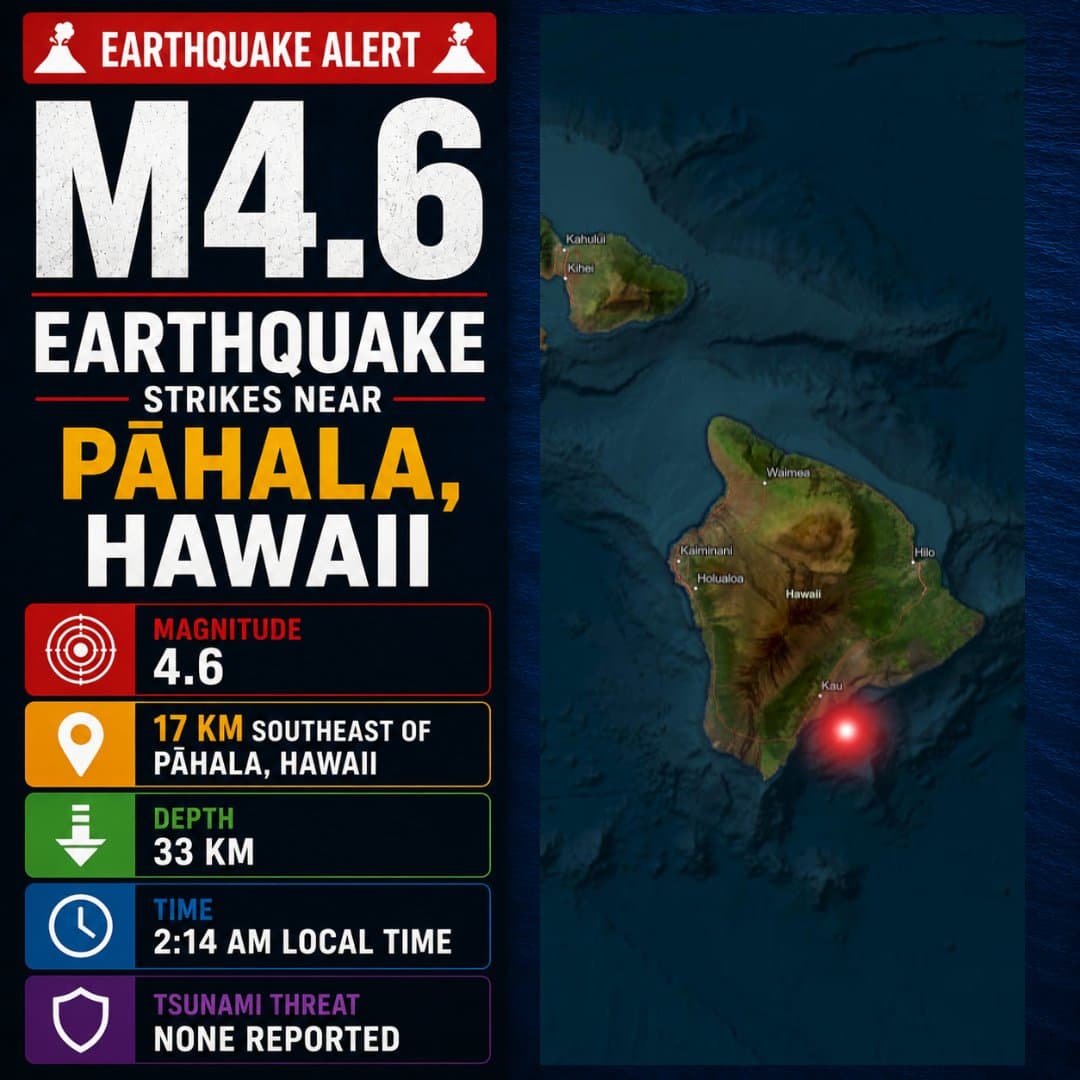
A magnitude 4.6 earthquake jolted Pāhala before dawn Tuesday, waking residents across parts of the Big Island and adding another sharp reminder that the island’s south flank is still active. The quake struck 17 kilometers southeast of Pāhala at 2:14 a.m. local time, at a depth of 33.1 kilometers, and no tsunami threat was indicated.
The depth helps explain why it was felt so widely. Quakes that originate well below the surface can send shaking across broad parts of Hawaii Island without causing the kind of localized damage tied to a shallow fault rupture. In this case, the event fit the pattern of Pāhala-area earthquakes that the U.S. Geological Survey has said are generated below the volcanoes and ocean crust in the upper mantle beneath the Hawaiian Islands, rather than at Kīlauea’s summit.

The morning’s shaking also came alongside more small quakes in the same area. USGS’ real-time map showed a magnitude 3.1 earthquake 1 kilometer west-southwest of Pāhala and a magnitude 3.3 earthquake 18 kilometers southeast of Pāhala on June 17, underscoring how persistent the seismic activity has been around the community. The Pāhala area has long drawn close scientific attention because it has been described as a seismic swarm zone.

For Kīlauea watchers, the key point is that the quake did not change the volcano’s near-term status. The Hawaiian Volcano Observatory said Kīlauea’s summit eruption in Halemaumau was paused as of June 16, even as inflation, vent glow and degassing continued, and another eruptive episode was forecast for June 24 to 29, most likely June 25 to 26. HVO also said Kīlauea has been erupting episodically since December 23, 2024, and the Pāhala quake had no apparent impact on either Kīlauea or Mauna Loa.

The island is still living with the effects of a stronger magnitude 6.0 earthquake on May 22, which caused rock slides, road closures, power outages and minor damage in West Hawaii. Against that backdrop, the latest Pāhala quake is a reminder that a deep earthquake near the volcano does not automatically mean an eruption is about to change, even when the ground shake is strong enough to be felt far beyond the epicenter.
This article was produced by Prism’s automated news system from verified source data, official records, and press releases, then run through automated quality and moderation checks before publishing. The system is built and supervised by the people who set the standards it runs under. Read our full AI policy.
Did this article answer your question?