Maunakea Telescopes Help Detect Rare Superkilonova That Produces Heavy Elements
Astronomers using multiple telescopes, including Keck on Maunakea, reported observations of what may be a rare "superkilonova," an event in which a star explodes as a supernova and its neutron-star remnants later collide to produce a second kilonova explosion. The finding matters to Big Island residents because Maunakea observatories played a key role in the rapid follow-up, highlighting local scientific capacity, economic ties to astronomy, and broader questions about who benefits from island-based research infrastructure.
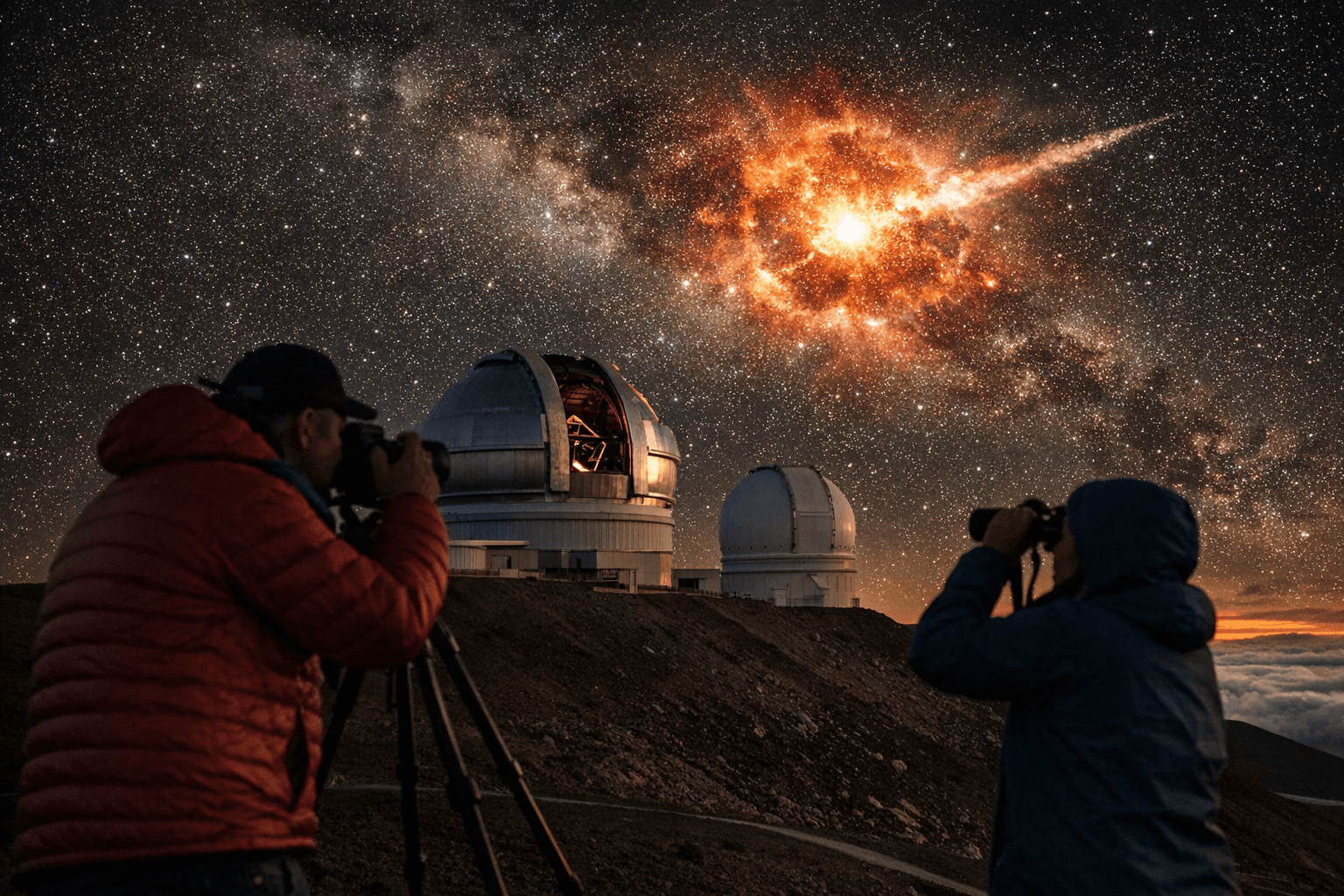
On December 28, 2025, a coordinated observing campaign produced data that may represent a superkilonova, a two-stage cosmic explosion in which a supernova leaves behind neutron stars that subsequently merge and ignite a separate kilonova. Astronomers described the sequence as a single stellar system detonating twice: first in a conventional supernova and later in a kilonova, the rarer event known to forge the universe's heaviest elements.
A team working with multiple telescopes provided the observations, with Keck Observatory on Maunakea identified among the instruments that contributed critical follow-up spectra and imaging. The speed and geographic distribution of those observations were essential: kilonova signatures evolve quickly, and capturing both phases of a double explosion requires fast, coordinated access to sensitive facilities. An explanatory animation and the discovery video are available at bigislandnow.com/2025/12/28/watch-superkilonova-a-star-so-nice-it-explodes-twice/.
Kilonovae are significant because they synthesize very heavy elements such as gold, platinum, and other r-process materials. Those elements have practical connections to life on Earth: platinum-group metals are used in medical devices, diagnostic equipment and some chemotherapeutic agents. While the astrophysical origin of those elements is an area of active research, the new observations offer data that can refine models of element production across the cosmos.
For residents of Big Island County, the discovery underscores the scientific value of local infrastructure. Maunakea's telescopes continue to enable frontline astronomical research, bringing visiting scientists, technicians, and students to the island and supporting local employment and education programs. Those economic benefits intersect with public health and social equity considerations: tourism, workforce housing, and access to training in STEM can influence community health determinants, including income stability, education opportunities and mental health supports for families tied to the observatory economy.
The event also highlights longstanding conversations about land stewardship and how benefits from federally and privately funded research are shared with Native Hawaiian communities. Ensuring that scientific activity on the island proceeds with respect for cultural values and yields tangible community benefits raises questions for policymakers about equitable investment, workforce pipelines, and community health protections.
The possible superkilonova adds to Big Island astronomy's portfolio of discoveries and offers a moment to consider how island resources are managed and how scientific gains translate into local wellbeing. Observers and community leaders will be watching how follow-up studies refine the interpretation of the event and how institutions connected to Maunakea collaborate with local communities to align research priorities with social and health equity goals.
This article was produced by Prism’s automated news system from verified source data, official records, and press releases, then run through automated quality and moderation checks before publishing. The system is built and supervised by the people who set the standards it runs under. Read our full AI policy.
Did this article answer your question?